


Across the world, the growing problem of waste has become one of the most pressing environmental challenges. Cities are expanding, populations are increasing, and consumption habits are changing rapidly. As a result, large amounts of waste are produced daily from homes, businesses, markets, and industries. Without proper management, this waste can overwhelm communities and damage the environment.
To address this issue, governments have taken active responsibility by introducing structured systems that guide how waste is collected, processed, and reused. These structured systems are known as government waste recycling programs, and they play a powerful role in shaping cleaner cities and more sustainable societies.
Instead of allowing waste to pile up in landfills or get burned in open spaces, these programs ensure that valuable materials such as plastic, glass, paper, and metal are recovered and transformed into useful products. This reduces environmental damage while also supporting economic growth.
More importantly, these initiatives help people understand that waste is not useless. With the right systems in place, waste becomes a resource that can support industries, create jobs, and conserve natural materials.
In today’s world, where environmental responsibility is becoming more important than ever, these programs represent a practical solution that benefits both people and the planet.
Table Summary on How Government Led Recycling Efforts Are Transforming Waste Into National Wealth and Cleaner Communities
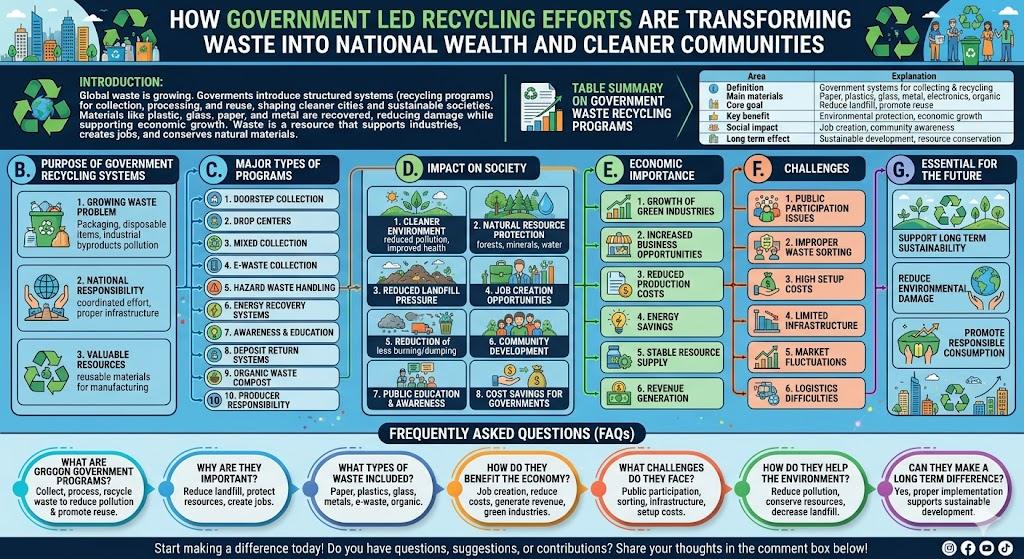
| Area | Explanation |
|---|---|
| Definition | Government organized systems for collecting and recycling waste materials |
| Main materials | Paper, plastics, glass, metal, electronics, organic waste |
| Core goal | Reduce landfill waste and promote reuse of materials |
| Key benefit | Environmental protection and economic growth |
| Social impact | Job creation and community awareness |
| Long term effect | Sustainable development and resource conservation |
B. Understanding the Purpose of Government Recycling Systems
1. The problem of growing waste
Modern society produces waste at an increasing rate. Packaging materials, disposable items, and industrial byproducts all contribute to rising waste levels. Without proper systems, this creates pollution, health risks, and environmental damage.
Governments step in to organize structured waste management systems that ensure waste is handled safely and efficiently.
2. Why recycling is a national responsibility
Waste management is not only an individual responsibility. It requires coordination at a national level to ensure proper infrastructure, rules, and facilities are available for everyone.
Through recycling infrastructure, governments make it easier for citizens to participate by providing collection services, sorting facilities, and recycling centers.
3. Turning waste into valuable resources
One of the most important goals of recycling programs is to convert waste into reusable materials. Instead of producing everything from scratch, industries can use recycled materials to manufacture new products.
This reduces pressure on natural resources and supports long term resource conservation.
C. Major Types of Government Waste Recycling Programs
Governments use different approaches depending on location, population size, and available resources. Each type plays a unique role in improving waste management systems.
1. Doorstep collection systems
In this system, waste is collected directly from homes and businesses. Citizens separate their waste into categories, and collection trucks pick it up on scheduled days. This makes recycling convenient and encourages participation.
2. Recycling drop centers
These are designated locations where people can bring recyclable materials themselves. They are usually placed in accessible areas such as markets, schools, or community centers.
3. Mixed collection systems
In some areas, different recyclable materials are collected together and sorted later at processing facilities. This system encourages participation even when sorting at home is not strict.
4. Electronic waste collection programs
Electronic devices contain valuable materials as well as harmful components. Governments provide special centers for collecting and safely processing old phones, computers, and appliances.
This helps reduce pollution from improper disposal of electronics and supports safe recovery of materials.
5. Hazard waste handling systems
Certain materials such as batteries, chemicals, and medical waste require special treatment. Governments ensure these items are handled safely to protect public health.
6. Energy recovery systems
Some programs convert waste into usable energy such as electricity or heat. This reduces landfill pressure while producing energy for public use.
7. Awareness and education campaigns
Education is a major part of recycling systems. Governments run campaigns to teach citizens how to sort waste properly and understand the importance of recycling.
This builds long term habits and improves participation in environmental protection efforts.
8. Deposit return systems
In this system, people pay a small deposit when buying bottled products and receive it back when they return the empty container. This encourages recycling and reduces littering.
9. Organic waste compost systems
Organic waste such as food scraps is collected and turned into compost. This compost is used to improve soil quality in agriculture and gardening.
10. Producer responsibility systems
Manufacturers are encouraged or required to take responsibility for the waste created by their products. This pushes companies to design items that are easier to recycle.
D. The Impact of Government Recycling Programs on Society
1. Cleaner environment
One of the most visible benefits is cleaner cities and communities. Proper waste handling reduces pollution and improves public health.
2. Protection of natural resources
By recycling materials, governments reduce the need to extract new raw materials from nature. This protects forests, minerals, and water resources.
3. Reduction of landfill pressure
Landfills fill up quickly when waste is not managed properly. Recycling reduces the amount of waste sent to these sites, extending their lifespan and reducing environmental damage.
4. Job creation opportunities
Recycling systems create employment in many areas such as waste collection, sorting, transportation, and manufacturing. This supports job creation and strengthens local economies.
5. Reduction of pollution
When materials are recycled instead of burned or dumped, air and water pollution decreases significantly. This improves overall environmental quality.
6. Community development
Recycling programs help build cleaner neighborhoods and encourage community participation in environmental activities.
7. Public education and awareness
Citizens learn more about responsible consumption and waste handling through government programs. This leads to more environmentally conscious behavior.
8. Cost savings for governments
Recycling is often more affordable than managing waste in landfills. Governments can use the saved funds for other public services such as healthcare and education.
Read Also: Complete Guide for Recycling e-Waste
E. Economic Importance of Recycling Programs
1. Growth of green industries
Recycling supports the development of environmentally friendly industries that focus on reusing materials and reducing waste.
This contributes to a stronger green economy.
2. Increased business opportunities
Recycled materials create new markets where manufacturers purchase and reuse recovered resources.
3. Reduced production costs
Using recycled materials often costs less than using raw materials. This helps industries lower production expenses.
4. Energy savings
Producing goods from recycled materials requires less energy compared to raw material extraction and processing.
5. Stable resource supply
Recycling reduces dependence on limited natural resources, helping stabilize supply and prices over time.
6. Revenue generation
Some recycling systems generate income through material sales or deposit return systems, adding financial value to the economy.
F. Challenges Facing Government Recycling Programs
1. Public participation issues
Some citizens do not fully participate due to lack of awareness or motivation.
2. Improper waste sorting
Mixing recyclable and non recyclable waste reduces efficiency and increases processing difficulty.
3. High setup costs
Building recycling facilities and systems requires significant investment.
4. Limited infrastructure in some regions
Rural or underdeveloped areas may lack proper recycling systems.
5. Market fluctuations
Demand for recycled materials can change based on economic conditions.
6. Logistics difficulties
Collecting and transporting waste across large areas can be challenging.
G. Why Government Recycling Programs Are Essential for the Future
As the global population continues to grow, waste generation will also increase. Without proper systems, environmental problems will worsen. Government led recycling initiatives provide a structured solution that ensures waste is managed responsibly.
These programs support long term, reduce environmental damage, and promote responsible consumption habits. They also encourage industries and individuals to adopt better practices that protect natural resources.
The future of waste management depends on how well societies adopt these systems and integrate them into everyday life.
Frequently Asked Questions on Government Waste Recycling Programs
1. What are government waste recycling programs?
Government waste recycling programs are organized systems created by authorities to collect, process, and recycle waste materials such as paper, plastic, glass, and metal in order to reduce environmental pollution and promote resource reuse.
2. Why are recycling programs important?
They are important because they reduce landfill waste, protect natural resources, create jobs, and help maintain a cleaner and healthier environment for communities.
3. What types of waste are included in recycling programs?
Common materials include paper, cardboard, plastics, glass, metals, electronic waste, and organic waste depending on the system in place.
4. How do recycling programs benefit the economy?
They support job creation, reduce production costs, generate revenue from recycled materials, and contribute to the growth of environmentally friendly industries.
5. What challenges do recycling programs face?
Challenges include lack of public participation, improper waste sorting, limited infrastructure, high setup costs, and fluctuating market demand for recycled materials.
6. How do recycling programs help the environment?
They reduce pollution, conserve natural resources, decrease landfill use, and lower greenhouse gas emissions by encouraging reuse of materials.
7. Can recycling programs really make a long term difference?
Yes, when properly implemented and supported by citizens, recycling programs significantly improve environmental quality and support sustainable development.
Government waste recycling programs are more than just waste collection systems. They are essential tools for building cleaner cities, stronger economies, and healthier environments. By encouraging proper waste handling and resource recovery, these programs help transform everyday waste into valuable materials that benefit society as a whole.
With continued support and participation, government waste recycling programs can lead the way toward a more sustainable and responsible future where waste is reduced, resources are preserved, and communities thrive.
Do you have any questions, suggestions, or contributions? If so, please feel free to use the comment box below to share your thoughts. We also encourage you to kindly share this information with others who might benefit from it. Since we can’t reach everyone at once, we truly appreciate your help in spreading the word. Thank you very much for your support and for sharing!
Read Also: Succulent Plants: A Guide to Growing and Caring for These Unique Plants