



Environmental psychology examines the relationship between people and the physical environments surrounding them. It considers how buildings, communities, natural landscapes, resources, pollution, climate, and environmental conditions influence human thoughts, feelings, decisions, and behaviour.
The field recognizes that people do not exist separately from their surroundings. Instead, individuals continuously respond to environmental conditions while their choices, activities, technologies, and social systems also modify those environments.
Ecological theory provides an important foundation for understanding these relationships because it focuses on connections among organisms, environments, resources, systems, and interactions. Environmental psychology applies similar relationship-based thinking to human experience and behaviour.
Understanding environmental psychology can improve environmental planning, community development, architecture, conservation, education, public health, workplace design, and waste management. It also helps explain why people accept, resist, protect, or damage environmental conditions.
This article explains environmental psychology, its relationship with ecological theory, major principles, environmental perception, behavioural responses, practical applications, and ways ecological thinking can support healthier and more sustainable human environments.
Meaning and Scope Of Environmental Psychology
Environmental psychology studies how people perceive, experience, interpret, and respond to physical surroundings, including homes, workplaces, neighbourhoods, cities, natural areas, agricultural landscapes, and other environmental settings.
The discipline considers both individual and collective behaviour. It examines privacy, crowding, place attachment, environmental stress, territoriality, satisfaction, environmental attitudes, resource use, conservation behaviour, and responses to changing environmental conditions.
Environmental psychology therefore connects psychological processes with environmental characteristics. Researchers examine how surroundings influence behaviour while also recognizing that people can redesign, manage, modify, and sometimes degrade the places where they live.
The scope extends beyond natural environments because constructed spaces strongly influence daily experiences. Roads, schools, offices, markets, housing estates, hospitals, parks, and public spaces can affect comfort, interaction, productivity, safety, and wellbeing.
Read Also: Concept of Environmental Management
Core Principles Of Environmental Psychology

1. Human–Environment Relationship: Environmental psychology views people and surroundings as interconnected systems, meaning human behaviour responds to environmental conditions while human activities continuously change physical, social, and ecological environments.
2. Environmental Perception: People interpret surroundings through sensory information, previous experiences, cultural meanings, expectations, and personal needs, causing the same place to produce different emotional and behavioural responses among individuals.
3. Behaviour And Place: Physical settings can encourage or discourage particular behaviours through their layout, accessibility, comfort, visibility, available resources, social expectations, and perceived levels of safety or control.
4. Environmental Adaptation: People often adapt to environmental conditions by changing routines, expectations, technologies, or behaviours, although prolonged exposure to uncomfortable, stressful, polluted, crowded, or unsafe environments can create harmful consequences.
5. Environmental Responsibility: Environmental psychology examines how attitudes, values, knowledge, social norms, perceived responsibility, and personal benefits influence decisions involving conservation, waste generation, recycling, energy use, transportation, and natural-resource consumption.
6. Place Attachment: Individuals and communities can develop strong emotional connections with particular places through memories, relationships, identity, cultural practices, experiences, and shared history, influencing environmental protection and development decisions.
Environmental Perception And Human Behaviour
Environmental perception describes how individuals select and interpret information from their surroundings. People notice features such as temperature, noise, cleanliness, vegetation, crowding, lighting, colour, odour, movement, and spatial arrangement.
These perceptions can influence emotional responses and practical decisions. A clean public environment may encourage responsible behaviour, while neglected surroundings can create perceptions of disorder that weaken social expectations concerning environmental care.
Environmental conditions can also affect concentration, stress, social interaction, movement, productivity, and comfort. For example, excessive noise, overcrowding, poor ventilation, inadequate lighting, or unpleasant odours can create environmental stress.
Behaviour can also reinforce environmental conditions. When individuals litter, waste resources, damage vegetation, or ignore pollution, their actions can gradually transform a shared environment and influence how other people perceive that place.
Research into environmental impacts of waste demonstrates why behavioural choices matter because daily activities can generate materials that affect communities, natural resources, public spaces, and ecological conditions.
Ecological Theory In Environmental Psychology

Ecological theory emphasizes relationships among organisms and their environments rather than studying living systems as isolated units. Environmental psychology adopts this relational perspective when examining people, social systems, physical settings, and ecological processes.
Human behaviour depends on available resources, environmental opportunities, physical limitations, social expectations, and learned responses. These factors interact continuously, creating patterns that cannot always be explained by individual psychology alone.
Ecological thinking also recognizes feedback. Environmental conditions influence behaviour, while behaviour changes environmental conditions. Those changes then produce new conditions that influence future choices, creating continuous cycles between people and surroundings.
Understanding ecosystem diversity strengthens this perspective because ecosystems contain interconnected physical and biological components whose relationships influence resource availability, ecological stability, habitat conditions, and human environmental experiences.
Similarly, natural resources form important environmental foundations because water, land, air, minerals, forests, and energy resources support human activities while their availability influences behaviour and development decisions.
Environmental Psychology In Daily Life
Environmental psychology has practical value because people encounter physical and ecological settings throughout their daily lives. Understanding those encounters can help professionals create environments that encourage comfort, safety, cooperation, productivity, and responsible behaviour.
Homes can benefit from appropriate ventilation, lighting, privacy, temperature control, spatial organization, and access to natural features. Such characteristics can influence comfort, household routines, social interaction, and satisfaction with living spaces.
Workplaces can also apply environmental psychology through ergonomic design, noise control, lighting, indoor air quality, comfortable layouts, natural views, and spaces that support concentration as well as social interaction.
Public spaces require similar attention because accessibility, cleanliness, greenery, seating, pedestrian movement, security, and visual organization can influence whether people use, value, protect, or avoid those environments.
Environmental decisions also depend on resource awareness. Research concerning the concept of natural resources shows why environmental choices must consider how human needs depend upon materials and ecological resources supplied by nature.
Effective environmental management by individuals can reinforce responsible behaviour because repeated personal decisions shape household practices, community conditions, resource consumption, and environmental quality over time.
Environmental Behaviour And Sustainability

1. Waste Reduction: People can reduce environmental pressure by preventing unnecessary purchases, avoiding excessive packaging, reusing suitable materials, improving consumption habits, and supporting systems that reduce waste before disposal becomes necessary.
2. Recycling Practices: Recycling can become more consistent when people understand available collection systems, recognize recyclable materials, receive convenient facilities, and develop positive social norms around responsible material recovery and reuse.
3. Resource Conservation: Sustainable behaviour involves careful use of water, energy, land, forests, and other resources because repeated individual decisions collectively influence resource demand, environmental quality, and long-term ecological resilience.
4. Environmental Participation: Communities can strengthen environmental outcomes when residents participate in planning, conservation, waste management, environmental education, monitoring, and local decision-making instead of leaving environmental responsibilities entirely to authorities.
Evidence surrounding proper waste reduction supports prevention at the source, showing how changes in practices, materials, products, and processes can reduce unnecessary waste generation.
Household decisions also matter because waste reduction can lower disposal pressures while encouraging individuals to examine purchasing, reuse, recycling, and consumption patterns within their everyday routines.
Environmental Stress And Ecological Conditions
Environmental stress occurs when surrounding conditions place physical, emotional, or cognitive demands upon individuals. Noise, heat, crowding, pollution, unpleasant odours, poor housing, insecurity, and limited access to resources can contribute.
Stress responses vary among individuals because personality, experience, expectations, cultural background, perceived control, social support, and coping resources can change how environmental conditions are interpreted and experienced.
Pollution presents a significant environmental concern because contaminated air, water, or land can alter ecological conditions while creating unpleasant surroundings and increasing risks for communities that depend upon affected resources.
Information about the concept of pollution helps explain how undesirable substances can alter environmental quality and influence how people experience and respond to their surroundings.
Water quality represents another important psychological and ecological concern. People often respond strongly to visible contamination, unpleasant smells, unsafe water sources, and declining confidence in environmental resources.
Understanding water quality principles can support environmental awareness because prevention, pollution control, resource protection, and responsible practices contribute to healthier environments and stronger community confidence.
Read Also: Guide on Environmental Management Tips for Reducing Waste
Applications Of Environmental Psychology

1. Urban Planning: Environmental psychology can help planners understand how residents use streets, parks, transport systems, neighbourhoods, and public facilities, supporting designs that improve accessibility, social interaction, safety, comfort, and environmental satisfaction.
2. Architecture And Housing: Architects can consider privacy, natural lighting, ventilation, noise, spatial arrangement, crowding, accessibility, and connections with nature when designing buildings that support healthier and more satisfying experiences.
3. Environmental Education: Educators can apply psychological principles to encourage conservation behaviour by connecting environmental information with personal experiences, community values, practical actions, social expectations, and visible benefits.
4. Conservation Planning: Conservation programmes can use place attachment, environmental values, community participation, perceived responsibility, and local knowledge to encourage people to support biodiversity protection and sustainable resource management.
Environmental planning also requires attention to ecological relationships. Information about biological sustainability demonstrates how habitat conditions, pollution, resource depletion, and human activities can influence ecological stability.
Climate conditions provide another important application area. Climate sustainability requires behaviour and planning approaches that strengthen adaptation, resource efficiency, ecosystem resilience, and long-term environmental protection.
Environmental Psychology For Better Management
1. Understand Local Behaviour: Effective environmental programmes should examine existing habits, beliefs, routines, cultural expectations, resource needs, and community experiences before introducing interventions intended to change environmental behaviour.
2. Improve Environmental Design: Facilities should make responsible choices convenient by providing accessible waste containers, recycling points, pedestrian routes, green spaces, clear information, adequate lighting, and comfortable public facilities.
3. Strengthen Environmental Awareness: Messages become more effective when they connect environmental problems with consequences people understand, practical solutions they can undertake, and benefits they can observe within their communities.
4. Encourage Community Ownership: Residents are more likely to support environmental programmes when they participate in decisions, understand local priorities, see measurable improvements, and recognize their contribution to shared environmental outcomes.
Waste management can apply these principles by examining how environmental conditions influence everyday disposal choices. Recycling systems become stronger when collection arrangements and public participation work together.
Organic waste provides another opportunity because composting practices can turn suitable materials into useful soil amendments while reducing biodegradable waste requiring conventional disposal.
Challenges and Future Directions
Environmental psychology faces challenges because environmental behaviour rarely results from one factor. Economic conditions, infrastructure, social norms, political decisions, culture, education, available technology, and personal preferences can interact simultaneously.
1. Complex Behaviour: People may understand environmental problems but still behave inconsistently because convenience, financial limitations, social pressure, habits, infrastructure, and immediate needs can outweigh environmental intentions.
2. Unequal Environmental Conditions: Communities do not experience identical environmental opportunities or risks, making it necessary to consider differences in income, infrastructure, environmental exposure, services, and access to healthy surroundings.
3. Changing Environmental Risks: Climate change, urban growth, pollution, resource pressures, and technological development continually create new environmental conditions that require flexible psychological research and adaptive management strategies.
4. Integrated Solutions: Future environmental programmes should combine psychological knowledge with ecology, planning, economics, public health, engineering, education, governance, and community participation to address interconnected environmental challenges.
Pollution deserves particular attention because different pollutants can produce different environmental and behavioural consequences. Understanding the types and classifications of pollutants helps improve targeted environmental responses.
Likewise, pollutant impacts can inform environmental education and management by connecting environmental quality with practical risks, resource protection, ecosystem health, and community wellbeing.
Industrial activities also require behavioural and ecological attention because waste generation occurs throughout production processes. The impact of industrial waste shows why responsible production remains essential.
Effective household action also depends upon understanding hazardous materials. Information about household hazardous waste can help people recognize materials requiring safer handling, collection, treatment, or disposal.
Water pollution provides another example of interconnected environmental behaviour. Understanding water pollution sources helps communities identify behaviours and activities that can introduce harmful substances into water bodies.
Prevention requires coordinated action because pollution can originate from households, industries, agriculture, transportation, and other activities. Strategies for reducing water pollution therefore require shared responsibility.
Environmental psychology can support these efforts by examining attitudes, perceived responsibility, environmental knowledge, social norms, and practical barriers that influence whether people adopt protective environmental behaviours consistently.
Summary on Meaning and Scope Of Environmental Psychology and Ecological Theory
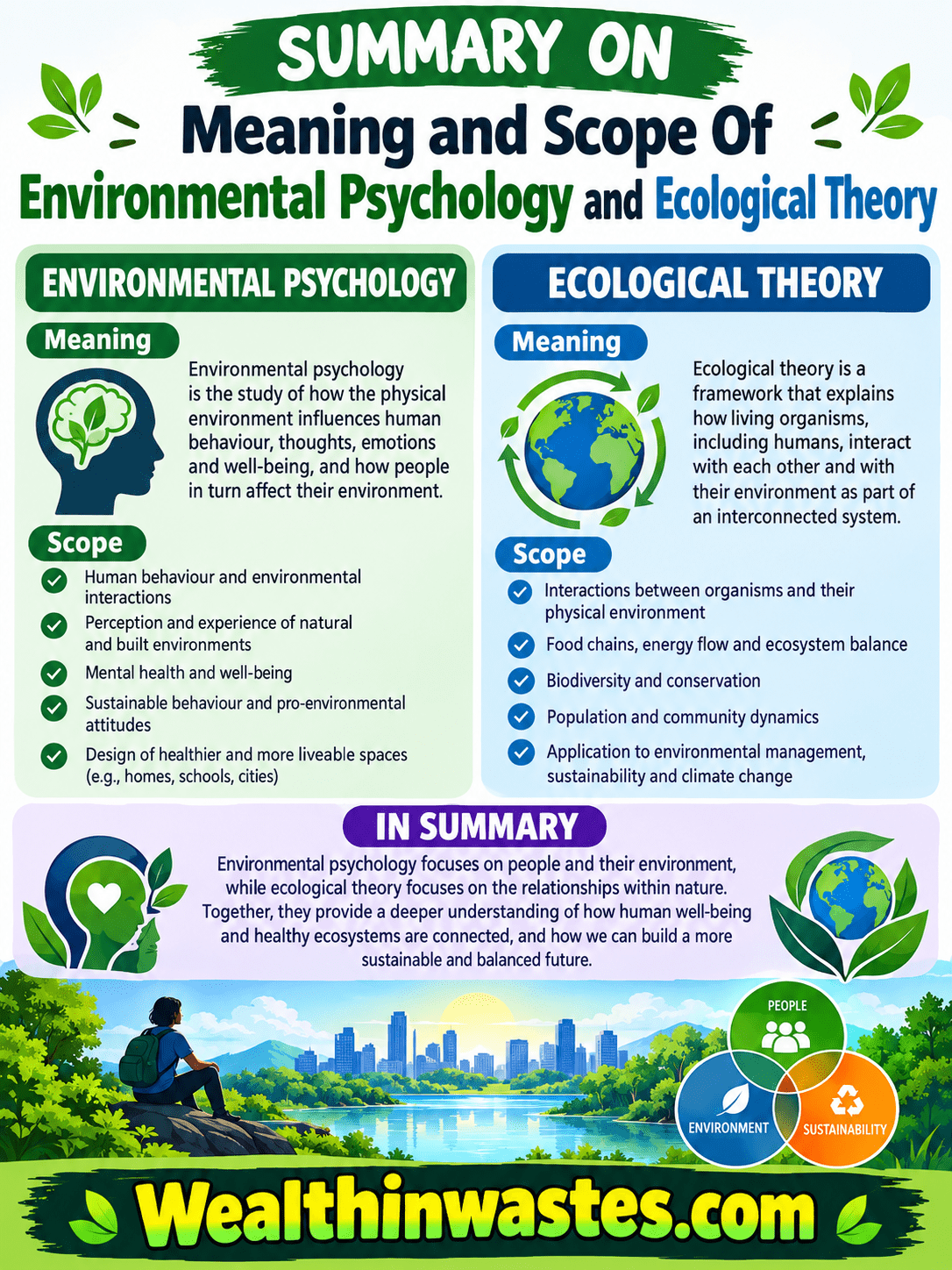
| Aspect | Summary |
|---|---|
| Environmental Psychology | Studies relationships between people, physical settings, social environments, and ecological conditions. |
| Environmental Perception | Explains how people interpret sensory, physical, social, and ecological features of their surroundings. |
| Human Behaviour | Behaviour responds to environmental conditions while human activities also modify surrounding environments. |
| Ecological Theory | Emphasizes relationships, interdependence, feedback, systems, organisms, resources, and environmental conditions. |
| Sustainability | Encourages resource conservation, waste reduction, recycling, responsible consumption, and ecological protection. |
| Environmental Stress | May arise from pollution, noise, crowding, heat, insecurity, poor housing, and unpleasant surroundings. |
| Applications | Useful in architecture, urban planning, conservation, education, public health, workplaces, housing, and environmental management. |
| Future Direction | Integrated approaches should combine psychology, ecology, planning, economics, governance, technology, education, and community participation. |
Frequently Asked Questions About Environmental Psychology and Ecological Theory Explained
1. What is Environmental Psychology?
Environmental psychology studies how physical, social, and ecological environments influence human perceptions, emotions, decisions, behaviour, wellbeing, and relationships with surrounding places and resources.
2. What Does Ecological Theory Explain?
Ecological theory explains relationships between organisms and environments, emphasizing interdependence, adaptation, feedback, resource availability, environmental conditions, and interactions within broader systems.
3. How Does Environment Affect Behaviour?
Environmental conditions can influence comfort, stress, movement, social interaction, concentration, decisions, resource use, conservation actions, and perceptions of safety, cleanliness, and environmental quality.
4. Why Is Environmental Perception Important?
Environmental perception affects how people interpret places and conditions, shaping emotional responses, behavioural choices, environmental satisfaction, place attachment, and willingness to protect surrounding environments.
5. How Can Environmental Psychology Support Sustainability?
It can identify behavioural barriers, strengthen environmental awareness, improve facility design, encourage responsible social norms, and make sustainable choices easier and more attractive.
6. Where Is Environmental Psychology Applied?
It applies to architecture, urban planning, housing, education, conservation, public health, workplaces, transportation, waste management, community development, and environmental policy.
7. What Is Environmental Stress?
Environmental stress occurs when surrounding conditions create physical, emotional, or cognitive demands that exceed a person’s ability or resources to comfortably adapt and respond.
8. Why Should Environmental Psychology Include Ecology?
Ecology highlights interdependence between living systems and surroundings, helping environmental psychology understand how individual behaviour connects with communities, resources, ecosystems, and wider environmental processes.
Do you have any questions, suggestions, or contributions? If so, please feel free to use the comment box below to share your thoughts. We also encourage you to kindly share this information with others who might benefit from it. Since we can’t reach everyone at once, we truly appreciate your help in spreading the word. Thank you very much for your support and for sharing!
Read Also: Historical Concept of Ecology in Agriculture and Environmental Science