



Environmental challenges increasingly affect communities through pollution, waste, resource depletion, climate pressures, biodiversity loss, and unsustainable production. These problems require informed decisions, practical skills, responsible behaviour, and coordinated action across society.
Educational intervention provides a structured approach for developing the knowledge, attitudes, skills, and experiences people need to understand environmental problems and participate meaningfully in solutions within their homes, schools, workplaces, and communities.
Environmental education therefore extends beyond classroom instruction because effective environmental action depends on how people apply information when making decisions about resources, waste, energy, pollution, consumption, conservation, and community development.
Knowledge alone does not automatically produce responsible environmental behaviour. People may understand environmental problems yet fail to act when they lack motivation, practical opportunities, supportive institutions, resources, or confidence in their ability to make meaningful changes.
Effective educational intervention connects awareness with participation, problem-solving, responsibility, and measurable environmental action. This approach can strengthen sustainable development by helping individuals and institutions understand environmental consequences while developing practical responses to local and global challenges.
Educational Intervention and Environmental Literacy
Educational intervention refers to a deliberate educational programme designed to improve knowledge, skills, attitudes, behaviour, or participation toward a clearly defined goal. Environmental intervention focuses these outcomes on ecological responsibility and sustainability.
Environmental literacy involves understanding environmental systems, recognizing human impacts, evaluating available choices, and developing the confidence needed to participate in solutions. Strong literacy helps people connect personal behaviour with wider environmental consequences.
Effective environmental education can also encourage responsible consumption, conservation, pollution prevention, and sustainable resource use. These outcomes complement broader environmental management practices by helping people understand why practical measures matter.
Environmental literacy should also help learners evaluate environmental claims, distinguish reliable information from misinformation, and understand how social, economic, technological, and ecological factors influence environmental decisions at different levels.
Current environmental management approaches increasingly recognize education and participation as important components of sustainability. Schools, communities, businesses, governments, and civil society organizations can therefore use educational intervention to support long-term environmental responsibility.
Read Also: Roles of Producers and Corporations in Waste Management
Goals of Educational Intervention
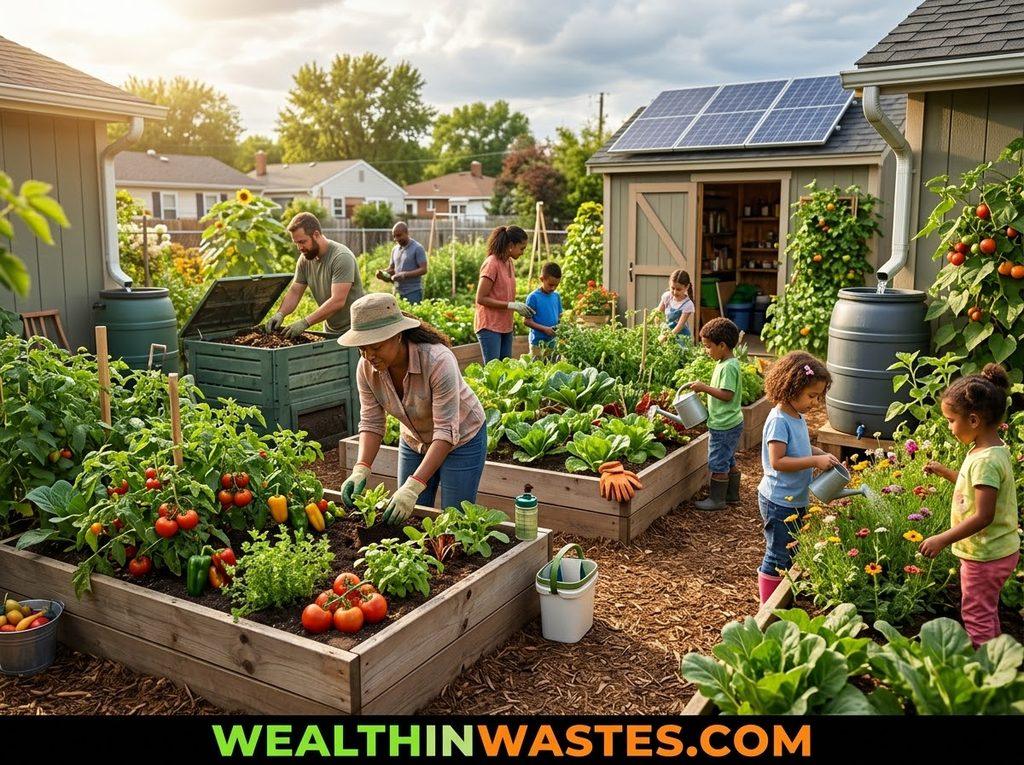
1. Build Environmental Awareness: Educational intervention should first help people recognize environmental problems, their causes, consequences, and possible solutions. Awareness creates the foundation for informed participation and encourages people to take environmental concerns seriously.
2. Develop Practical Knowledge: Learners need usable information rather than facts alone. Educational programmes should explain appropriate waste handling, conservation, pollution prevention, resource efficiency, and sustainable practices that people can apply in real situations.
3. Strengthen Environmental Skills: People require practical abilities for environmental action, including observation, problem identification, decision-making, communication, planning, evaluation, teamwork, and responsible resource management. These skills transform environmental knowledge into useful community responses.
4. Encourage Responsible Attitudes: Educational intervention can strengthen concern for environmental quality and encourage people to accept responsibility for their actions. Responsible attitudes become more meaningful when educational activities provide realistic opportunities for participation.
5. Promote Environmental Participation: The ultimate goal involves active participation in solving environmental problems. Learners should gain opportunities to support conservation, waste reduction, recycling, pollution prevention, community improvement, and sustainable development through practical collective action.
Core Skills for Environmental Action
Environmental action requires more than remembering definitions or understanding scientific concepts. People must identify problems, investigate causes, compare possible responses, communicate effectively, cooperate with others, and evaluate whether chosen solutions produce meaningful results.
Critical thinking enables learners to examine environmental issues from different perspectives before making decisions. It helps them consider ecological consequences alongside social needs, economic costs, technological limitations, cultural practices, and available resources.
Problem-solving skills allow learners to turn environmental concerns into practical responses. These skills become especially useful when communities address pollution, waste accumulation, resource shortages, or environmental degradation that requires coordinated local action.
Understanding pollutants and their environmental impacts can help learners identify pollution sources and support appropriate prevention measures. Such knowledge strengthens their ability to connect environmental conditions with everyday human activities.
Communication and collaboration remain equally important because environmental problems rarely affect one person alone. Successful environmental action often requires households, schools, businesses, communities, government agencies, and organizations to coordinate their responsibilities.
Educational programmes should therefore combine classroom learning with practical experiences, discussions, projects, demonstrations, field activities, and community participation. This approach makes environmental knowledge more relevant while encouraging learners to practise responsible behaviour.
Community-Based Educational Intervention

1. Community Awareness Campaigns: Community education can use workshops, meetings, radio programmes, demonstrations, posters, and digital communication to explain environmental challenges. Accessible messages should address local problems and provide realistic actions residents can adopt.
2. Practical Environmental Projects: Communities can learn through activities such as clean-up exercises, tree planting, recycling campaigns, composting, water conservation, and restoration projects. Practical projects allow participants to experience environmental responsibility rather than simply discussing it.
3. Stakeholder Participation: Successful intervention should involve residents, educators, traditional leaders, businesses, local authorities, youth groups, environmental organizations, and other relevant stakeholders. Shared participation increases ownership and helps ensure that interventions reflect local environmental priorities.
4. Local Problem-Solving: Community programmes should respond to specific local challenges instead of relying entirely on general environmental messages. Issues such as land pollution and soil contamination may require different interventions from those addressing air or water pollution.
5. Continuous Environmental Education: Environmental intervention should continue beyond one campaign or event. Repeated education, monitoring, feedback, and community engagement help reinforce responsible behaviour and maintain attention toward environmental priorities over time.
Educational Intervention in Schools
Schools provide an important setting for educational intervention because they can combine formal teaching with practical activities. Students can learn environmental concepts while applying them through daily decisions and organised projects within school communities.
Environmental education can become more effective when teachers connect classroom subjects with real environmental challenges. Science, geography, agriculture, economics, social studies, technology, and civic education can all contribute different perspectives to sustainability.
Schools can strengthen learning through recycling programmes, waste segregation, school gardens, composting, energy conservation, water-saving activities, tree planting, environmental clubs, and campus clean-up initiatives. These activities create opportunities for students to practise environmental responsibility.
Current guidance on environmental management in schools also emphasizes integrating environmental considerations into school operations, curriculum, resource use, and institutional culture. Such integration turns sustainability into a regular part of school life.
Schools can also encourage students to investigate local problems and propose solutions. This process develops research, communication, teamwork, creativity, leadership, and decision-making skills that remain useful beyond formal education.
Students can then transfer these lessons to their households and communities. As young people share practical knowledge with others, educational intervention can extend beyond school boundaries and contribute to broader environmental awareness and action.
Environmental education can also address waste through practical initiatives that support responsible litter management. Such activities help students understand how individual behaviour affects public spaces, ecosystems, health, and community wellbeing.
Environmental Action Through Sustainable Development

1. Resource Conservation: Sustainable environmental action encourages efficient use of water, energy, land, materials, and biological resources. Conservation reduces unnecessary pressure on natural systems while supporting present needs and protecting resources for future generations.
2. Waste Reduction and Recovery: Communities can prevent unnecessary waste, reuse suitable materials, recycle recoverable resources, and compost appropriate organic materials. These practices reduce disposal pressures while keeping valuable resources within productive use for longer.
3. Pollution Prevention: Environmental action should prioritize preventing pollution before contamination occurs. Cleaner production, responsible consumption, safe waste handling, and appropriate treatment can reduce harmful releases into air, soil, and water.
4. Climate Responsibility: Environmental education can encourage practical responses to climate pressures, including energy efficiency, renewable energy adoption, sustainable transport, ecosystem protection, and responsible land management. These actions support broader climate sustainability efforts.
5. Circular Resource Use: Sustainable development becomes stronger when societies reduce the linear pattern of taking resources, producing goods, and discarding materials. Circular approaches encourage reuse, repair, recycling, recovery, and better resource efficiency.
Measuring Educational Intervention Outcomes
Educational intervention should include measurable objectives because outcomes cannot be evaluated effectively without clear expectations. Objectives may concern knowledge, attitudes, practical skills, participation levels, behavioural changes, or measurable environmental improvements.
Evaluation can begin with a baseline assessment that establishes existing knowledge, attitudes, practices, and environmental conditions. Educators can then compare later findings with the baseline to determine whether meaningful changes occurred.
Useful indicators may include participation rates, waste reduction, recycling quantities, energy savings, water conservation, improved sanitation, reduced litter, increased environmental knowledge, and greater community involvement in environmental programmes.
Environmental action can produce broader economic effects as well. Recycling, for example, can conserve resources, reduce disposal requirements, support employment, and contribute to circular economic activity, as demonstrated by the environmental and economic benefits of recycling.
Evaluation should also consider unintended effects and implementation challenges. A programme may improve environmental knowledge without changing behaviour, particularly when participants lack infrastructure, incentives, supportive policies, or practical opportunities to act.
Continuous evaluation allows educators and decision-makers to adjust interventions according to evidence. This creates a learning cycle in which environmental programmes improve through monitoring, feedback, adaptation, and renewed community participation.
Understanding the principles of environmental management can further help evaluators consider participation, ecological protection, socioeconomic needs, and long-term environmental performance when assessing educational intervention outcomes.
Read Also: Climate Change and Sustainability for a Resilient Future
Practical Environmental Action Strategies

1. Reduce Waste at Source: Individuals and organizations should examine consumption patterns and avoid unnecessary materials before waste develops. Source reduction lowers disposal volumes, conserves resources, and can reduce the environmental pressures associated with production and waste handling.
2. Reuse Suitable Materials: Reusing products extends their useful life and reduces demand for replacement items. Educational programmes can teach repair, repurposing, sharing, and responsible purchasing as practical ways to reduce unnecessary material consumption.
3. Recycle Recoverable Resources: Proper segregation helps recyclable materials reach suitable recovery systems instead of disposal sites. Communities can strengthen recycling through public education, accessible collection systems, responsible handling, and partnerships with recycling organizations.
4. Compost Organic Materials: Organic waste can often become useful compost instead of entering conventional disposal systems. Educational intervention can teach households, schools, farmers, and communities how appropriate organic materials support soil improvement.
5. Encourage Collective Responsibility: Environmental action becomes stronger when individuals, organizations, and institutions recognize shared responsibilities. Community cooperation can improve waste collection and environmental services while supporting cleaner and healthier surroundings.
6. Support Sustainable Consumption: Consumers can consider durability, packaging, resource use, repairability, and environmental impacts when purchasing products. Better consumption decisions reduce unnecessary waste and support businesses that adopt more sustainable production practices.
7. Protect Land and Water: Communities should prevent indiscriminate dumping, protect drainage systems, reduce harmful discharges, and support conservation activities. Understanding waste sources and environmental impacts helps people target prevention effectively.
8. Promote Climate-Smart Practices: Environmental education should encourage efficient resource use, ecosystem protection, sustainable agriculture, cleaner energy choices, and climate adaptation. These approaches connect environmental action with resilience, livelihoods, food security, and sustainable development.
Effective action also depends on understanding the consequences of poor waste practices. Communities can use information about environmental and health effects of waste to strengthen prevention, education, and responsible disposal behaviours.
Education can also support informed responses to pollution because people need to understand how contaminants enter ecosystems and affect living organisms. Clear information strengthens participation in appropriate pollution prevention and control measures.
For communities facing serious contamination, understanding the concept of pollution provides a useful foundation for identifying undesirable environmental changes and explaining why prevention, monitoring, and corrective action remain necessary.
Where energy and climate pressures intersect with environmental management, educational programmes can promote practical solutions. Communities can learn about efficiency, renewable energy, cleaner transportation, sustainable land use, and responsible consumption.
The transition toward sustainability also benefits from circular economy principles, which encourage societies to keep materials useful for longer while reducing unnecessary extraction, disposal, and environmental pressure.
Environmental action should also address specific pollution challenges rather than treating every problem identically. For example, communities affected by petroleum activities may need specialized responses based on oil pollution sources and effects.
Likewise, communities can strengthen environmental responsibility by understanding wider social responses to contamination. Education about social responses to environmental pollution can encourage collective participation and responsible community decision-making.
Broader climate education can also explain why environmental pressures extend beyond individual communities. Learning about global warming and its environmental consequences can encourage greater support for mitigation, adaptation, and conservation measures.
Households can participate directly by separating reusable, recyclable, compostable, and disposable materials. Practical household approaches can also create economic opportunities, especially where household waste generates income through appropriate recovery activities.
Reducing litter remains another practical environmental action. Education can encourage residents to prevent indiscriminate disposal, participate in clean-up activities, and support community systems that keep public areas cleaner.
Communities can also adopt broader strategies for reducing waste and creating greener communities by combining responsible consumption, reuse, recycling, composting, and pollution prevention in everyday routines.
The overall purpose of educational intervention is therefore not simply to transfer information. It is to develop capable people who understand environmental challenges, recognize their responsibilities, and participate confidently in practical solutions.
When educational intervention connects knowledge with skills, participation, measurable goals, and supportive institutions, environmental action becomes more achievable. Communities can then move from recognizing environmental problems toward preventing damage and improving sustainability.
Strong environmental action ultimately depends on cooperation among individuals, communities, businesses, educational institutions, and governments. Each group has different responsibilities, yet all contribute to the collective protection of natural resources and human wellbeing.
Environmental education should therefore remain continuous rather than occasional. As technologies, environmental risks, regulations, consumption patterns, and community priorities change, educational programmes must adapt to provide relevant information and practical responses.
Summary on Educational Intervention and Environmental Action
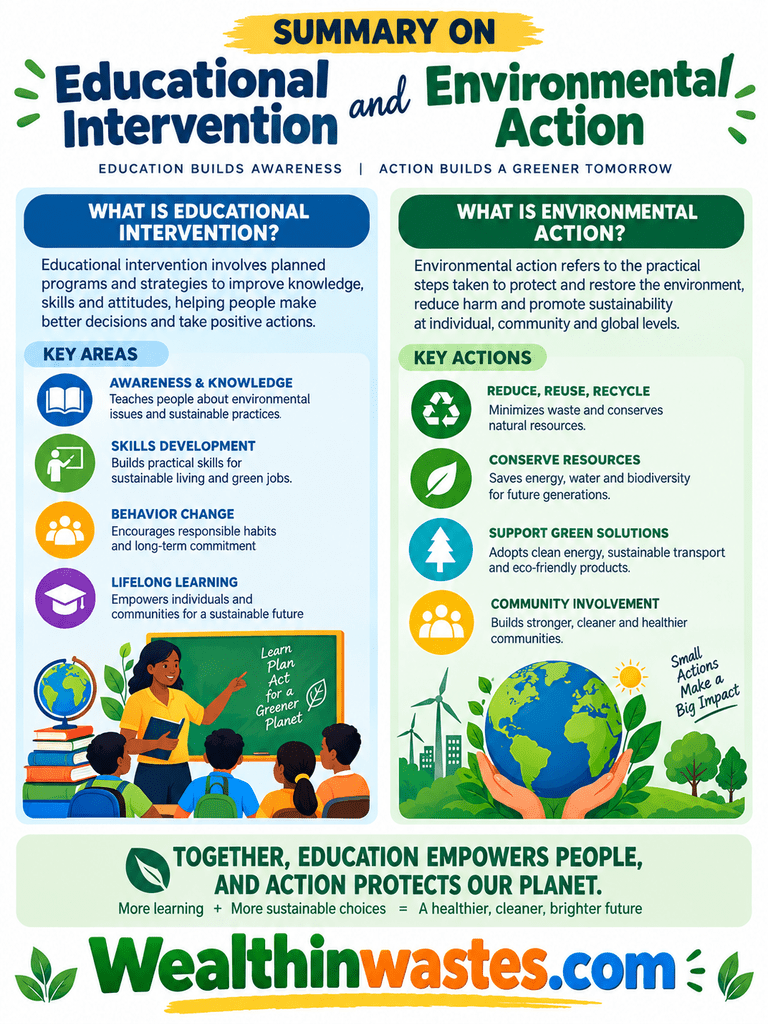
| Aspect | Summary |
|---|---|
| Educational Intervention | A deliberate educational process that develops knowledge, attitudes, skills, and responsible behaviour. |
| Environmental Literacy | Understanding environmental problems, consequences, choices, and practical solutions. |
| Key Skills | Critical thinking, communication, problem-solving, teamwork, planning, and evaluation. |
| Community Action | Awareness campaigns, practical projects, stakeholder participation, and continuous education. |
| School Action | Recycling, composting, gardens, conservation activities, environmental clubs, and practical learning. |
| Sustainable Development | Responsible resource use, pollution prevention, waste reduction, climate responsibility, and circular practices. |
| Measurement | Baseline assessments, measurable objectives, behavioural indicators, environmental outcomes, and continuous evaluation. |
| Overall Goal | Transform environmental knowledge into responsible participation and measurable environmental improvement. |
Frequently Asked Questions About Educational Intervention and Environmental Action
1. What Is Educational Intervention?
Educational intervention is a deliberate educational programme designed to improve knowledge, skills, attitudes, behaviour, or participation toward a clearly defined objective.
2. Why Is Educational Intervention Important For Environmental Protection?
It helps people understand environmental problems while developing the skills, motivation, responsibility, and confidence required to participate in practical environmental solutions.
3. Does Environmental Knowledge Automatically Change Behaviour?
No. Knowledge can support responsible behaviour, but people also need motivation, practical opportunities, supportive systems, resources, and social encouragement to act.
4. What Skills Does Environmental Education Develop?
Environmental education can develop critical thinking, problem-solving, communication, teamwork, decision-making, planning, observation, research, evaluation, and practical environmental management skills.
5. How Can Schools Support Environmental Action?
Schools can support environmental action through recycling, composting, school gardens, energy conservation, water-saving activities, tree planting, environmental clubs, projects, and practical environmental lessons.
6. How Can Communities Use Educational Intervention?
Communities can use workshops, campaigns, demonstrations, practical projects, local research, clean-up activities, recycling programmes, and stakeholder partnerships to address environmental challenges.
7. How Is Environmental Action Connected With Sustainable Development?
Environmental action supports sustainable development by promoting responsible resource use, pollution prevention, waste reduction, conservation, climate responsibility, and protection of future resource availability.
8. How Can Educational Intervention Be Evaluated?
Evaluation can compare baseline and later measurements of knowledge, attitudes, participation, behaviour, waste reduction, conservation activities, and other measurable environmental outcomes.
9. Who Should Participate In Environmental Action?
Individuals, families, schools, businesses, communities, governments, environmental organizations, and other stakeholders all have important responsibilities because environmental problems affect society collectively.
10. What Is The Main Purpose Of Educational Intervention?
Its main purpose is to develop informed and capable people who can understand environmental challenges, make responsible decisions, and participate effectively in practical environmental action.
Do you have any questions, suggestions, or contributions? If so, please feel free to use the comment box below to share your thoughts. We also encourage you to kindly share this information with others who might benefit from it. Since we can’t reach everyone at once, we truly appreciate your help in spreading the word. Thank you very much for your support and for sharing!
Read Also: Climate-Smart Cropping Systems Principles and Practices for Sustainable Farming