


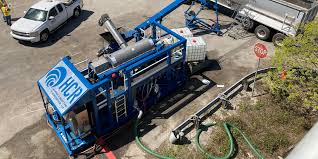
Waste is commonly regarded as an unwanted by-product of human, commercial, agricultural, and industrial activities. However, many waste materials represent valuable resources when they are properly managed, recovered, reused, or recycled.
Waste generation can result from inefficient production processes, excessive resource consumption, damaged materials, poor handling, unnecessary packaging, and avoidable losses. Reducing these losses can improve operational efficiency while lowering environmental pressures.
Organizations often underestimate the true financial consequences associated with waste. Beyond disposal expenses, businesses may lose money through wasted raw materials, energy consumption, labour, processing costs, and missed opportunities.
Effective waste minimization therefore requires organizations to examine how resources move through their operations. Identifying where materials, water, electricity, fuel, packaging, and products become unnecessarily wasted creates opportunities for improvement.
A successful waste minimization programme focuses primarily on preventing waste before it occurs. It also encourages efficient resource utilization, reuse, recycling, recovery, process improvement, responsible purchasing, and suitable treatment of unavoidable residues.
Waste minimization should not be confused with disposal alone because disposal occurs after waste has already been generated. Minimization instead addresses the causes and quantities of waste throughout operational processes.
What is Waste Minimization?

Waste minimization refers to systematically reducing the quantity or harmfulness of waste generated from an activity. It emphasizes prevention at source before recycling, treatment, recovery, or disposal becomes necessary.
The concept encourages organizations to use raw materials, packaging, water, electricity, and fuel efficiently. Better resource efficiency generally means fewer unnecessary materials are consumed and consequently less waste requires management.
1. Prevention and reduction: Waste minimization emphasizes preventing unnecessary waste generation and reducing quantities that cannot be completely eliminated through improved planning, handling, production, maintenance, and operational control.
2. Efficient material use: Businesses can reduce waste by purchasing appropriate quantities, improving storage practices, optimizing material dimensions, reducing damage, and selecting processes that generate fewer unused residues.
3. Efficient utility use: Careful management of electricity, water, fuel, steam, and other utilities can reduce avoidable losses while improving production efficiency and reducing the environmental burden associated with consumption.
4. Improved waste quality: Improving the composition and separation of unavoidable waste can make recycling easier, increase recovery opportunities, and reduce the hazards associated with materials requiring specialized handling.
5. Reuse, recycling, and recovery: Materials should remain useful for as long as possible through direct reuse, recycling, recovery, refurbishment, remanufacturing, or conversion into useful products before final disposal.
Waste minimization requires organizations to understand their production processes and identify where losses occur. A waste characterization and analysis programme can reveal waste types, quantities, sources, and avoidable losses.
Another important requirement is understanding the complete movement of materials from extraction through production, consumption, recovery, and final disposal. This broader perspective encourages decisions that reduce waste throughout the material lifecycle.
Waste minimization may also be described using terms such as waste reduction, source reduction, pollution prevention, cleaner production, and waste minimisation. These approaches share the objective of preventing unnecessary waste at source.
However, waste minimization cannot eliminate every environmental problem. Some residual materials will still require recycling, treatment, recovery, controlled storage, or environmentally responsible disposal through appropriate waste management systems.
Processes of Waste Minimization
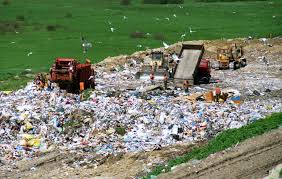
Waste minimization processes provide practical methods for preventing unnecessary material losses and improving the efficiency of production systems. These methods can be adopted individually or combined within an integrated waste management programme.
The first approach is to understand where waste originates, how frequently it occurs, and which resources are responsible. Establishing accurate information makes it easier to identify realistic opportunities for reduction.
An effective industrial waste management approach should examine purchasing, production, storage, transportation, maintenance, packaging, cleaning, and disposal activities because each stage can contribute to avoidable waste.
Organizations should establish measurable targets for reducing material losses, unnecessary energy consumption, excessive water use, rejected products, damaged packaging, and other waste streams generated during routine operations.
Management commitment is important because employees need clear responsibilities, suitable equipment, appropriate training, and consistent procedures. Waste minimization succeeds when environmental objectives become part of everyday operational decisions.
The waste management hierarchy provides useful guidance by placing prevention and reduction ahead of reuse, recycling, recovery, treatment, and final disposal whenever those options are technically and economically appropriate.
Waste minimization should also consider product quality because defective products represent wasted materials, labour, utilities, packaging, and production time. Preventing defects can therefore reduce both environmental and financial losses.
Continuous monitoring allows organizations to determine whether implemented measures are working. Results can then be reviewed, weaknesses corrected, successful practices expanded, and additional opportunities identified for further waste reduction.
1. Source reduction: Prevent waste generation by changing product designs, materials, production methods, handling procedures, purchasing practices, or operational systems before waste is created.
2. Material reuse: Return suitable materials, components, scraps, containers, or by-products into productive activities so they remain useful instead of becoming unnecessary waste requiring external disposal.
3. Recycling and recovery: Recover useful materials from unavoidable waste streams and process them into secondary raw materials or products, thereby reducing dependence on virgin resources and disposal facilities.
4. Process improvement: Modify equipment, procedures, production controls, maintenance schedules, and operating conditions to reduce defects, spills, material losses, excessive consumption, and unnecessary generation of residual waste.
5. Responsible distribution: Deliver materials close to their point of use where practical, minimizing protective packaging, unnecessary handling, breakage, contamination, and losses associated with repeated movement.
These methods complement one another and can produce better results when introduced through coordinated planning. The most suitable combination depends on the type of organization, materials involved, production requirements, and available technology.
Organizations should also examine reduce, reuse, and recycle practices because these principles provide a practical framework for keeping materials useful while minimizing unnecessary disposal.
1. Resource Optimization
Resource optimization involves using raw materials, utilities, equipment, labour, and packaging as efficiently as possible. It reduces waste by preventing unnecessary consumption and improving productivity throughout an operational process.
Organizations can begin by determining the exact quantities of materials required for production. Purchasing excessive quantities increases storage requirements and creates greater risks of deterioration, contamination, damage, or expiration.
Production planning can further improve material efficiency by matching input quantities with expected output. Accurate forecasting reduces overproduction and helps prevent materials from being consumed for products that cannot be sold.
Better cutting, measuring, mixing, filling, and formulation techniques can also reduce physical losses. For example, fabric manufacturers can arrange patterns carefully to maximize usable material from every piece.
Resource optimization also applies to utilities. Businesses can reduce unnecessary water and electricity consumption by repairing leaks, maintaining equipment, using efficient machinery, and switching off systems when they are not required.
Organizations should consider the sources of industrial waste because understanding where materials become waste helps managers identify specific points where resource use can be improved.
Regular performance measurement makes resource optimization more effective. Comparing material inputs with production outputs can reveal unusually high losses and indicate processes requiring closer examination or technical improvement.
When resource optimization becomes part of daily management, organizations can reduce purchasing costs, lower waste disposal requirements, improve productivity, conserve natural resources, and strengthen the overall efficiency of their operations.
Read Also: Other Methods/Technologies for Solid Waste Treatment
2. Reuse of Scrap Material

Reuse of scrap material involves returning suitable leftover materials directly into productive activities. The approach prevents usable scraps from becoming waste and reduces demand for new raw materials.
Manufacturing operations often generate off-cuts, defective components, surplus materials, damaged packaging, and process residues. Some of these materials can be safely reintroduced into production after suitable inspection.
Paper manufacturing, plastics production, metalworking, textile production, woodworking, and food processing can sometimes reuse production remnants within their processes. The exact method depends on material properties and product requirements.
Scrap reuse becomes more effective when materials are separated at their point of generation. Keeping different materials apart reduces contamination and makes recovery easier, safer, and more economically attractive.
Businesses should determine whether reused scraps affect product quality, safety, durability, or regulatory requirements. Materials unsuitable for direct reuse may instead be recycled, recovered, exchanged, or processed through another beneficial route.
The concept connects closely with recovering useful products from industrial waste, because materials that appear worthless can sometimes become valuable inputs for another production process.
Successful scrap reuse can reduce raw material purchases, lower disposal volumes, decrease transportation requirements, and conserve resources. These savings can improve profitability while simultaneously reducing the environmental impacts associated with waste.
Employees should receive clear instructions on identifying reusable materials, storing them properly, preventing contamination, and returning suitable scraps to production. Consistent handling practices help ensure that reuse remains safe and reliable.
3. Improved Quality Control and Process Monitoring
Quality control and process monitoring reduce waste by detecting errors before large quantities of materials become defective products. Early identification allows operators to correct problems before production losses increase significantly.
Frequent inspections can identify incorrect measurements, unsuitable temperatures, equipment faults, contamination, poor alignment, leakage, inefficient settings, or other conditions that may produce rejected batches and unnecessary waste.
Automated monitoring systems can provide continuous information about production conditions. Sensors and control devices may detect deviations quickly, allowing corrective action before defects spread throughout an entire production run.
Quality records should be examined regularly to identify recurring problems. When the same defect occurs repeatedly, management can investigate its underlying cause instead of repeatedly treating the resulting waste.
Preventive maintenance also supports process monitoring because worn machinery can increase product defects, energy consumption, spills, material losses, and equipment downtime. Maintaining equipment helps keep production conditions stable.
Organizations can strengthen this approach through a structured waste management strategy that establishes responsibilities, measurable targets, monitoring procedures, staff training, and regular performance reviews.
Improved process control can deliver environmental and financial benefits simultaneously. Fewer rejected products mean less wasted material, lower processing costs, reduced energy consumption, and smaller quantities requiring recycling or disposal.
Continuous improvement should remain an ongoing objective rather than a one-time project. Production teams should regularly review performance data and introduce practical improvements whenever new waste reduction opportunities are discovered.
4. Waste Exchanges
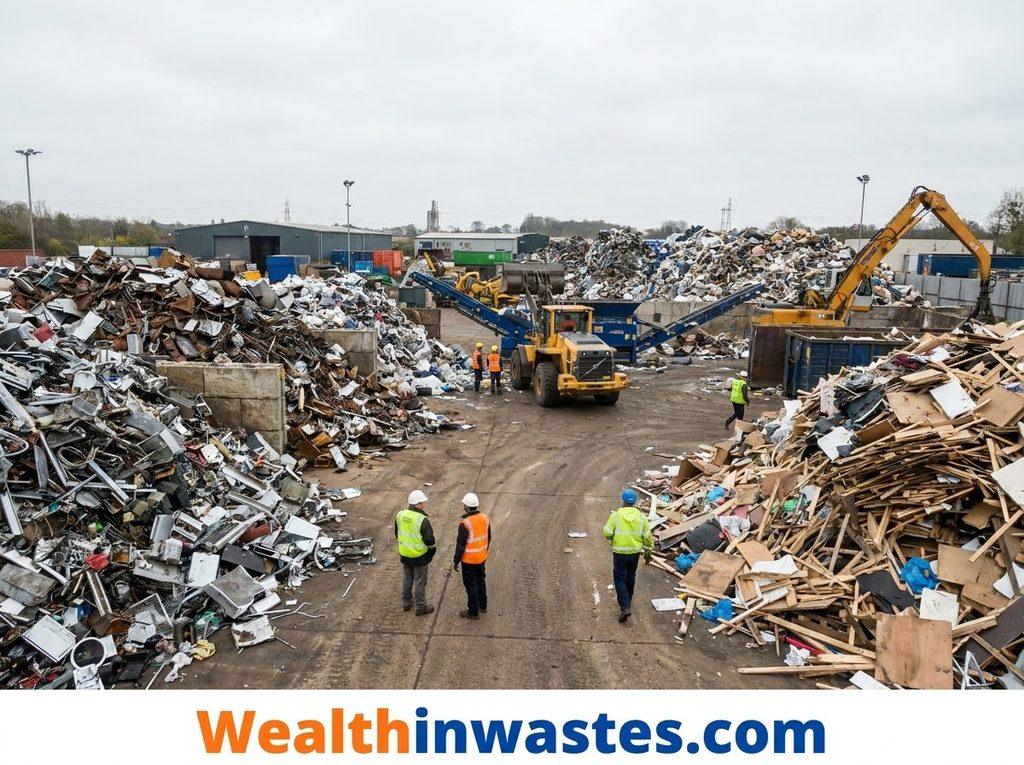
Waste exchange is a process in which material regarded as waste from one activity becomes a useful raw material or input for another activity, reducing disposal requirements and conserving resources.
This approach is particularly useful when one organization generates materials that possess properties valuable to another organization. The exchange can therefore create economic opportunities while reducing pressure on disposal facilities.
Suitable waste exchange opportunities may involve paper, plastics, metals, construction materials, organic residues, process by-products, packaging materials, solvents, or other materials that retain useful properties after their original use.
Before exchanging materials, organizations should assess their composition, quality, contamination risks, handling requirements, transportation needs, and legal considerations. Appropriate evaluation helps protect users and maintain reliable material quality.
Waste exchange can support circular economy practices because materials remain within productive systems instead of moving directly toward disposal. This approach helps extend the useful life of resources and materials.
The principle also aligns with creating economic value from industrial waste, since recovered materials can sometimes provide income while reducing disposal costs and environmental impacts.
Successful exchanges require communication between waste generators and potential users. Waste databases, industry networks, recycling companies, and waste management organizations can help identify businesses seeking particular secondary materials.
When properly organized, waste exchanges reduce landfill dependence, conserve virgin resources, support secondary-material markets, encourage industrial cooperation, and transform selected waste streams into economically useful resources.
5. Ship to Point of Use
Shipping materials directly to their point of use involves delivering incoming raw materials or components close to where they are required within the production process, reducing unnecessary handling and packaging.
Traditional supply systems may involve repeated movement between warehouses, storage areas, production rooms, and workstations. Each additional movement creates opportunities for damage, contamination, spillage, misplacement, and packaging waste.
Direct delivery can reduce the need for temporary protective materials such as excessive wrapping, secondary containers, pallets, and additional handling equipment when those materials are otherwise unnecessary.
Efficient delivery planning also reduces the likelihood that components will remain unused for extended periods. Shorter storage times can decrease deterioration, expiration, contamination, and unnecessary inventory accumulation.
Businesses should coordinate suppliers, transportation schedules, receiving procedures, storage requirements, and production timetables carefully. Poor coordination could cause stock shortages or delays even though the strategy reduces unnecessary handling.
This approach contributes to broader industrial waste reduction and environmental protection because fewer damaged materials and packaging items may enter waste streams during transportation and storage.
Point-of-use delivery can also improve workplace efficiency by reducing the movement of workers and materials. Less internal transportation may save time, reduce handling costs, and create a more organized production environment.
When combined with inventory control, appropriate packaging, supplier coordination, and careful production planning, direct delivery can become a practical waste minimization measure for many industrial and commercial operations.
Waste minimization becomes more effective when organizations integrate resource optimization, scrap reuse, quality monitoring, waste exchanges, and point-of-use delivery. Together, these approaches address waste prevention from multiple operational perspectives.
Organizations should also recognize that recycling remains important for unavoidable waste. A well-designed waste recycling programme can recover useful materials that cannot reasonably be eliminated during production.
Waste minimization should therefore be viewed as an ongoing management responsibility rather than a temporary environmental initiative. Regular reviews can identify changing production conditions and reveal new opportunities for resource efficiency.
The most effective programmes combine technical improvements with employee participation. Workers who understand waste sources and reduction targets are better positioned to identify practical solutions during everyday operations.
Management should measure progress using indicators such as material use, waste generation, rejected products, energy consumption, water consumption, recycling rates, disposal volumes, and financial savings achieved.
Waste minimization can also support responsible environmental management by reducing pollution risks and unnecessary pressure on natural resources. Proper planning helps organizations become more efficient while meeting environmental and operational responsibilities.
For agricultural enterprises, the same principles apply to crop residues, livestock manure, packaging, water, energy, and processing losses. Practical farm waste management practices can turn some residues into useful resources.
Waste minimization should not eliminate appropriate treatment and disposal systems because some hazardous or contaminated materials cannot be safely reused or recycled. Such wastes require suitable handling and environmentally responsible management.
Read Also: Community Level Composting (Manure Pit)
Summary on Definition and Waste Minimization/Reduction Process
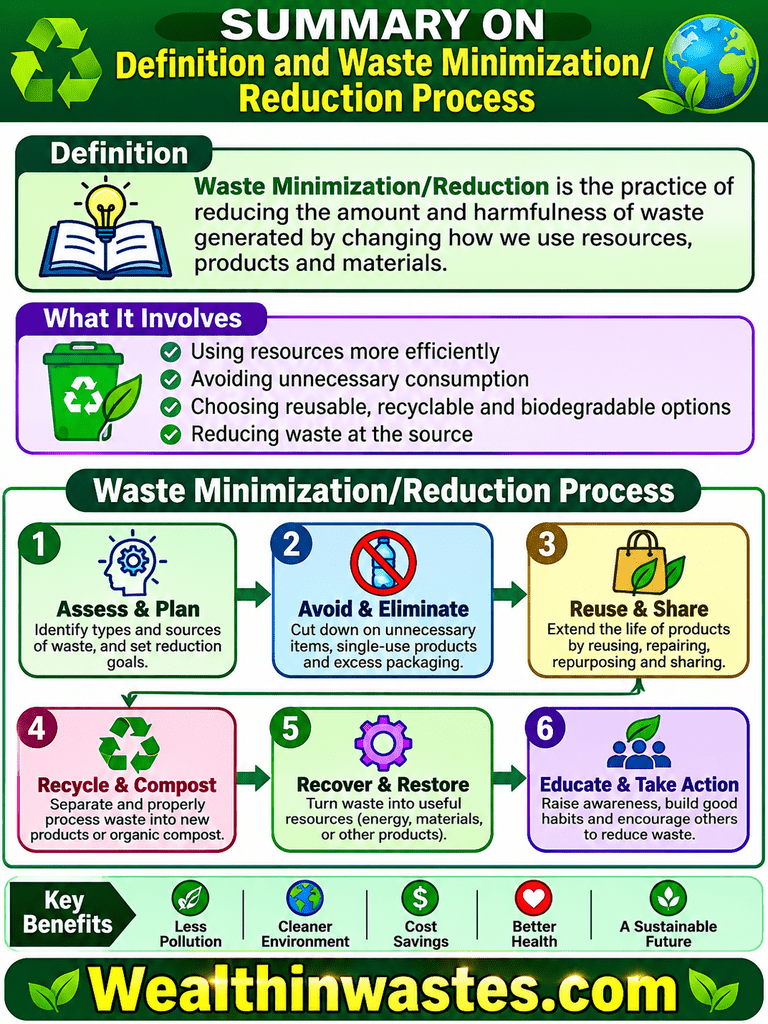
| Aspect | Summary |
|---|---|
| Waste | Waste includes unwanted materials and inefficiently used resources generated through domestic, commercial, agricultural, and industrial activities. |
| Waste Minimization | Waste minimization is the systematic reduction of waste quantity or harmfulness at source before treatment or disposal. |
| Main Objective | The major objective is to conserve resources, reduce waste generation, improve efficiency, lower costs, and reduce environmental impacts. |
| Resource Optimization | This involves using raw materials, water, electricity, fuel, packaging, and other resources efficiently to prevent unnecessary losses. |
| Scrap Reuse | Suitable scraps and production remnants can be returned to productive activities instead of becoming disposal wastes. |
| Quality Control | Frequent inspection, monitoring, maintenance, and process control can reduce defective products and rejected production batches. |
| Waste Exchange | Materials discarded by one process can become useful inputs for another process when quality and safety requirements are satisfied. |
| Point-of-Use Delivery | Direct delivery of materials to their place of use can reduce handling, damage, storage losses, and unnecessary packaging. |
| Recycling | Recycling recovers useful materials from unavoidable waste streams, extending material value and reducing disposal requirements. |
| Overall Benefit | Effective waste minimization improves resource efficiency, reduces pollution, lowers operating costs, and supports more sustainable production systems. |
Frequently Asked Questions About Definition and Waste Minimization/Reduction Process
1. What is waste minimization?
Waste minimization is the systematic reduction of waste quantity or harmfulness at its source through efficient resource use, prevention, reuse, recycling, recovery, and improved production practices.
2. Why is waste minimization important?
Waste minimization reduces resource consumption, disposal costs, pollution risks, production losses, and environmental pressures while improving operational efficiency and encouraging more responsible use of materials.
3. What are the main processes of waste minimization?
The main processes include resource optimization, reuse of scrap materials, improved quality control, process monitoring, waste exchanges, and shipping materials directly to their point of use.
4. How does resource optimization reduce waste?
Resource optimization reduces waste by ensuring that raw materials, water, electricity, fuel, packaging, and other inputs are used efficiently without unnecessary consumption, losses, or avoidable production residues.
5. What is scrap material reuse?
Scrap material reuse involves returning suitable production leftovers, off-cuts, components, or residues into useful processes instead of sending them directly for recycling or disposal.
6. How does quality control minimize waste?
Quality control identifies production problems early, preventing large quantities of defective materials and products from being generated through repeated errors, equipment faults, incorrect settings, or contamination.
7. What is a waste exchange?
A waste exchange occurs when material considered waste by one organization or process becomes a useful raw material or input for another activity.
8. Does waste minimization eliminate the need for disposal?
No. Waste minimization reduces unnecessary waste, but some materials remain unavoidable and may require appropriate recycling, treatment, controlled storage, or environmentally responsible final disposal.
9. Can agriculture benefit from waste minimization?
Yes. Farms can reduce losses by efficiently managing water, feed, fertilizers, packaging, crop residues, manure, energy, and other resources while converting suitable agricultural residues into useful products.
10. How can organizations improve waste minimization?
Organizations can improve waste minimization by conducting waste assessments, setting measurable targets, training employees, improving processes, monitoring results, reusing materials, recycling unavoidable waste, and reviewing performance regularly.
Do you have any questions, suggestions, or contributions? If so, please feel free to use the comment box below to share your thoughts. We also encourage you to kindly share this information with others who might benefit from it. Since we can’t reach everyone at once, we truly appreciate your help in spreading the word. Thank you very much for your support and for sharing!
Read Also: All You Need To Know About Sustainable Practices In Agriculture