


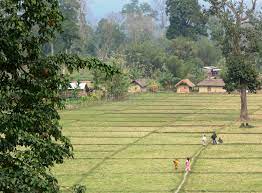
Conflict management in resources conservation refers to the processes used to prevent, reduce, and resolve disagreements over access to land, forests, water, wildlife, and other natural resources that support daily life.
These disagreements often involve conservation authorities, farmers, pastoralists, fishers, businesses, Indigenous peoples, and nearby residents whose livelihoods depend directly on ecosystems or whose daily activities conservation rules may restrict in nearby settlements.
Protected areas can preserve biodiversity and ecological services, yet poorly designed restrictions may limit grazing, farming, fishing, fuelwood collection, or access to sacred sites without offering practical alternatives for affected households.
Effective management therefore balances ecological protection with human rights, community knowledge, fair benefits, and realistic livelihood options. When people participate in decisions, they are more likely to support conservation measures over time.
Three broad models help explain how authorities and communities share responsibility: top-down management, mixed top-down and bottom-up management, and community-centred bottom-up management. Each model influences trust, accountability, and conflict risk.
Why Conflicts Arise in Resource Conservation
Conflicts usually arise when conservation rules affect local access to natural resources, benefits are unevenly distributed, or authorities make decisions without understanding customary rights, livelihood needs, and cultural practices, especially where rights remain unclear.
1. Competition Over Resources: Households and industries may compete for limited farmland, grazing areas, forests, fisheries, or water supplies, especially when population growth, drought, and habitat loss intensify pressure throughout the year.
2. Exclusion From Decisions: Communities may resist protected-area rules when authorities restrict traditional activities without consultation, clear explanations, secure rights, or meaningful opportunities to influence management priorities and local livelihoods.
3. Unequal Costs and Benefits: Residents may absorb restrictions and losses linked to human pressure on the environment, while tourism operators or distant institutions receive most revenue, deepening distrust and resistance to conservation programmes.
4. Weak Communication and Enforcement: Confusing boundaries, inconsistent penalties, corruption, or poor communication can create uncertainty, favour powerful users, and turn manageable disagreements into persistent disputes and weaken public confidence.
Read Also: Methods of Disposal of Waste Pesticide Containers
Management Approaches for Conservation Conflicts

Conservation managers choose governance arrangements based on legal responsibilities, ecological goals, community rights, available capacity, and the types of natural resources involved. No single model suits every location, so local conditions should guide the choice.
1. Top-Down Management: Government agencies or park authorities direct resource conservation and management, while residents hold little formal influence. This model can deliver clear protection, but exclusion and unfair costs often fuel opposition.
2. Mixed Top-Down and Bottom-Up Management: Authorities retain legal responsibility but consult residents, accept local recommendations, and share selected duties. This approach is useful when renewable and non-renewable resources require coordinated decisions.
3. Bottom-Up Management: Local groups help define priorities, rules, monitoring, and permitted resource use, while government supplies legal support and technical advice. This approach can strengthen ownership when participation includes diverse residents.
Community Participation in Conflict Management
Community participation works best when residents join conservation planning before decisions become final. Their knowledge of seasonal water, wildlife movement, sacred places, and traditional resource use can improve practical management.
Local committees should include women, young people, Indigenous groups, farmers, pastoralists, fishers, and other resource users. Broad representation prevents influential households from capturing decisions and overlooking vulnerable groups in every meeting.
Participatory governance also needs clear responsibilities, accessible records, and agreed ways to raise concerns. Linking residents with wildlife sanctuary management can improve habitat protection while clarifying legitimate community roles and follow-up.
Where communities help safeguard biodiversity and threatened species, managers can combine local observations with scientific monitoring. This cooperation supports decisions that protect wildlife without dismissing the social importance of surrounding landscapes.
Shared governance also strengthens ecological sustainability by giving residents incentives to report illegal extraction, support restoration, and negotiate responsible resource use instead of viewing conservation as an outside restriction over the long term.
Fair Benefits and Sustainable Livelihoods

Conservation becomes more acceptable when residents can see fair, reliable benefits and maintain dignified livelihoods over the long term, including access to water and productive land, especially where subsistence depends on local ecosystems.
1. Share Conservation Revenue: Allocate a transparent portion of ecotourism, concession, or permit revenue to community priorities such as clinics, schools, clean water, local roads, and conservation jobs, with public accounts.
2. Support Sustainable Livelihoods: Training, small-business support, agroforestry, beekeeping, responsible tourism, improved farming, and water conservation can reduce reliance on destructive extraction while giving households viable income alternatives near protected landscapes.
3. Reduce Human-Wildlife Losses: Use locally appropriate barriers, early-warning systems, compensation schemes, and rapid response teams to reduce crop and livestock losses, including damage linked to forest-edge change, without ignoring family needs.
4. Protect Resource Access Rights: Clear agreements on grazing routes, fishing seasons, fuelwood collection, and water access can reduce uncertainty. Practical land stewardship, including soil conservation practices, can protect livelihoods and ecosystems together.
Practical Steps for Resolving Conservation Disputes
Conflicts rarely disappear through enforcement alone. Managers should create trusted procedures that let parties explain concerns, examine evidence, negotiate options, and record decisions before disputes escalate into threats or violence, while supporting responsible environmental use.
1. Map Stakeholders and Issues: Identify affected groups, resource uses, legal rights, seasonal pressures, and existing agreements. A shared map of concerns helps distinguish factual disagreements from competing priorities and misunderstandings.
2. Use Dialogue and Mediation: Bring parties together through respected, neutral facilitators. Separate urgent safety issues from negotiable questions, give each group equal speaking opportunities, and record agreed actions, deadlines, and responsibilities.
3. Agree on Fair Rules: Establish understandable boundaries, harvesting limits, seasonal access arrangements, and sanctions through consultation. Rules work better when people understand their purpose and view enforcement as consistent rather than selective.
4. Track Agreements and Review Them: Assign responsible people, set review dates, and document complaints and outcomes. Use environmental management best practices to make monitoring practical, transparent, and responsive at regular intervals.
5. Provide Trusted Complaint Channels: Create safe ways to report abuse, bribery, damage, or unfair treatment to accountable environmental institutions. Clear escalation steps and independent review can reduce retaliation fears and strengthen confidence.
Law, Monitoring and Conservation Education
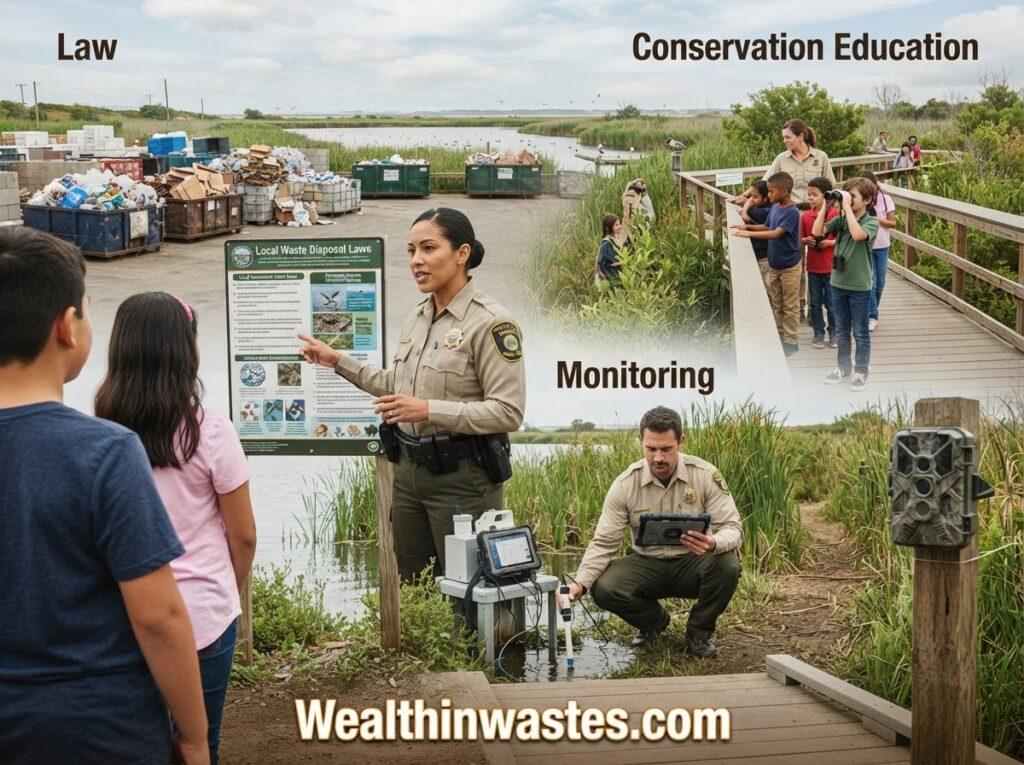
Strong laws help define rights and responsibilities, but fair implementation matters as much as the wording. Authorities should explain restrictions, publish permits and penalties, and provide accessible processes for appeals.
Regular monitoring can combine patrol records, community reports, wildlife surveys, land-use observations, and water-quality checks. Reliable evidence helps managers adjust rules before ecological pressure creates further competition or local hardship.
Environmental education should explain conservation goals, permitted activities, and the reasons behind restrictions in accessible local languages. Programmes can also connect communities with climate change and resource pressures that may intensify competition.
Local pollution concerns deserve attention because contamination can reduce access to safe water, fish, farmland, and grazing. Understanding environmental degradation and water and air systems helps groups identify shared risks and plan practical responses.
Where rivers, forests, or wildlife cross administrative boundaries, neighbouring districts should coordinate rules and information. Joint planning reduces confusion, limits displacement of harmful activities, and supports consistent protection across connected ecosystems.
Long-Term Benefits of Conflict Management
Effective conflict management builds trust between communities and conservation authorities, making people more willing to share information, follow agreed rules, and participate in habitat restoration and long-term monitoring across the protected landscape.
Fair agreements can also reduce illegal harvesting, destructive land clearing, and retaliatory actions. They create room for resource users to benefit responsibly from ecosystems while protecting the ecological functions that sustain livelihoods.
Coastal and inland communities alike depend on healthy ecosystems, as explained in this overview of coastal and marine environments. Inclusive decisions help protect fisheries, water supplies, forests, and local economies together.
Ultimately, lasting conservation requires a balance between ecological limits and human well-being. Recognising the connections between people and the natural environment helps managers design policies communities can support for generations.
Read Also: Control of Conflicts in Resources Conservation
Summary on Conflict Management in Resources Conservation Strategies
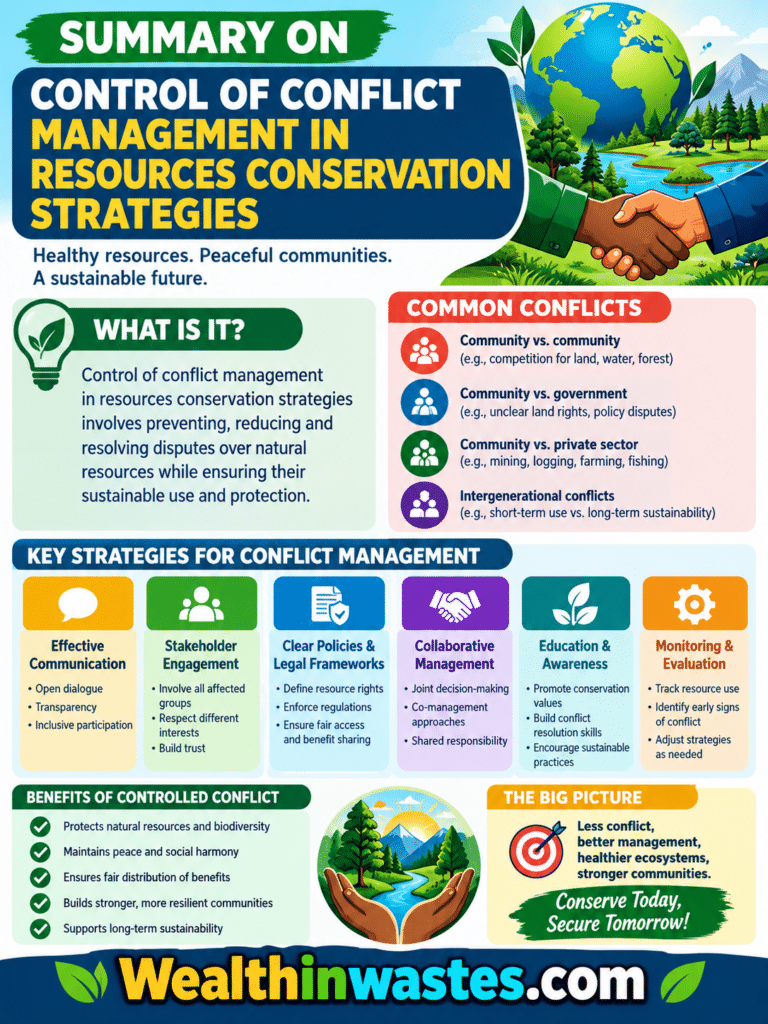
| Topic | Main Points | Expected Outcome |
|---|---|---|
| Conflict Causes | Competition, exclusion, unequal benefits, and weak communication. | Better understanding of disputes and their underlying causes. |
| Management Approaches | Top-down, mixed top-down and bottom-up, and bottom-up management. | Governance that reflects local needs and conservation objectives. |
| Community Participation | Inclusive consultations, shared decisions, and community representation. | Greater trust, local ownership, and cooperation. |
| Fair Benefits | Transparent revenue sharing, sustainable livelihoods, and reduced wildlife losses. | Improved livelihoods and stronger conservation support. |
| Conflict Resolution | Dialogue, mediation, fair rules, monitoring, and complaint procedures. | Fewer disputes and more accountable decisions. |
| Law and Education | Clear regulations, environmental education, monitoring, and coordination. | Better compliance and long-term resource protection. |
Frequently Asked Questions About Conflict Management in Resources Conservation Strategies
1. What Is Conflict Management in Resources Conservation?
It is the process of preventing, addressing, and resolving disagreements about access to natural resources while balancing biodiversity protection, local livelihoods, legal rights, and long-term ecosystem health through dialogue, negotiation, and fair rules.
2. What Causes Conflicts in Resource Conservation?
Conflicts commonly emerge when protected-area restrictions limit farming, grazing, fishing, or cultural practices, especially where residents lack consultation, fair benefits, clear rights, alternative income opportunities, and reliable complaint procedures for affected families.
3. What Are the Main Conservation Management Approaches?
Top-down management concentrates decisions with authorities; mixed management combines authority with consultation; bottom-up management gives communities a larger role in planning, monitoring, and local resource-use decisions, when legal arrangements and local capacity allow.
4. How Can Managers Resolve Conservation Disputes?
Managers can build trust through early consultation, neutral mediation, transparent rules, fair benefit-sharing, written agreements, accessible complaint channels, and regular reviews involving all affected groups, including residents with less political influence.
5. Why Is Community Participation Important?
Community participation can improve local knowledge, accountability, rule acceptance, monitoring, and fairer distribution of costs and benefits. It also helps managers identify practical livelihood alternatives before disputes worsen for nearby households.
6. How Can Conservation Reduce Human-Wildlife Conflicts?
Park authorities should assess compensation options, document crop or livestock damage, verify claims fairly, and pair payments with prevention measures such as alerts, barriers, and community response teams where locally appropriate.
Do you have any questions, suggestions, or contributions? If so, please feel free to use the comment box below to share your thoughts. We also encourage you to kindly share this information with others who might benefit from it. Since we can’t reach everyone at once, we truly appreciate your help in spreading the word. Thank you very much for your support and for sharing!
Read Also: Conservation and Management of Natural Resources in Agriculture