


Crude oil comes from different geological sources, organic materials, source rocks, and reservoir conditions. Consequently, its chemical composition can vary substantially between oil fields and even between wells within one field.
The composition of crude oil matters because it influences processing requirements, product yields, environmental behaviour, market value, demand, and selling price. Understanding its major constituents therefore helps explain why crude oils differ commercially.
Crude oil is not a single chemical substance. Instead, it is a complex mixture dominated by hydrocarbons, together with smaller quantities of sulphur, nitrogen, oxygen, metallic compounds, salts, and other trace materials.
These constituents occur in different proportions depending on the crude source, maturity, geological history, and reservoir conditions. Such differences create variations in density, viscosity, boiling range, sulphur level, and refining behaviour.
Crude oil composition is often discussed by grouping compounds into hydrocarbon families and non-hydrocarbon compounds. Those groups provide a practical framework for understanding petroleum properties, processing challenges, and product potential.
Understanding Crude Oil Composition
Crude oil composition reflects the materials and geological conditions that produced it. Different source rocks, organic materials, temperatures, pressures, and reservoir histories can produce oils with noticeably different chemical characteristics.
Information about the geological origin of petroleum helps explain why petroleum composition changes from one location to another. Marine and terrestrial organic materials can contribute different molecular structures, affecting the resulting crude oil characteristics.
Crude oils may also change in composition during migration, accumulation, and geological alteration. These processes can influence the distribution of hydrocarbons and the concentration of sulphur, nitrogen, oxygen, metals, and other compounds.
Such variation makes petroleum transformation processes important when interpreting crude oil properties. The composition eventually determines how efficiently a refinery can separate, convert, treat, and upgrade different petroleum fractions for overall product quality.
A useful way to study crude oil composition is to divide its constituents into hydrocarbons and non-hydrocarbon compounds. Hydrocarbons provide most of the material, while the remaining groups influence processing and environmental performance.
Read Also: Mechanisms of Petroleum Migration and Petroleum Occurrence
Hydrocarbon Components in Crude Oil

Hydrocarbons contain only carbon and hydrogen and form the principal chemical portion of crude oil. Their structures range from relatively small molecules to large, complex molecules found mainly in heavier petroleum fractions.
1. Distilled Hydrocarbons: Distilled petroleum fractions contain different proportions of paraffins, naphthenes, aromatics, and heavier compounds. Their distribution affects boiling ranges and the products that refineries can produce from particular crude oils.
2. Fuel Hydrocarbons: Hydrocarbon fuels commonly originate from petroleum mixtures containing many hydrocarbon structures. Crude oil itself is not a finished fuel; refining separates and converts its components into gasoline, kerosene, diesel, and other products.
3. Major Families: Petroleum hydrocarbons can be grouped into three major families: alkanes, cycloalkanes, and aromatic hydrocarbons. Their relative abundance helps describe crude types and influences density, viscosity, volatility, octane characteristics, and processing requirements.
4. Resource Context: Understanding natural resource classifications also places crude oil within the broader group of non-renewable resources. Its finite nature increases the importance of efficient recovery, processing, use, conservation, and environmental management.
Alkane Paraffin in Crude Oil
Alkanes, also called paraffins, are saturated hydrocarbons containing straight or branched carbon chains. They follow the general molecular formula CnH2n+2 and represent a major hydrocarbon family within many crude oils.
1. Straight-Chain Alkanes: These compounds contain unbranched carbon chains and are commonly called normal alkanes or n-paraffins. Their boiling points generally increase as molecular size increases across the petroleum mixture.
2. Branched Alkanes: These saturated hydrocarbons contain side branches attached to a main carbon chain. Branching changes physical and combustion properties, making isomer distribution important when assessing petroleum fractions and gasoline quality.
3. Light Alkanes: Methane, ethane, propane, and butane contain relatively few carbon atoms and occur mainly in petroleum-associated gases. Methane forms the principal component of petroleum as a fossil fuel, while ethane and propane also occur in varying amounts.
4. Refinery Importance: Alkanes contribute to fuel fractions and can undergo conversion processes that improve product quality. Non-renewable resource conservation supports more efficient use of these finite petroleum resources in modern refineries.
Cycloalkanes And Naphthenes in Crude Oil

Cycloalkanes, commonly called naphthenes, are saturated hydrocarbons whose carbon atoms form rings. They represent another important part of crude oil and commonly occur in light, middle, and heavier petroleum fractions.
1. Ring Structures: Common lower naphthenes include cyclopentane and cyclohexane, together with substituted forms. These compounds occur naturally in crude oil and support interpretation of petroleum migration mechanisms within petroleum systems.
2. Crude Type: The proportion of paraffinic and naphthenic hydrocarbons helps characterize crude oils. A crude richer in straight and branched saturated hydrocarbons may show different physical behaviour from one containing more cyclic saturated compounds.
3. Fused Rings: Heavier petroleum fractions may contain fused cyclohexane rings and bicyclic structures. Their larger molecular structures contribute to the complexity of kerosene, gas oil, and other higher-boiling petroleum fractions.
4. Aromatic Precursors: Some naphthenes can undergo dehydrogenation during processing to produce aromatic compounds. For example, methylcyclohexane can form toluene, while related cyclic compounds contribute to refinery aromatic production and natural resource management.
Aromatic Hydrocarbons in Crude Oil
Aromatic hydrocarbons contain stable ring structures and occur in crude oils in proportions that vary with crude type. Important examples include benzene, toluene, and xylene, commonly grouped together as BTX compounds.
These compounds relate closely to petroleum chemistry because petroleum water pollution can involve complex mixtures of hydrocarbons when petroleum products or crude oil enter aquatic environments through spills and discharges.
Aromatic compounds usually occur in smaller quantities in lighter fractions, while more complex aromatic structures become increasingly important in heavier fractions. Oil pollution effects can therefore involve chemically diverse petroleum components.
BTX compounds have commercial importance because refineries and petrochemical industries use them as valuable intermediates. Aromatics also influence gasoline characteristics, while heavier aromatic molecules contribute to the complex chemistry of residual petroleum materials.
Complex mixtures of aromatic and heterocyclic structures contribute to asphaltene materials and other heavy crude components. Their presence can increase processing difficulty and make detailed molecular characterization more challenging during refinery operations.
Non-Hydrocarbon Compounds in Crude Oil
Non-hydrocarbon compounds contain elements besides carbon and hydrogen and occur throughout crude oil, particularly heavier fractions. Major groups include sulphur, nitrogen, oxygen, and metallic compounds, each affecting overall processing behaviour.
These constituents can affect industrial waste impacts because petroleum processing can generate wastes containing oils, chemicals, metals, and other contaminants. Effective treatment and control protect refinery equipment, workers, and surrounding environments.
1. Sulphur Compounds: Crude oil mainly contains organosulphur compounds, although hydrogen sulphide may also occur. Sulphur compounds can promote corrosion and hazardous waste sources while contributing to concerns surrounding sulphur emissions from fuels.
2. Nitrogen Compounds: Organic nitrogen compounds commonly occur as heterocyclic structures. They can poison refinery catalysts and therefore require treatment, especially when processing heavier crude oils containing higher nitrogen concentrations.
3. Oxygen Compounds: Oxygen-containing compounds include acids, phenols, ethers, esters, carbonyls, and related materials. Their concentration varies among crude oils and contributes to differences in acidity and chemical behaviour.
4. Metallic Compounds: Trace metals such as vanadium and nickel may occur in organic complexes, while sodium, magnesium, calcium, and elements can occur as inorganic salts. These substances complicate crude processing and industrial waste sources.
Sulphur And Nitrogen Compounds

Sulphur and nitrogen compounds deserve special attention because both can interfere with refinery operations. Their concentrations differ among crude oils, and heavier petroleum commonly contains greater amounts of these unwanted constituents.
1. Sour and Sweet Crude: Crude oil with higher sulphur content is generally described as sour, while lower-sulphur crude is commonly called sweet. Sulphur content strongly influences treatment needs and crude market value.
2. Sulphur Removal: Refineries reduce sulphur through treatment processes designed to remove hydrogen sulphide and convert troublesome organic sulphur compounds. These operations increase processing requirements when the incoming crude contains substantial sulphur.
3. Basic Nitrogen: Basic nitrogen compounds include pyridine, quinoline, isoquinoline, and acridine structures. These compounds can interfere with catalytic processing, making nitrogen removal important for efficient refinery operation and safer industrial wastewater sources management.
4. Porphyrins: Porphyrins are complex nitrogen-containing compounds related to porphine. Their structures can incorporate metals and provide useful clues about petroleum origin, organic matter sources, and biological materials involved in petroleum formation.
Oxygen And Metallic Compounds
Oxygen-containing and metallic compounds complete the major non-hydrocarbon groups considered in crude oil composition. Although their quantities may be relatively small, they can strongly influence acidity, desalting, catalyst performance, and refinery equipment.
1. Oxygen Compounds: Acidic oxygen compounds include carboxylic acids, cresylic acids, phenols, and naphthenic acids. Non-acidic examples include ethers, esters, carbonyls, and amides, which vary between crude oils and influence watershed pollution.
2. Vanadium and Nickel: Vanadium and nickel occur prominently among petroleum metals and may associate with complex porphyrin structures. Their presence is undesirable because they can poison catalysts and promote unwanted reactions during conversion.
3. Inorganic Salts: Sodium, magnesium, calcium, iron, and aluminium may occur as inorganic salts, including chlorides. Calcium and magnesium can contribute to emulsions, while chloride salts can generate hydrochloric acid during processing.
4. Processing Effects: Refineries use desalting, hydrotreatment, and other treatment steps to reduce troublesome compounds. Managing these contaminants protects equipment, improves conversion processes, and supports pollution control concepts during crude refining.
Read Also: Roles of Producers and Corporations in Waste Management
Elemental Composition of Crude Oil

The broad elemental composition of crude oil shows why petroleum behaves as a complex mixture rather than a single substance. Carbon and hydrogen dominate, while nitrogen, oxygen, sulphur, and metals occur in smaller proportions.
| Element or Component | General Composition |
|---|---|
| Carbon | 83.0% to 87.0% |
| Hydrogen | 10.0% to 14.0% |
| Nitrogen | 0.1% to 2.0% |
| Oxygen | 0.05% to 1.5% |
| Sulphur | 0.05% to 6.0% |
| Metals (Ni and V) | <1000 ppm |
Published composition ranges can vary considerably with crude source and analytical method. The figures supplied for this article provide a useful general guide rather than a universal composition for every crude oil.
Economic losses from pollution demonstrate why crude oil composition matters beyond refinery operations. Contaminants and petroleum releases can create treatment expenses, environmental damage, production losses, and wider socioeconomic costs for affected communities.
Likewise, air pollution from petroleum connects crude composition with environmental concerns. Sulphur, nitrogen, hydrocarbons, and other constituents can significantly contribute to pollutants generated during petroleum processing, transportation, and fuel combustion.
Overall, understanding the composition of crude oil helps explain its economic value, refining behaviour, environmental effects, and product potential. Each crude requires appropriate assessment before detailed processing decisions are made safely.
Summary on Key Components and Composition of Crude Oil
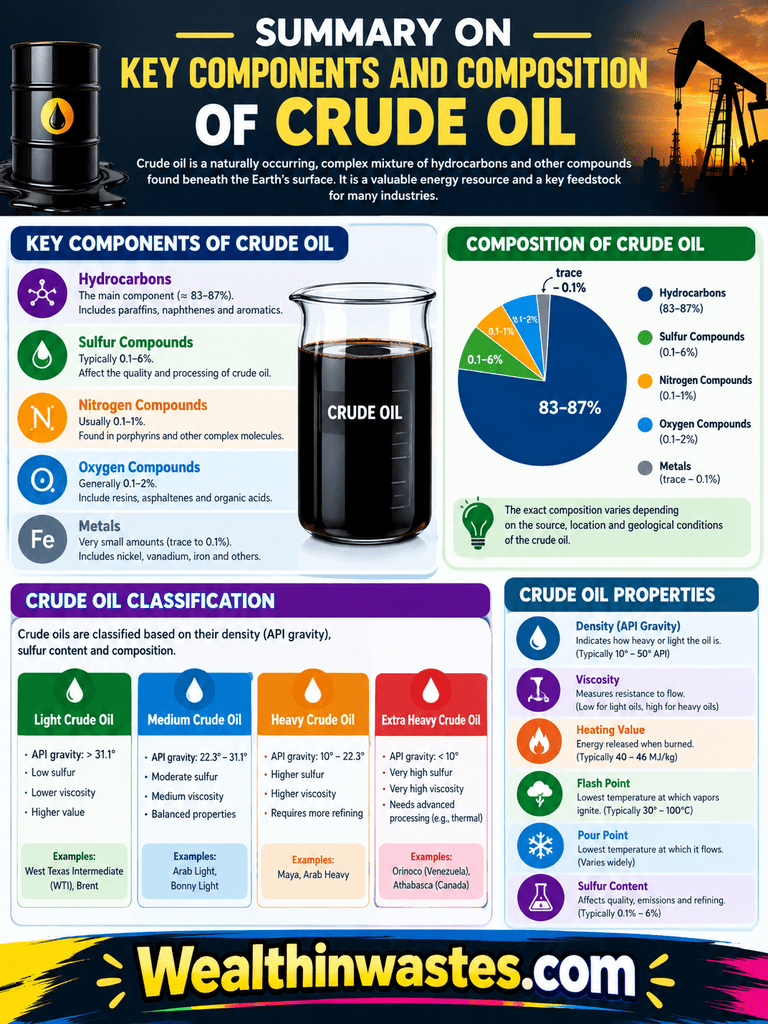
| Composition Group | Major Examples | Importance |
|---|---|---|
| Alkanes | Methane, ethane, propane, butane, n-alkanes, branched alkanes | Major saturated hydrocarbon family contributing to petroleum fuels |
| Cycloalkanes | Cyclopentane, cyclohexane, substituted and fused rings | Important saturated cyclic constituents influencing crude type |
| Aromatics | Benzene, toluene, xylene, heavier aromatic structures | Important for petrochemical production and fuel characteristics |
| Sulphur Compounds | Hydrogen sulphide, thiols, thiophenes, sulphides, disulphides | Influence corrosion, treatment costs, emissions, and crude value |
| Nitrogen Compounds | Pyridine, quinoline, isoquinoline, acridine, porphyrins | Can poison catalysts and increase hydrotreatment requirements |
| Oxygen Compounds | Carboxylic acids, phenols, ethers, esters, carbonyls | Influence acidity and chemical behaviour of crude |
| Metallic Compounds | Vanadium, nickel, sodium, magnesium, calcium, iron | Can poison catalysts, form emulsions, and cause corrosion |
| Major Elements | Carbon and hydrogen, with smaller amounts of N, O, S, metals | Describe the overall elemental nature of crude oil |
Frequently Asked Questions About Composition of Crude Oil: Key Components and Properties
1. What is the composition of crude oil?
Crude oil is a complex mixture dominated by hydrocarbons, together with sulphur, nitrogen, oxygen, metallic compounds, salts, and other trace materials.
2. What are the main hydrocarbons in crude oil?
The main hydrocarbon families are alkanes, cycloalkanes, and aromatic hydrocarbons, although their proportions vary significantly among crude oil sources.
3. Why does crude oil composition vary?
Composition varies because crude oils originate from different organic materials, source rocks, geological conditions, maturation histories, migration processes, and reservoir environments.
4. What are alkanes in crude oil?
Alkanes are saturated straight-chain or branched hydrocarbons with the general formula CnH2n+2. They form a major hydrocarbon family in crude oil.
5. What are naphthenes?
Naphthenes are saturated cyclic hydrocarbons, also called cycloalkanes. Common examples include cyclopentane, cyclohexane, and substituted ring structures.
6. Why is sulphur important in crude oil?
Sulphur affects crude quality, treatment requirements, corrosion, emissions, catalyst performance, and market value. Higher-sulphur crude generally requires more extensive processing.
7. What metals occur in crude oil?
Vanadium and nickel commonly occur among petroleum metals, while sodium, magnesium, calcium, iron, and aluminium may also occur, particularly in inorganic salt forms.
8. What is the major element in crude oil?
Carbon is the major element, generally accounting for about 83% to 87% of crude oil, while hydrogen forms roughly 10% to 14%.
Do you have any questions, suggestions, or contributions? If so, please feel free to use the comment box below to share your thoughts. We also encourage you to kindly share this information with others who might benefit from it. Since we can’t reach everyone at once, we truly appreciate your help in spreading the word. Thank you very much for your support and for sharing!
Read Also: Water Pollution And Its Agricultural Implications