


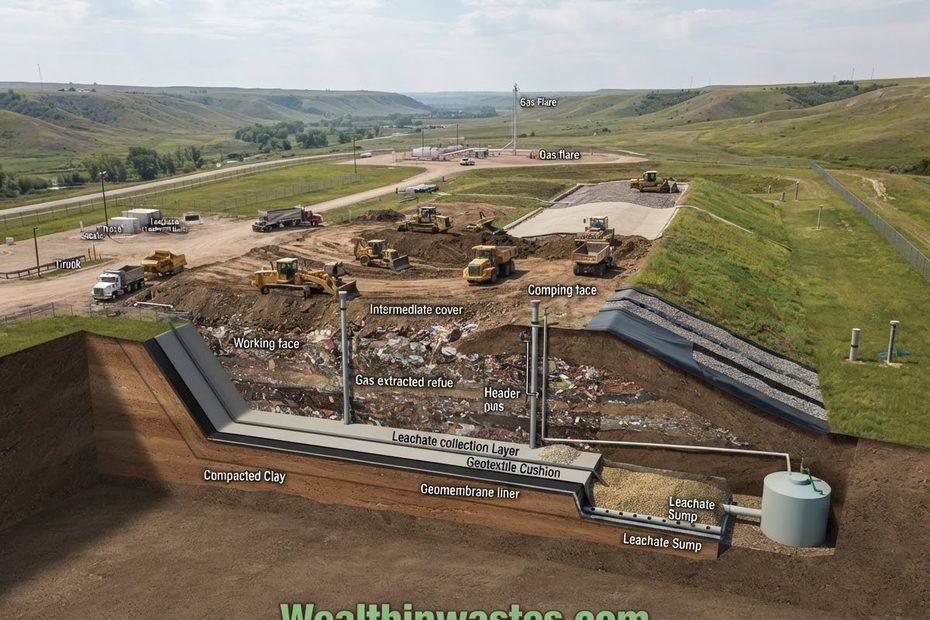
Sanitary landfills provide controlled facilities for receiving and containing solid waste while reducing risks to public health, surrounding communities, soil, surface water, groundwater, and the atmosphere through engineered disposal practices.
Unlike uncontrolled dumpsites, modern sanitary landfills use planned cells, protective liners, drainage systems, gas controls, monitoring wells, access roads, and carefully managed cover materials throughout their operating life.
The success of landfill management depends on suitable site conditions, sound engineering, trained operators, adequate equipment, environmental monitoring, maintenance programmes, and strict adherence to approved waste acceptance and operating procedures.
Understanding the components of a landfill helps readers recognize how individual systems work together, especially when controlling contaminated liquids, rainfall, landfill gases, waste movement, groundwater risks, and final site restoration.
Landfill operation also follows a coordinated sequence that starts when waste arrives and continues through inspection, weighing, placement, spreading, compaction, covering, monitoring, environmental protection, and equipment maintenance each working day.
What Is a Sanitary Landfill?
A sanitary landfill is an engineered disposal facility where acceptable solid waste is placed in planned areas, compacted into controlled layers, covered regularly, and managed to reduce environmental and public-health risks.
The basic purpose of sanitary landfilling is to isolate waste from surrounding environmental systems while controlling the liquids, gases, odours, pests, traffic, and surface conditions created during daily operations.
A properly designed facility differs greatly from an open dumpsite because it combines engineered containment with operational controls, environmental monitoring, waste acceptance procedures, drainage management, and long-term maintenance.
The structure and operating principles of a sanitary landfill are explained further in this comprehensive explanation of sanitary landfills, which provides useful background.
Landfill construction begins with careful assessment of the proposed location because geology, soil, groundwater, drainage, climate, accessibility, and surrounding land use can influence containment and environmental performance.
Good landfill site selection practices therefore help determine whether a proposed location can support safe construction while reducing potential impacts on water resources and nearby communities.
Landfilling should also remain part of a broader waste-management strategy because reduction, reuse, recycling, treatment, and recovery can decrease the quantity of materials requiring final disposal.
The relationship between landfill disposal and the wider waste-management process becomes clearer when examining the main elements of solid waste management that precede final disposal.
Read Also: Elements of Solid Waste Management Processes
Main Components of a Landfill
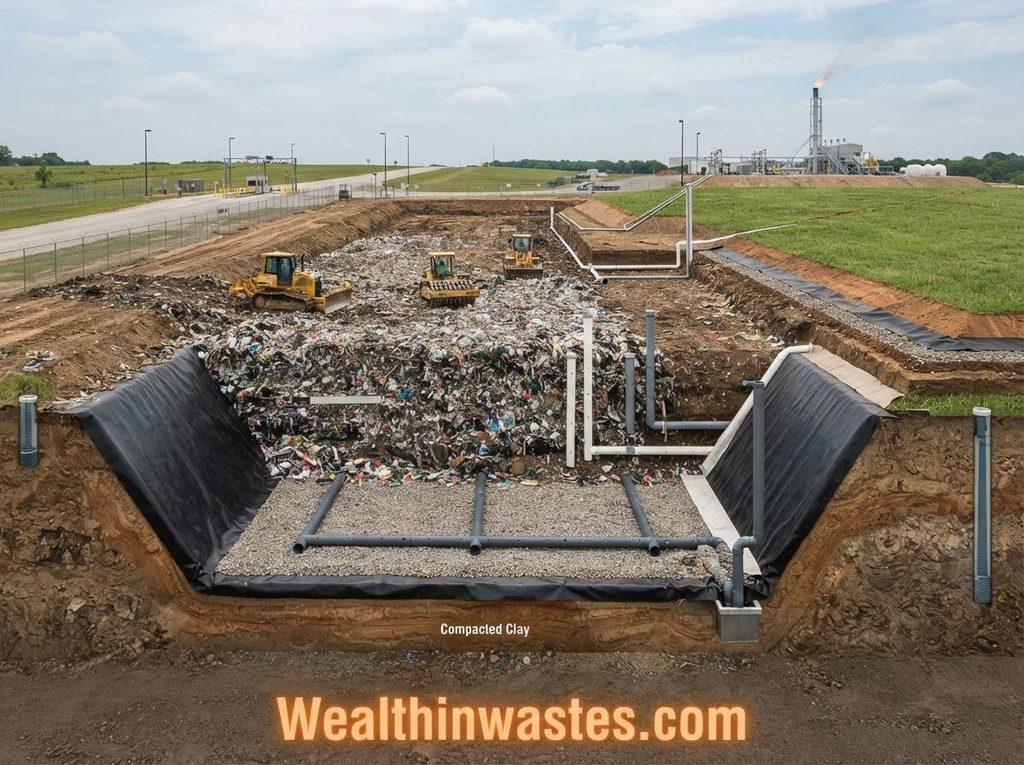
1. Bottom Liner: The bottom liner separates buried waste from natural soil and helps control contaminant movement. Facilities may combine compacted clay with synthetic membranes to strengthen containment performance.
2. Landfill Cells: Cells provide planned areas for waste placement, spreading, compaction, and covering. Their design allows operators to develop disposal space gradually while maintaining traffic routes, drainage, stability, and operational control.
3. Leachate Collection System: Drainage layers and perforated pipes collect contaminated liquid generated inside the waste mass. The system directs leachate toward sumps where operators can remove it for controlled management.
4. Stormwater Drainage: Channels, berms, ditches, drains, and retention structures guide rainfall runoff away from active disposal areas. Proper drainage reduces erosion, flooding, unnecessary infiltration, and excessive leachate generation.
5. Landfill Gas System: Decomposing organic waste can generate methane, carbon dioxide, and other gases. Collection wells and pipes capture landfill gas and support controlled venting, flaring, treatment, or energy recovery.
6. Cover System: Daily and final covers limit waste exposure, reduce odours, discourage pests, control litter, support drainage, and restrict rainfall infiltration into completed disposal areas and operating cells.
7. Groundwater Monitoring Wells: Monitoring stations provide information about groundwater quality around the landfill. Up-gradient and down-gradient wells help operators identify unusual changes that may require investigation or corrective action.
The performance of several components depends on waste composition, moisture, particle size, permeability, and other properties. The characteristics of municipal solid waste therefore influence landfill behaviour.
Waste characterization also supports landfill planning because operators need reliable information about the materials entering a facility. Proper waste characterization and analysis can improve disposal decisions.
Landfill Cells and Liner Systems
Landfill cells organize the waste mass into manageable sections that operators can construct, fill, compact, cover, and close progressively rather than spreading refuse across the entire facility.
Each cell should fit the overall landfill design, available airspace, expected waste quantities, equipment capability, drainage layout, liner configuration, and future development requirements throughout the facility’s useful life.
Operators develop working areas according to the approved site plan, ensuring waste placement remains inside engineered boundaries while protecting completed sections from unnecessary disturbance, erosion, and damage.
The liner system plays a crucial role because it creates a low-permeability barrier beneath the waste and reduces downward migration of contaminated liquids into underlying geological materials.
Good landfill design begins with appropriate geological and soil conditions because natural materials can influence containment, excavation, drainage, slope stability, and contaminant movement beneath disposal areas.
The principles described under environmental factors affecting disposal-site selection are important because unsuitable ground conditions can increase engineering challenges and environmental risks.
Waste placement should protect liners from unnecessary damage by using appropriate equipment practices, controlled tipping procedures, suitable lift thicknesses, and careful traffic management inside active disposal areas.
The facility can also preserve valuable airspace when operators maintain accurate records, compact waste effectively, design cells carefully, and limit unnecessary land disturbance during routine disposal activities.
Leachate and Stormwater Control
1. Leachate Collection: Leachate forms when water contacts waste and extracts soluble or suspended materials. Drainage layers and collection pipes move the liquid toward designated sumps for controlled removal.
2. Leachate Management: Collected leachate requires appropriate storage, treatment, recirculation where approved, discharge, or off-site management. The selected approach depends on regulatory requirements, composition, volume, and treatment capacity.
3. Surface Drainage: Stormwater channels intercept rainfall before it reaches active waste. Separating clean runoff from contaminated areas helps reduce leachate production and prevents uncontrolled water movement across disposal surfaces.
4. Retention Structures: Ponds, basins, and related structures temporarily hold runoff while sediments settle. These facilities help control erosion and provide operators with better management of stormwater during intense rainfall.
Waste moisture strongly influences leachate generation because materials differ in their capacity to absorb, retain, release, and transmit water through compacted landfill layers.
The classification and composition of solid waste can therefore help operators understand the kinds of materials entering cells and anticipate different moisture-management requirements.
Operators must inspect drainage channels regularly and remove obstructions before they reduce flow capacity. Good maintenance limits flooding, erosion, ponding, and unexpected water contact with buried waste.
Facilities should also account for extreme rainfall when designing drainage structures because undersized systems may overflow, damage landfill slopes, expose waste, and increase the movement of contaminated water.
Landfill Gas and Groundwater Monitoring

1. Gas Collection Wells: Vertical or horizontal collection systems capture landfill gases generated during biological decomposition. Pipes then transport the gas toward treatment, flaring, controlled release, or energy-recovery equipment.
2. Methane Control: Methane requires careful management because accumulation can create fire, explosion, odour, and climate-related concerns. Gas control systems reduce uncontrolled migration and support safer landfill operation.
3. Groundwater Wells: Monitoring wells allow operators to collect samples from groundwater surrounding a landfill. Regular testing helps identify changes in chemical indicators that may require investigation and corrective measures.
4. Environmental Records: Operators maintain monitoring results, inspection findings, maintenance records, gas data, leachate information, and waste quantities to demonstrate control and support long-term facility management.
Landfill gas management deserves attention because decomposing organic materials can generate gas for many years. The environmental implications are discussed further in landfill emissions and their environmental impact.
Groundwater monitoring becomes particularly important where site hydrogeology creates potential pathways for contaminants to move. Monitoring data can reveal unexpected changes before problems become more difficult to address.
The surrounding waste stream also matters because hazardous materials can introduce additional risks. Operators should apply strict acceptance procedures and use appropriate hazardous-waste disposal practices where necessary.
Environmental monitoring should continue after landfill closure because gas generation, settlement, leachate movement, and groundwater conditions can persist after active waste placement ends.
Daily Landfill Operation Steps
1. Waste Arrival: Collection vehicles enter through designated access points, where staff direct traffic, check documentation, and apply site safety rules before vehicles proceed toward the disposal area.
2. Weighing and Inspection: Operators record incoming waste quantities and inspect loads when required. This process helps confirm compliance with acceptance rules and identify materials requiring alternative handling.
3. Controlled Tipping: Accepted vehicles travel to the active working face and unload within designated boundaries. Operators maintain traffic control so unloading does not interfere with equipment or workers.
4. Waste Placement: Bulldozers or compactors spread incoming materials into controlled lifts. Operators maintain the planned slope, thickness, working area, and cell geometry during placement.
5. Waste Compaction: Heavy equipment repeatedly passes over each lift to reduce volume and improve density. Effective compaction increases usable airspace while supporting stability for future waste layers.
6. Daily Cover: Operators cover compacted waste with approved soil or alternative materials before the end of the operating period. Cover limits odour, pests, litter, fire risk, and exposure.
7. Vehicle Exit: Vehicles leave through designated routes and may pass wheel-cleaning facilities before returning to public roads. Weight records can also support operational statistics and billing.
These activities work best when the landfill forms part of an integrated system that includes collection, transportation, treatment, recovery, and final disposal, as described in the essential waste-management framework.
Waste acceptance procedures should also consider the material categories arriving at the site. Understanding different solid waste types and sources can improve inspection and handling decisions.
Read Also: Traditional Solid Waste Disposal Methods
Waste Compaction and Daily Cover
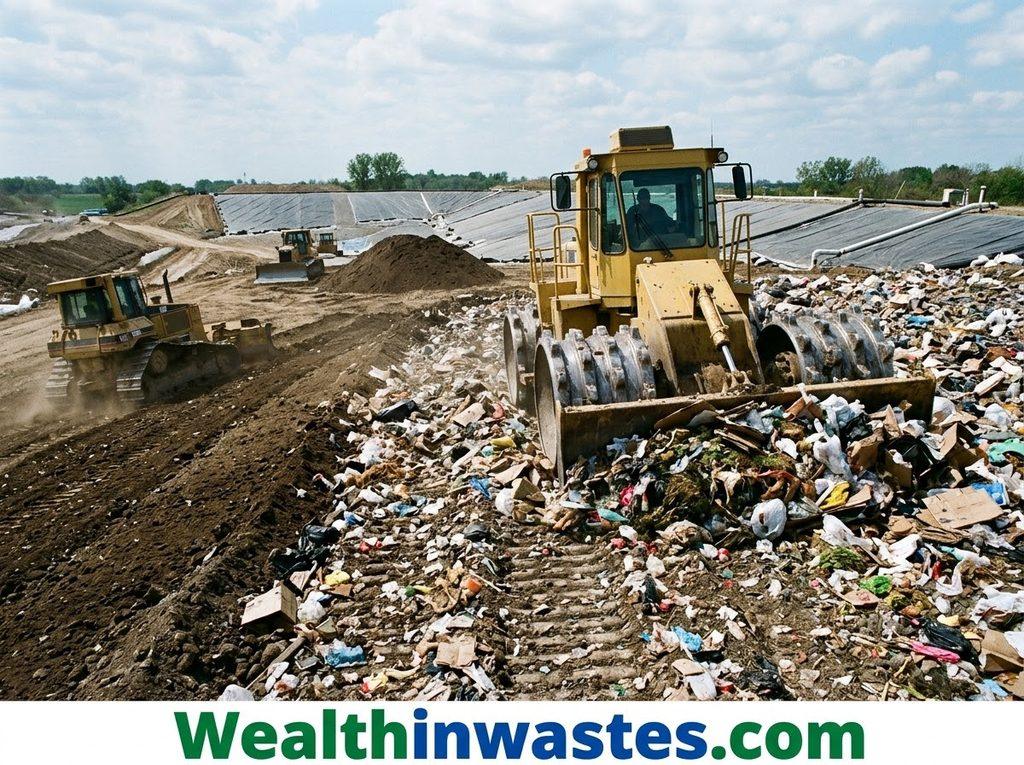
Waste compaction is one of the most important operational activities because it reduces the volume occupied by refuse, increases available airspace, improves stability, and supports orderly cell development.
Compactors achieve better results when operators spread waste evenly and maintain suitable lift thicknesses. Repeated passes then compress the material into a denser and more stable landfill mass.
Good compaction also reduces void spaces that can compromise equipment movement, slope stability, and subsequent waste placement. Operators should inspect working areas continuously to maintain consistent compaction quality.
Daily cover provides another essential control by separating freshly compacted waste from the surrounding environment. Soil or approved alternatives can help control odours, pests, litter, fire, and rain infiltration.
Operators may use alternative cover materials where regulations permit, provided these materials achieve the required performance and remain compatible with the facility’s drainage, gas, safety, and operational needs.
Cover requirements become easier to understand when waste reduction occurs before disposal. The proper waste reduction process can lower the quantity requiring landfill placement.
Recycling provides another opportunity to conserve landfill capacity by diverting recoverable materials from disposal. Facilities benefit when communities strengthen the proper waste recycling process before collection.
Organic materials can also leave the disposal stream through composting and other recovery methods. Diverting suitable biodegradable materials can reduce the waste burden and extend the useful life of landfill cells.
Environmental Safety and Capacity Management
Landfill safety covers workers, vehicle operators, surrounding residents, environmental resources, and the facility itself. Daily inspections help identify hazards involving traffic, slopes, equipment, fire, litter, gas, and drainage.
Operators should maintain safe access roads and working surfaces because poor traffic conditions increase collision risks, equipment delays, dust generation, and difficulties during wet-weather operations.
Waste storage and collection before landfill delivery also influence site performance. Proper hygienic waste storage practices can reduce nuisance conditions before materials reach the facility.
Landfill management should prevent unsuitable materials from entering ordinary disposal cells. Hazardous, infectious, reactive, corrosive, or otherwise restricted wastes may require specialized treatment or dedicated disposal controls.
Environmental impacts can extend beyond the landfill boundary when leachate, gas, dust, odours, runoff, or litter escape established control systems. The health and environmental impacts of waste show why control matters.
Capacity management also requires looking beyond disposal itself. The three principles of reducing, reusing, and recycling can decrease the amount of waste entering landfill cells.
Some organic materials can support recovery initiatives instead of final disposal. Exploring beneficial uses of biodegradable waste can create additional diversion opportunities.
Landfill operators should review waste quantities, remaining airspace, environmental data, equipment condition, and maintenance needs regularly to support reliable capacity planning throughout the facility’s operational period.
Summary on Components of a Landfill and Landfill Operation Guide
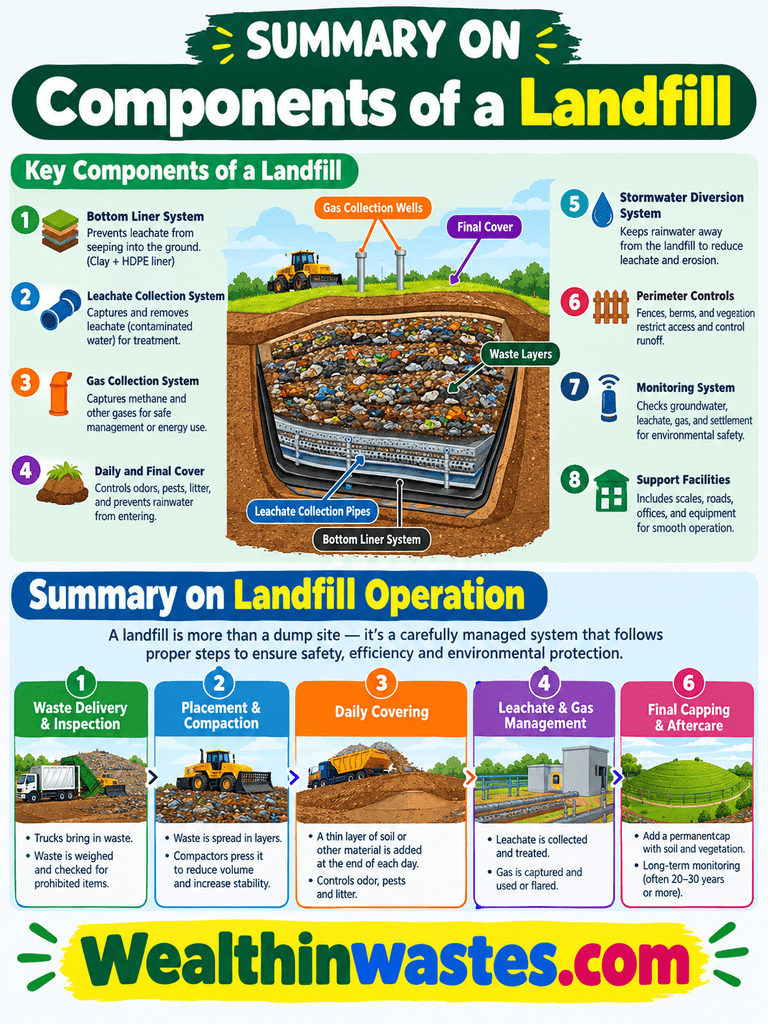
| Component or Activity | Primary Function |
|---|---|
| Bottom liner | Separates waste from underlying soil and limits downward movement of contaminated liquids. |
| Landfill cells | Provide controlled areas for waste placement, compaction, covering, and progressive site development. |
| Leachate collection | Collects contaminated liquid and directs it toward sumps for controlled management. |
| Stormwater drainage | Controls rainfall runoff and reduces unnecessary water entry into active waste areas. |
| Landfill gas system | Captures gas and supports controlled venting, flaring, treatment, or energy recovery. |
| Cover system | Controls odours, litter, pests, rainfall infiltration, and direct waste exposure. |
| Groundwater monitoring | Tracks water quality and helps identify possible changes associated with landfill operations. |
| Waste compaction | Reduces waste volume, improves stability, and increases usable landfill capacity. |
| Waste inspection | Confirms incoming materials meet facility acceptance requirements and identifies restricted loads. |
| Daily operation | Coordinates receiving, placement, compaction, covering, monitoring, safety, and environmental control. |
Frequently Asked Questions About Components of a Landfill and Landfill Operation Guide
1. What are the main components of a sanitary landfill?
Major components include bottom liners, landfill cells, leachate collection systems, stormwater controls, gas collection systems, cover systems, monitoring wells, access facilities, and operational infrastructure.
2. Why does a landfill need a liner?
A liner creates a protective barrier beneath waste and helps reduce the downward movement of contaminated liquids into surrounding soil and groundwater beneath the landfill.
3. What is leachate in landfill operation?
Leachate is contaminated liquid associated with waste. Landfill drainage systems collect it and direct it toward sumps or other facilities for controlled storage, treatment, discharge, or management.
4. Why is landfill gas collected?
Landfill gas contains methane and other gases produced during decomposition. Collection systems reduce uncontrolled gas movement and support safe treatment, flaring, venting, or energy recovery.
5. Why do operators compact landfill waste?
Compaction reduces waste volume, improves stability, increases available airspace, and produces a more orderly waste mass for subsequent lifts, cover placement, and cell development.
6. Why is daily cover necessary?
Daily cover reduces odours, litter, pest activity, exposure, fire risk, and rainfall infiltration while keeping the active working face safer, cleaner, and easier to manage.
7. What is the purpose of groundwater monitoring wells?
Monitoring wells provide groundwater-quality information around the landfill and help operators identify unusual changes that could indicate leakage, contamination, or other environmental concerns.
8. How can landfill capacity be extended?
Capacity can be conserved through effective compaction, controlled cell development, waste reduction, recycling, composting, material recovery, accurate airspace planning, and careful operational management.
Do you have any questions, suggestions, or contributions? If so, please feel free to use the comment box below to share your thoughts. We also encourage you to kindly share this information with others who might benefit from it. Since we can’t reach everyone at once, we truly appreciate your help in spreading the word. Thank you very much for your support and for sharing!
Read Also: Management of Nigerian Soils in Agriculture