


Industrial biotechnology applies biological systems, living organisms, and enzymes to make useful products or improve manufacturing processes. Its growing role helps industries increase productivity while responding to economic and environmental pressures.
Instead of depending entirely on energy-intensive chemical methods, manufacturers can use carefully selected microorganisms and enzymes to transform raw materials. These biological processes often operate under milder conditions and may reduce resource consumption.
Industrial biotechnology supports production in sectors such as food, paper, textiles, chemicals, pharmaceuticals, packaging, and bioenergy. Each sector can adapt biological tools to improve product quality, reduce unwanted by-products, or recover valuable materials.
Its value also reaches beyond the factory floor. By turning suitable agricultural residues and organic by-products into useful materials, businesses can create additional income streams and reduce reliance on fossil-based feedstocks.
However, biotechnology does not automatically make every product cheaper or greener. Results depend on the organism, feedstock, production scale, energy source, safety controls, and full environmental impact of the manufacturing system.
Meaning and Scope of Industrial Biotechnology

Industrial biotechnology uses cells, microorganisms, enzymes, and other biological components to produce materials or improve industrial operations. It connects biology with engineering so manufacturers can convert suitable inputs into products more efficiently.
Common tools include fermentation, enzyme-based processing, microbial conversion, and biocatalysis. These methods can help produce food ingredients, industrial chemicals, fuels, fibres, and treatment agents while controlling selected reactions with biological systems.
Understanding the basic meaning of biotechnology helps explain why its uses range from traditional fermentation to advanced manufacturing. The underlying idea remains the practical use of biological activity to achieve a defined purpose.
Some industrial processes use naturally occurring organisms, while others use carefully selected or modified strains. Scientists choose an appropriate biological system according to the desired product, production conditions, cost, safety needs, and required output.
Manufacturers often run these processes inside controlled tanks or reactors where they monitor temperature, acidity, oxygen, nutrients, and mixing. Accurate control encourages consistent performance and helps maintain the quality of the final product.
Biotechnology does not always replace conventional manufacturing completely. Companies may combine biological steps with mechanical separation, heating, purification, or other established operations to achieve reliable performance and meet product specifications.
The scope therefore includes both making new products and improving existing processes. Its greatest value appears when biological methods deliver measurable gains in quality, material efficiency, safety, cost, or environmental performance.
Read Also: Benefits of Biotechnology Application to Agriculture
Key Benefits of Biotechnology Application
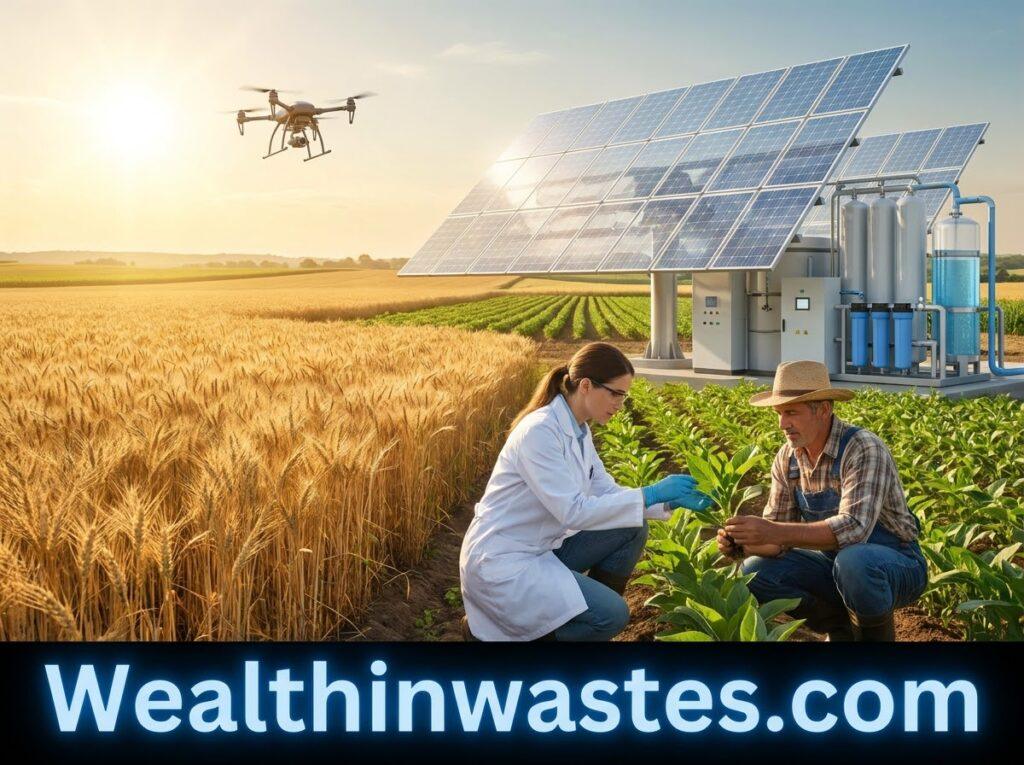
1. Lower Production Costs: Enzymes can speed up selected reactions and reduce the need for harsh chemicals, high temperatures, or repeated processing steps. Companies may therefore lower energy use, material losses, and operating expenses.
2. Better Resource Efficiency: Biological processes can improve the conversion of raw materials into products. Better yields mean manufacturers may obtain more output from each batch and reduce unused material requiring disposal.
3. More Valuable By-products: Some production residues contain fibres, sugars, oils, or nutrients that can support another process. With suitable recovery systems, firms may turn certain by-products into feedstocks, energy, or marketable materials.
4. Improved Product Quality: Enzymes and microorganisms can perform specific tasks with considerable selectivity. In suitable applications, this helps manufacturers control product characteristics, reduce unwanted compounds, and achieve more consistent results between production batches.
5. New Business Opportunities: Biological production creates demand for process operators, laboratory staff, engineers, logistics providers, and feedstock suppliers. Local businesses may also earn income from agricultural waste through reliable collection and preparation.
6. Better Use of Organic Resources: Industries can assess agricultural waste streams as feedstocks instead of treating every by-product as rubbish. Suitable recovery can create income and reduce reliance on virgin resources across manufacturing operations.
How Biotechnology Improves Manufacturing Processes
1. Fermentation: Microorganisms convert sugars and other suitable feedstocks into products such as organic acids, solvents, enzymes, and selected ingredients. Operators control nutrients and process conditions to encourage the desired biological activity.
2. Enzyme-Based Processing: Enzymes help break down or modify specific substances without requiring a living organism throughout the entire production stage. Manufacturers use them in food processing, detergents, textiles, pulp, and other applications.
3. Biocatalysis: Selected biological catalysts can carry out particular chemical reactions with useful selectivity. This can simplify production routes for fine chemicals and ingredients, although performance depends on substrate compatibility and stable operating conditions.
4. Biological Treatment: Microorganisms can reduce biodegradable organic matter in selected process water and wastewater. Treatment may lower pollution loads before discharge, although persistent chemicals still need separate controls and monitoring.
5. Material Recovery: Biological and mechanical steps can work together to recover usable fibres, organic compounds, or other materials from production residues. This complements established waste recycling processes and can reduce demand for virgin inputs.
6. Process Optimisation: Sensors, testing, and process data help engineers maintain consistent biological performance. Facilities handling different manufacturing waste streams must match each treatment method to the material’s composition and risks.
Industrial Sectors That Benefit from Biotechnology
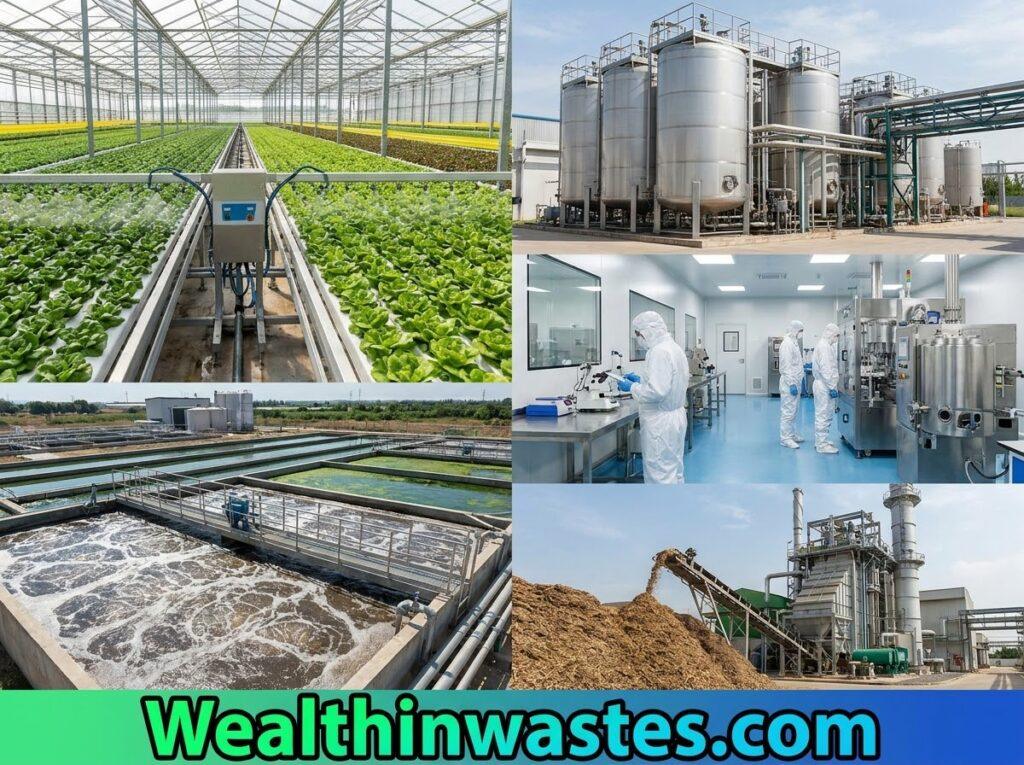
In the food and beverage sector, fermentation supports products such as yoghurt, bread, vinegar, and selected food ingredients. Enzymes can also help manufacturers adjust texture, clarify liquids, or improve processing efficiency.
The paper and pulp industry uses enzymes in selected stages to support fibre processing, improve bleaching performance, or reduce reliance on some harsh chemicals. Results vary with wood sources, mill equipment, and product specifications.
Textile producers may use enzymes in fabric preparation, washing, and finishing. These applications can deliver desired fabric characteristics and may reduce chemical intensity or water demand when factories optimise the full process.
In chemicals and pharmaceuticals, fermentation and biocatalysis can help manufacture vitamins, organic acids, intermediates, and selected active ingredients. Product purity and regulatory requirements remain essential, so companies must validate each process carefully.
Biotechnology can also assist with detergents, personal-care ingredients, biodegradable materials, and some polymers. Industrial buyers should review performance and end-of-life options rather than assume every bio-based material automatically biodegrades in ordinary environments.
Recycling systems form another part of the picture because industrial production can reuse certain recovered materials rather than rely only on new resources. The wider benefits of waste recycling include conservation and reduced disposal needs.
Sector-specific planning matters because one process cannot serve every factory. A manufacturer should evaluate its feedstocks, product standards, wastewater profile, energy supply, equipment, and market before selecting a biological technology.
Many facilities gain the most from combining biotechnology with efficient equipment, water reuse, preventive maintenance, and cleaner production methods. This broader approach to sustainable waste management helps connect factory-level improvements with wider resource goals.
Some businesses can also recover materials before sending residues for final treatment. Applying reuse and recycling alternatives alongside biological processing can keep useful materials in circulation and limit avoidable disposal.
Environmental Benefits of Industrial Biotechnology
1. Potentially Lower Energy Demand: Some enzymes and biological reactions operate at milder temperatures and pressures than conventional alternatives. When the full process confirms the saving, manufacturers can reduce energy demand and associated emissions.
2. Reduced Waste Generation: Higher conversion efficiency can leave less unused feedstock and fewer unwanted by-products. Better separation and recovery may further reduce disposal volumes, though hazardous residues still require suitable handling and treatment.
3. Renewable Feedstock Options: Certain processes use plant sugars, oils, starches, or organic residues. Their value depends on responsible sourcing, protection of soil and mineral resources, transport, and processing impacts.
4. Cleaner Wastewater Management: Biological treatment can reduce biodegradable organic matter in selected wastewater streams before further treatment or discharge. Facilities must still monitor toxicity, nutrients, solids, and pollutants that microorganisms cannot adequately remove.
5. Recovery of Useful Resources: Turning organic residues into energy or materials can reduce uncontrolled disposal and create a more circular production system. A sound plan follows the environmental impacts of waste through each step.
6. Lower Pollution Pressure: Biological processes may reduce selected chemical inputs or emissions, but contaminated feedstocks and untreated discharge remain risks. Facilities must control industrial effluents before they reach surrounding ecosystems.
7. Climate Estimates: Earlier industry assessments projected substantial greenhouse-gas savings from wider adoption, but estimates depend on uptake and assumptions. Companies should use site-specific life-cycle assessments rather than treat headline projections as guaranteed results.
Industrial Biotechnology and Job Creation
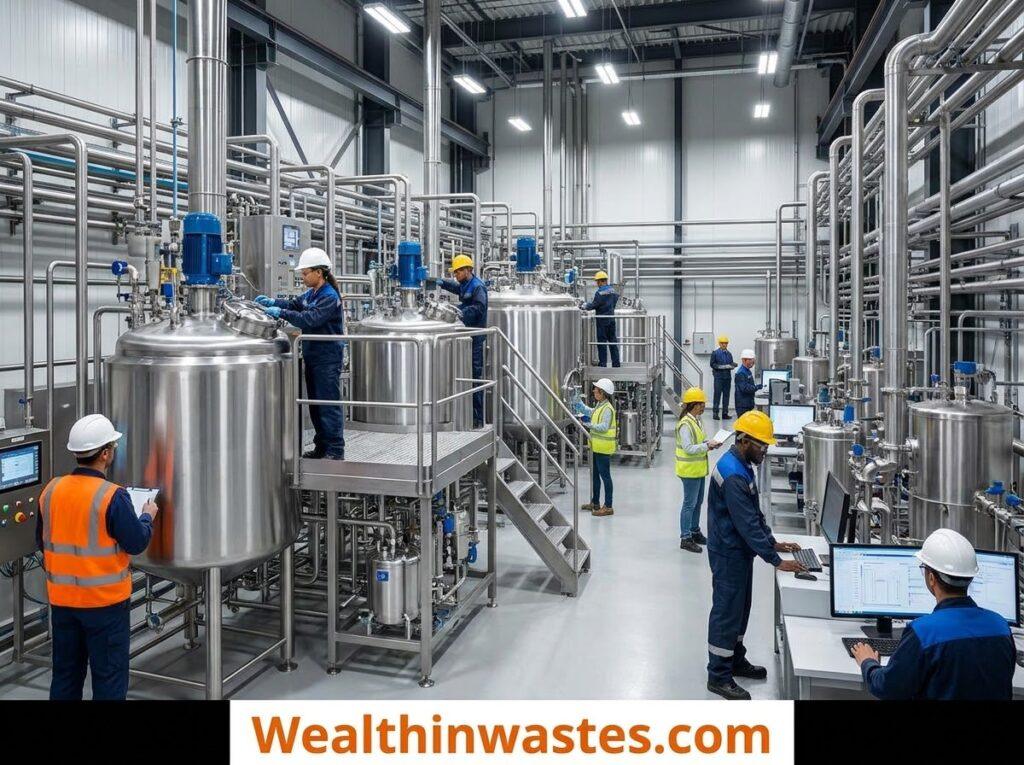
Industrial biotechnology can create jobs in research, production, quality assurance, engineering, equipment maintenance, transport, and feedstock supply. New roles may emerge as companies build pilot plants, scale proven processes, and maintain specialised facilities.
Small and medium-sized businesses may participate by supplying clean residues, producing fermentation inputs, maintaining equipment, or collecting by-products. Local partnerships work best when suppliers understand the factory’s specifications, volumes, schedules, and safety requirements.
Economic benefits also depend on sound waste systems. Clear solid waste management objectives help communities and manufacturers handle recoverable materials safely, prevent contamination, and avoid costs linked to poor disposal practices.
Investment can involve laboratory development, pilot trials, staff training, specialised tanks, quality testing, and reliable utilities. Businesses should compare those costs with expected savings, product demand, operating risks, and the useful life of the equipment.
Government support, industry partnerships, technical education, and access to finance can help promising technologies reach commercial scale. Transparent performance data can build trust among manufacturers, investors, workers, regulators, and nearby communities.
Companies can strengthen these gains by following the main methods of waste management and preventing unnecessary waste at its source. Less waste often means fewer handling steps, lower disposal costs, and better material productivity.
The waste management hierarchy also helps organisations compare prevention, reuse, recycling, recovery, and disposal. Biotechnology provides value when it supports this order rather than encouraging unnecessary processing of materials that should never become waste.
For communities, a functioning bio-based industry can create markets for suitable by-products and improve technical skills. Long-term success still depends on dependable supply, fair working conditions, safety oversight, and products that customers genuinely need.
Waste Conversion and Bioenergy Opportunities
1. Agricultural Residues: Straw, husks, bagasse, fruit residues, and other clean organic materials may provide feedstocks for selected industrial processes. Their suitability depends on moisture, composition, seasonal availability, contamination, and transport costs.
2. Anaerobic Digestion: Microorganisms break down suitable organic waste without oxygen and produce biogas plus digestate. Operators can use biogas for heat or power when systems control gas quality, leakage, odour, and residue management.
3. Fermentation for Fuels and Chemicals: Selected microbes convert suitable sugars into ethanol and other products. Production needs dependable feedstocks, controlled conditions, separation equipment, and a market that justifies operating costs.
4. Organic Soil Products: Suitable biodegradable residues can become compost or other soil-supporting products through managed biological treatment. Guidance on agricultural waste management helps identify safe recovery routes and materials that need separate handling.
5. Combined Treatment Systems: Some facilities combine biological digestion with filtration or separation. Exploring additional waste treatment technologies helps operators match each stage to a waste stream’s composition and risks.
6. Recovery Before Disposal: Biological conversion should sit within a wider waste plan, not replace sorting and prevention. The treatment and transformation of solid waste illustrates why facilities need different routes for different materials.
7. Project Economics: Waste-to-energy projects should test feedstock supply and energy demand carefully. Transporting wet, low-value residues over long distances can erase environmental benefits, increase costs, and cause avoidable financial losses.
8. Safe Outputs: Digestate, compost, and recovered products need quality checks before use. Contaminants, pathogens, salts, or unsuitable chemicals can limit applications, so testing and compliance help protect soil and water.
Challenges and Responsible Industrial Adoption
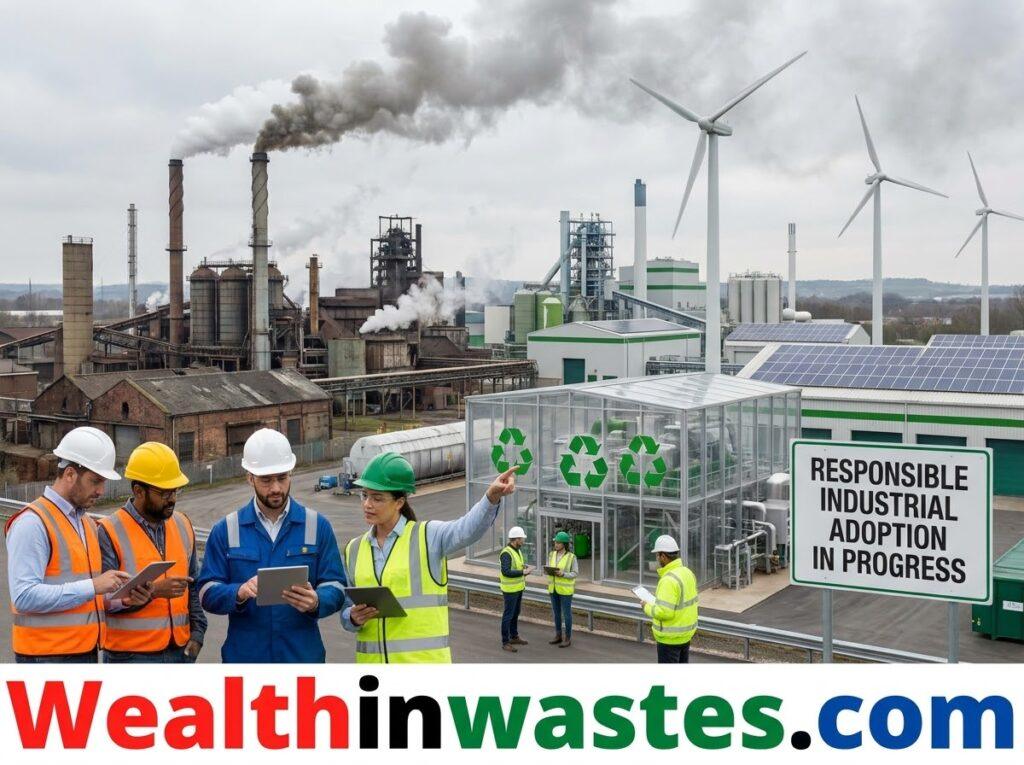
Biological processes can respond to small changes in temperature, acidity, feedstock quality, or contamination. Manufacturers need trained staff, reliable monitoring, and contingency plans because unstable conditions may lower yields or spoil entire batches.
Some systems require substantial investment before companies can prove commercial performance. Pilot testing, market research, maintenance planning, and realistic financial projections can reduce uncertainty before a business commits to a large production facility.
Feedstocks also require scrutiny. Using crops or land that compete with food production may create trade-offs, while unsuitable residues can contain pesticides, metals, plastics, or other contaminants that complicate biological processing.
Safe adoption includes containment, worker training, product testing, and compliance with relevant environmental and product rules. Even familiar organisms need controlled handling when a process concentrates biological material or produces substances that require special management.
Companies should separate biodegradable materials from unsuitable waste before treatment. Learning how to manage clean organic waste also shows why source separation and contamination control influence the quality of biological outputs.
Correct classification matters because different solid waste categories require different treatment options. Items that appear recyclable or biodegradable may be unsuitable when contaminated with hazardous chemicals, medical waste, or mixed materials.
Manufacturers should not send every remaining material through a biological system. Reviewing materials that cannot enter ordinary recycling reinforces the need to identify specialised waste streams and use approved handling routes.
Finally, firms should compare the whole product life cycle, including feedstock production, transport, factory utilities, emissions, product use, and disposal. Independent testing and transparent reporting help establish whether biotechnology delivers genuine benefits in practice.
Read Also: The Application of Biotechnology to Waste Management
Summary on Benefits of Biotechnology Application to Industrial Production
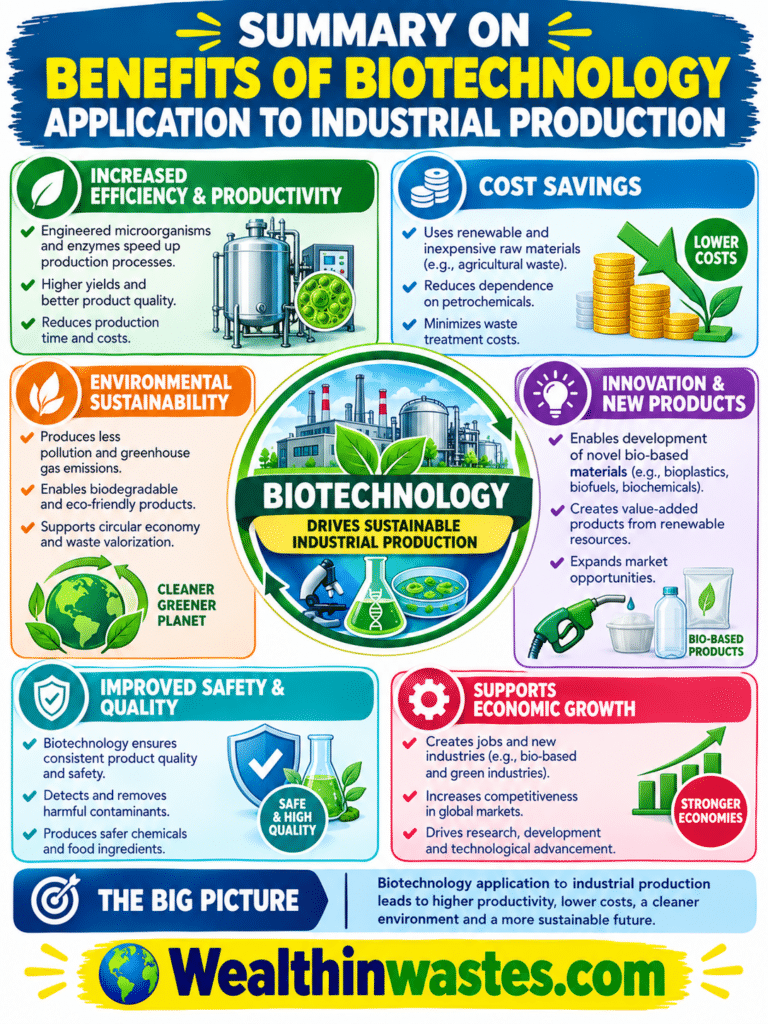
| Area | Summary of Benefits | Important Consideration |
|---|---|---|
| Manufacturing efficiency | Enzymes and microorganisms can improve conversion, product consistency, and selected processing steps. | Results depend on the process, inputs, and operating conditions. |
| Resource use | Biological methods may reduce material losses, energy demand, or selected chemical inputs. | Measure the whole process rather than one stage alone. |
| Waste recovery | Suitable organic residues may become feedstocks, useful materials, compost, or biogas. | Check feedstock quality, contamination, collection costs, and output safety. |
| Environment | Well-managed systems can reduce some waste and pollution burdens. | Benefits require appropriate treatment, monitoring, and life-cycle assessment. |
| Industry and jobs | New activities can support laboratory, engineering, production, logistics, and supply roles. | Commercial demand and reliable investment determine job sustainability. |
| Responsible adoption | Biotechnology can complement recycling, clean production, and circular resource use. | Safety, regulation, cost, and measurable performance remain essential. |
Frequently Asked Questions About Benefits of Biotechnology Application: Industrial Production
1. What is industrial biotechnology?
It uses organisms, cells, enzymes, or biological processes to manufacture products or improve industrial operations.
2. How can biotechnology reduce production costs?
In suitable processes, it can improve yields and reduce energy, chemical use, processing time, or material losses.
3. Which industries use industrial biotechnology?
Food, textiles, paper, chemicals, pharmaceuticals, detergents, biofuels, and selected material manufacturers use biological methods.
4. Can biotechnology help reduce industrial waste?
Yes. It can improve conversion and recover value from suitable residues, but unsuitable or hazardous waste still needs separate management.
5. Does industrial biotechnology always protect the environment?
No. Benefits depend on feedstocks, energy, process controls, pollution management, and the product’s full life cycle.
6. Can biotechnology create jobs?
It can support jobs in research, manufacturing, quality control, engineering, maintenance, transport, and feedstock supply.
7. What is the role of enzymes in industrial production?
Enzymes act as biological catalysts that speed up selected reactions and can improve processing precision under suitable conditions.
8. What should companies assess before adopting biotechnology?
They should assess cost, feedstock supply, output quality, safety, environmental performance, regulations, and customer demand.
Do you have any questions, suggestions, or contributions? If so, please feel free to use the comment box below to share your thoughts. We also encourage you to kindly share this information with others who might benefit from it. Since we can’t reach everyone at once, we truly appreciate your help in spreading the word. Thank you very much for your support and for sharing!
Read Also: Contribution of Biotechnology to Crop Production and Related Fields