


The biosphere is the part of Earth where life exists, including organisms and the environments they inhabit. It connects plants, animals, microorganisms, and people through ecological relationships that continually support survival.
No living organism functions alone. Every species depends on air, water, land, sunlight, and other organisms, while biological activity also changes environmental conditions through growth, respiration, decomposition, and nutrient cycling.
These relationships show why environmental systems should not be studied separately. The atmosphere, hydrosphere, and geosphere provide conditions and resources that allow the biosphere to develop, reproduce, and remain productive.
The importance of these links becomes clearer when we examine the natural resources that sustain communities, including clean air, freshwater, fertile soil, minerals, forests, and energy sources used for food, shelter, health, and livelihoods.
Understanding the biosphere’s dependence is practical, not merely academic. It helps farmers, households, businesses, and governments recognize how pollution, overuse, or habitat destruction in one sphere can affect life elsewhere over time.
What Is the Biosphere and Why Does It Matter?
The biosphere includes all living organisms and the parts of Earth where they survive, from deep soils and freshwater systems to forests, oceans, and the lower atmosphere. Its boundaries follow life-supporting conditions.
Plants, animals, fungi, bacteria, and humans form connected communities within this sphere. Their feeding relationships, reproduction, decomposition, and competition help transfer energy and recycle materials through ecosystems across land and water.
People belong to the biosphere rather than standing outside it. Food production, public health, livelihoods, and settlement depend on functioning ecosystems, as explained through the natural assets found across Earth.
The biosphere also changes the other environmental spheres. Roots break down rock, vegetation influences water movement, and organisms exchange gases with the atmosphere, while decomposers return nutrients to soil and water.
These interactions make biodiversity and ecosystem health essential to human wellbeing. When one environmental component becomes degraded, its effects can spread through food chains, water supplies, climate patterns, and economic activity.
Read Also: Land Environment and Biological Environment (Biosphere) Structure of the Environment
How the Biosphere Depends on Other Spheres

1. Atmosphere: Living things need atmospheric gases, especially oxygen for respiration and carbon dioxide for photosynthesis. The atmosphere also moderates temperature and supports weather patterns that influence habitats and food production.
2. Hydrosphere: Organisms require water for metabolism, transport, growth, and reproduction. Rivers, lakes, wetlands, groundwater, and oceans also provide habitats and move nutrients between ecosystems, supporting diverse forms of life.
3. Geosphere: Rocks, minerals, landforms, and soil supply physical habitats and materials needed by living organisms. Soil anchors plant roots, stores nutrients, holds water, and supports numerous organisms that maintain fertility.
4. Energy and Nutrient Exchange: Sunlight provides most ecosystems with their primary energy source, while organisms circulate carbon, nitrogen, phosphorus, and other nutrients through food webs and natural chemical processes.
5. Interdependence: These spheres continually interact, so damage to one can weaken the others. Responsible management of land and mineral resources helps retain habitats and vital ecosystem functions for both people and wildlife.
Atmosphere-Biosphere Links Sustain Life
The atmosphere supplies gases that organisms use in essential life processes. Plants absorb carbon dioxide during photosynthesis and release oxygen, while animals, plants, and microorganisms consume oxygen during aerobic respiration.
Photosynthesis and respiration help maintain the exchange of carbon and oxygen between living organisms and the air. Decomposition, wildfires, volcanic activity, and human fuel use also influence atmospheric composition in a changing environment.
The atmosphere regulates temperature and carries moisture from one region to another. These functions shape rainfall, growing seasons, migration patterns, and the range of habitats available to plants and animals.
Excess greenhouse gases trap additional heat and contribute to climate change, which can alter ecosystems, water availability, and species distribution. Air contamination can also damage leaves and worsen respiratory problems in people and animals.
Air protection therefore supports the whole biosphere. Communities can reduce harmful emissions, improve energy efficiency, and monitor environmental risks and resource use to limit damage to living systems and their habitats.
Air pollution rarely remains an isolated problem because pollutants may settle on land, enter water, or move through food webs. Understanding the main forms of environmental pollution helps communities identify connected risks.
Hydrosphere-Biosphere Links Support Water Cycles

The hydrosphere includes oceans, seas, rivers, lakes, wetlands, glaciers, groundwater, and atmospheric water. Life depends on these water stores because organisms need water for cellular reactions, nutrient movement, and temperature regulation.
Plants absorb dissolved nutrients and water through their roots, then use them to build tissues and support photosynthesis. Animals obtain water through drinking, food, and metabolic processes essential for survival.
Water also transports materials through ecosystems. Rain dissolves and carries nutrients into streams and soils, while rivers move sediment toward wetlands and coastal areas, connecting habitats across entire watersheds and adjacent floodplains.
Pollution can break these relationships when sewage, industrial discharge, oil, plastics, or farm chemicals enter water bodies. Readers can explore common sources of water contamination to understand how pollutants reach aquatic environments.
Different contaminants harm organisms in different ways. The classification of water pollution sources helps distinguish direct discharges from diffuse runoff, while global water-quality concerns show why monitoring matters across vulnerable habitats.
Geosphere-Biosphere Links Sustain Soil and Habitat
The geosphere consists of Earth’s solid materials, including rocks, minerals, landforms, and soil. It supports terrestrial habitats and supplies physical foundations for forests, grasslands, farms, settlements, and many underground ecosystems.
Soil forms where mineral particles mix with organic matter, water, air, and living organisms. Healthy soil provides plant support, stores moisture, cycles nutrients, and hosts bacteria, fungi, earthworms, insects, and other life.
Because fertile soil develops slowly, its protection is essential for food security and biodiversity. Practical soil conservation measures can reduce erosion and help land remain productive for future generations in agricultural landscapes.
Soil properties influence how well land supports roots, drains water, and retains nutrients. Understanding soil composition and characteristics helps explain why different habitats and crops require different forms of land management.
When vegetation disappears, rain and wind can remove exposed topsoil, carrying sediment into rivers and reservoirs. Learning about the causes and forms of soil erosion helps communities prevent land degradation.
Anthrosphere Effects Across Natural Spheres

The anthrosphere, also called the technosphere, includes buildings, roads, farms, industries, machines, and other environments people create or modify. These systems provide services and livelihoods, but they can also put pressure on nature.
1. Atmosphere: Transport, electricity generation, industry, and agriculture release gases and particles that alter air quality and climate. Reducing emissions and improving cleaner technologies can lower these impacts across communities.
2. Hydrosphere: Excessive groundwater extraction can lower water tables, while untreated sewage, farm runoff, and industrial effluent can contaminate rivers and aquifers. Effective treatment and careful water use protect people and wildlife.
3. Biosphere: Clearing forests for crops, pasture, roads, or settlements destroys habitats and fragments wildlife populations. Land-cover change and deforestation can reduce biodiversity and weaken ecosystem services when land conversion proceeds without safeguards.
4. Geosphere: Mining, construction, intensive cultivation, and poorly planned waste disposal disturb land and soil. Land pollution and its effects can damage crop productivity, habitats, and nearby communities over the long term.
5. Cross-Sphere Contamination: Chemicals and discarded materials can move between air, water, soil, and living organisms. Understanding land-pollution pathways helps explain how contaminants spread beyond their original location and affect human exposure.
Industrial operations can produce dangerous residues if businesses neglect safe handling and treatment. Reviewing hazardous-waste sources and control measures helps prevent toxic substances from entering natural systems and downstream habitats.
Environmental Economics and Shared Resources
Environmental economics examines how production, consumption, and resource decisions affect nature and human wellbeing. It considers the benefits people gain from ecosystems alongside the pollution, depletion, and restoration costs their activities create.
1. Recognize Environmental Costs: A product’s market price may exclude damage to health, wildlife, water quality, or climate. Policy and business decisions should account for these impacts when evaluating costs and benefits.
2. Protect Human and Ecological Health: Toxic substances can move from soil into plants, animals, and food chains. Guidance on hazardous substances affecting soil and plants illustrates why prevention and careful monitoring matter.
3. Reduce Wasteful Material Flows: Communities can use materials efficiently, prevent avoidable pollution, and improve waste collection. The wider health and environmental effects of waste show why responsible management benefits people and ecosystems.
4. Balance Present and Future Needs: Renewable resources require sound management because harvesting faster than natural recovery can exhaust them. Classifying natural resources and understanding resource conservation help protect supplies for future generations.
Read Also: The Air Environment (Atmosphere) and Water Environment (Hydrosphere) Structure of the Environment
Sustainable Actions Protect Biosphere Connections

1. Conserve Habitats: Protect forests, wetlands, rivers, coastal areas, and grasslands from unnecessary destruction. Restore degraded sites with suitable native species, and plan settlements and farms to preserve wildlife corridors and ecological functions.
2. Prevent Pollution at Source: Treat sewage and industrial effluent before discharge, store chemicals safely, and reduce open burning. These actions limit harmful substances moving from human systems into air, water, and soil.
3. Manage Materials Responsibly: Reduce unnecessary purchases, reuse durable products, sort recyclable materials, and compost suitable organic waste. Effective solid-waste management can reduce pollution and pressure on natural resources in towns and rural areas.
4. Use Land and Water Wisely: Apply erosion-control measures, protect watersheds, conserve irrigation water, and maintain soil organic matter. Farmers can adapt practices to local conditions and monitor changes in soil fertility and water availability.
5. Support Informed Decisions: Environmental education, reliable monitoring, public participation, and enforceable standards help communities identify risks early. Cooperation among residents, farmers, industries, and authorities makes long-term protection more achievable.
Summary on Biosphere and its Dependent Links to the other Spheres
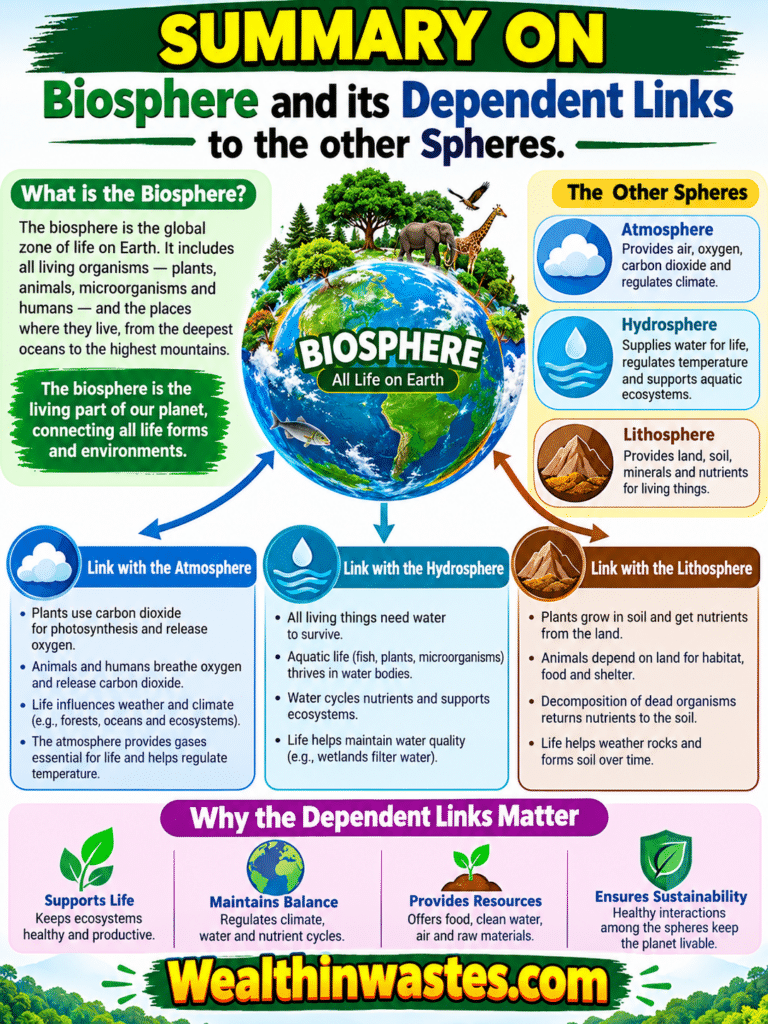
| Topic | Key Point | Why It Matters |
|---|---|---|
| Biosphere | Includes all living organisms and life-supporting habitats. | Supports biodiversity, food webs, and human wellbeing. |
| Atmosphere | Supplies gases and helps regulate climate. | Enables respiration, photosynthesis, and suitable living conditions. |
| Hydrosphere | Provides water, habitats, and nutrient transport. | Maintains metabolism, aquatic life, and ecosystem functions. |
| Geosphere | Supplies soil, minerals, landforms, and physical habitats. | Supports plants, agriculture, and terrestrial ecosystems. |
| Anthrosphere | Includes human-made systems and modified environments. | Can meet human needs but may cause pollution and habitat loss. |
| Environmental Economics | Considers environmental effects of economic choices. | Encourages efficient resource use and sustainable development. |
| Protection | Conservation, pollution prevention, and responsible waste management. | Helps keep connected environmental systems healthy for future generations. |
Frequently Asked Questions About Biosphere and its Dependent Links to Other Spheres
1. What Is the Biosphere?
The biosphere includes all living organisms and the places on Earth where life exists.
2. Which Spheres Support the Biosphere?
The atmosphere, hydrosphere, and geosphere provide essential gases, water, nutrients, land, and habitats.
3. How Does the Atmosphere Help Living Things?
It provides gases for respiration and photosynthesis while regulating temperature and weather patterns.
4. Why Is Water Essential to the Biosphere?
Water supports cellular processes, transports nutrients, regulates temperature, and provides habitats for aquatic organisms.
5. How Does Soil Support Life?
Soil anchors roots, stores water and nutrients, and provides habitats for many organisms.
6. What Is the Anthrosphere?
It is the human-made or human-modified part of the environment, including farms, roads, buildings, and industries.
7. How Do Humans Damage Biosphere Connections?
Pollution, deforestation, mining, overuse of water, and greenhouse gas emissions can disrupt connected environmental systems.
8. How Can We Protect the Biosphere?
Conserve habitats, reduce pollution, manage resources carefully, restore damaged land, and dispose of waste responsibly.
Do you have any questions, suggestions, or contributions? If so, please feel free to use the comment box below to share your thoughts. We also encourage you to kindly share this information with others who might benefit from it. Since we can’t reach everyone at once, we truly appreciate your help in spreading the word. Thank you very much for your support and for sharing!
Read Also: Soil and Water Conservation Guide