


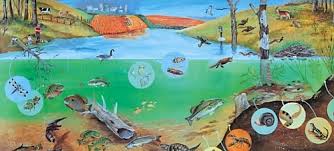
Ecology is the scientific study of how plants, animals and microorganisms interact with one another and with their physical surroundings. It explains how living things survive, reproduce and respond to changing conditions.
Ecologists examine relationships between organisms and factors such as light, water, temperature, soil and air. Their work helps explain why certain species thrive in particular habitats while others struggle or disappear.
The environment includes living components such as plants, animals, fungi and bacteria, alongside non-living elements such as sunlight, rainfall, rocks, wind and minerals. These conditions influence food supplies, shelter, growth and reproduction.
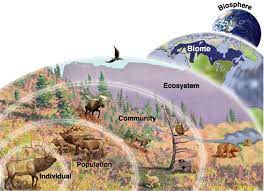
An organism is an individual living thing, while a population contains members of one species in a defined area. Several populations form a community, and their interactions with non-living surroundings create an ecosystem.
Ecology is useful beyond classrooms because its principles guide agriculture, conservation, public health and resource management. Understanding ecological connections helps people protect habitats, use resources responsibly and recognise how local actions affect wider natural systems.
What Ecology Means and Why It Matters
The word ecology combines ideas about a home and the study of life. In practice, it examines where organisms live, what they need, and how their activities affect other species and surroundings.
Ecology overlaps with other subjects, but it focuses particularly on relationships in nature. It also shows how natural resources support organisms and why careless use can disturb habitats and ecological processes over time.
These connections also explain why the types of natural resources available in an area matter. Ecological knowledge helps farmers, researchers and communities plan development while reducing environmental costs over time.
Read Also: Soil Conservation: Meaning, Categories and Soil Management Practices
Environmental Factors That Shape Life

Ecologists group environmental influences into broad categories, although factors often work together. A change in one condition can affect food availability, shelter, reproduction and the survival of organisms throughout a habitat.
1. Abiotic Conditions: Sunlight, temperature, rainfall, soil texture, water availability and wind affect whether organisms grow, feed, reproduce and survive. Seasonal climate patterns can also influence flowering, migration and breeding times in a particular habitat.
2. Biotic Interactions: Competition, predation, parasitism, disease and cooperation shape survival among organisms. Human activities can alter these relationships by removing habitats, introducing species or reducing food supplies in natural communities over short periods.
3. Habitat Suitability: Species do not occur evenly everywhere. Differences in light, moisture, food, shelter and soil conditions affect their distribution and abundance, so each habitat supports organisms suited to its conditions over time.
Levels of Organization in Ecology
Ecologists arrange life into connected levels, starting with one organism and extending to the entire Earth. Each level answers different questions while building upon interactions at smaller scales and broader surroundings.
1. Organism: An organism is one individual living thing, such as a maize plant, earthworm, goat or bacterium. Ecologists examine its behaviour, needs, growth, reproduction and responses to environmental conditions throughout its life.
2. Population: A population consists of members of the same species living in one area at the same time. Members may compete, reproduce, cooperate and respond collectively to food supplies, predators and weather.
3. Community: A community includes populations of different species living and interacting in one area. A farm community, for example, may contain crops, insects, birds, soil microbes, weeds and grazing animals with linked roles.
4. Ecosystem: An ecosystem combines a community with non-living surroundings, including water, air, rocks, soil and climate. Energy flow and nutrient cycling connect these parts and influence productivity, interactions and survival over time.
5. Biome: A biome is a broad region characterised by climate, vegetation and typical animal life. Tropical rainforests, savannas, deserts and tundra differ in rainfall, temperature and dominant plant communities across large areas.
6. Biosphere: The biosphere includes every part of Earth where life exists, from deep ocean habitats to soils and the lower atmosphere. It connects ecosystems through global water, nutrient and energy cycles on a planetary scale.
Biotic and Abiotic Factors in Ecosystems
Every ecosystem contains living and non-living components. Ecologists separate them for study, but organisms depend on both: plants need suitable soil and light, while animals need food, water, oxygen and shelter.
1. Biotic Factors: Biotic factors are living organisms, including plants, animals, fungi, bacteria and other microbes. They provide food, pollination, decomposition, shelter, competition and other interactions that shape community structure in each habitat.
2. Water and Soil Conditions: Water and soil conditions control moisture, nutrients, oxygen availability and root growth. Changes caused by polluted runoff or erosion can reduce habitat quality and affect fish, crops and soil-dwelling organisms.
3. Air and Weather Conditions: Temperature, wind, humidity and air quality influence breathing, water loss, plant growth and movement. Harmful emissions associated with air pollution can stress organisms and damage vegetation over time.
4. Contaminants: Chemical and biological contaminants may disrupt an ecosystem when their concentrations exceed what natural processes can handle. Understanding pollutant sources helps explain why contamination harms organisms and changes ecological relationships.
Energy Flow and Nutrient Cycling in Ecosystems
In most ecosystems, sunlight supplies the energy that green plants and algae capture through photosynthesis. Herbivores obtain energy by eating producers, while carnivores gain it by feeding on other animals.
A food chain shows one feeding pathway, whereas a food web connects many pathways. These networks help ecologists understand how changes to one population may affect predators, prey and competitors in the same habitat.
Nutrients move differently from energy because organisms reuse elements such as carbon, nitrogen and phosphorus. Decomposers break down dead matter and return nutrients to soil or water, supporting new growth.
Farmers can support nutrient cycling by returning suitable plant residues and manure to the soil through managed composting. Properly prepared compost adds organic matter and helps reduce avoidable farm waste.
Turning safe biodegradable leftovers into compost illustrates how human activity can work with ecological processes rather than discard useful nutrients. Farmers must avoid contaminated materials and manage moisture and aeration carefully.
Ecological Balance and Natural Change

Ecosystems rarely remain exactly the same. Rainfall, fires, disease, migration, seasonal growth and human activity can change species numbers, habitat conditions and the availability of essential resources from one period to another.
A relatively stable ecosystem may show approximate equilibrium, meaning its overall processes continue despite normal fluctuations. This does not mean nothing changes; populations and species composition can shift while key functions persist.
Long-term shifts in temperature and rainfall may intensify droughts, floods or heat stress, placing pressure on species unable to adapt or move. A practical overview of climate change helps explain these wider ecological effects.
Water shortages, polluted waterways and excessive extraction can further disturb ecological stability. These pressures may reduce habitat quality and livelihoods, making careful planning of water resource development essential for communities and wildlife.
Pollution also carries economic costs when communities lose fisheries, clean water, productive land or tourism opportunities. Recognising these connections supports prevention before damage becomes more expensive or difficult to reverse.
Why Ecology Matters in African Communities
Ecological knowledge has immediate value in African communities where livelihoods depend on farming, fisheries, forests, grazing lands and reliable water supplies. It helps explain why healthy ecosystems support food production and local income.
Farmers who understand soil organisms, pollinators, rainfall and pests can make better decisions about crop mixtures, irrigation, tree cover and safe chemical use. These choices can protect productivity while lowering environmental pressure.
Good environmental management joins ecological knowledge with practical action. Reducing pollution, conserving water, protecting native vegetation and handling waste responsibly can strengthen community resilience without assuming that all ecosystems respond alike. Effective environmental management practices help communities apply these principles locally.
Planning should also balance current needs with future ecological health. Responsible development protects habitats and natural resources while supporting human well-being, recognising that a damaged ecosystem can weaken livelihoods for generations.
Practical Ways to Protect Ecosystems

Ecosystem protection starts with everyday decisions by households, farmers, businesses and public institutions. The most effective actions reduce pressure at its source and match local ecological conditions and community needs.
1. Protect Natural Habitats: Protect habitats by retaining native trees, wetlands, riverbanks and vegetated field margins. Community restoration should use locally suitable species and safeguard breeding areas, wildlife corridors and water sources needed by organisms.
2. Prevent Pollution: Prevent contamination by separating waste, treating wastewater, avoiding open dumping and using farm chemicals carefully. Coordinated pollution control helps authorities, businesses and residents protect ecosystems and limit harm to neighbouring communities.
3. Manage Waste Responsibly: Manage waste through reduction, reuse, recycling and safe treatment rather than uncontrolled disposal. Proper waste handling keeps harmful materials away from soil, drains, rivers and habitats where wildlife and people may encounter them.
4. Assess Environmental Risks: Assess environmental conditions before choosing disposal areas or developing land. Consider groundwater, flood risk, soil permeability, nearby habitats and settlement distance, then monitor the site to identify problems early and reduce harm through careful disposal-site selection.
Read Also: What Is the Difference Between Environmental Science and Ecology?
Summary on Basics and Levels of Organization of Ecology
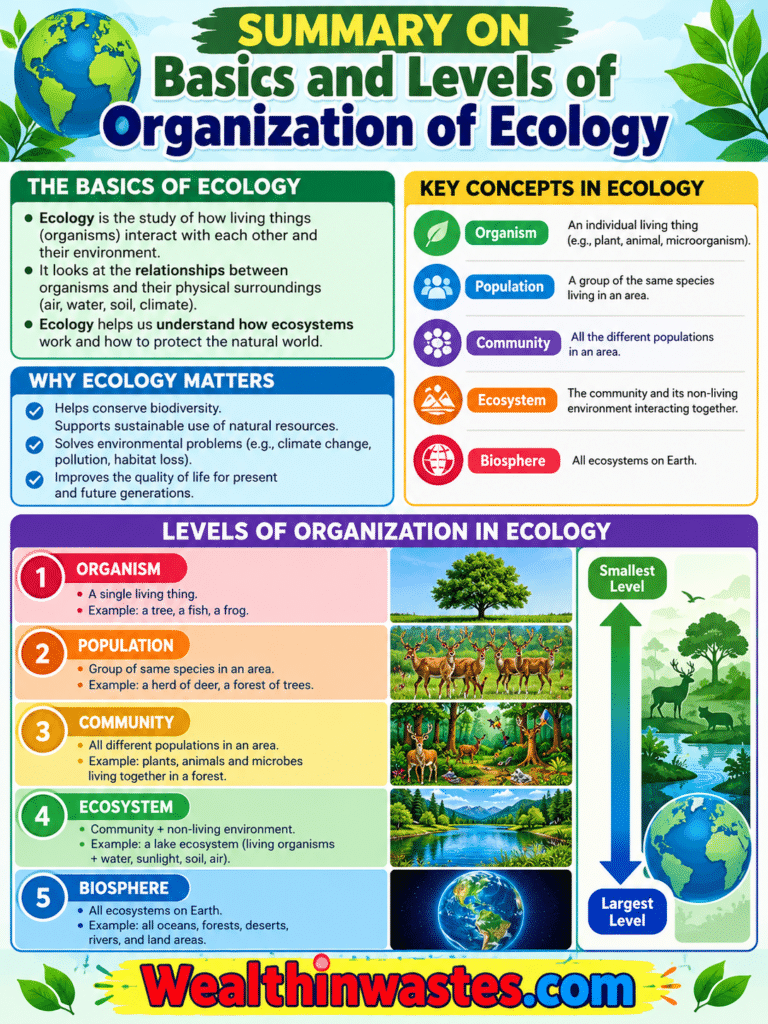
| Topic | Summary |
|---|---|
| Ecology | The scientific study of interactions between organisms and their environment. |
| Environment | Includes living and non-living conditions that influence survival and reproduction. |
| Organism | An individual living thing. |
| Population | Members of the same species living in one area. |
| Community | Populations of different species interacting in one area. |
| Ecosystem | Living communities interacting with non-living surroundings. |
| Biome | A broad region characterised by climate and typical communities. |
| Biosphere | All parts of Earth where life exists. |
| Biotic Factors | Living components, including plants, animals, fungi and microorganisms. |
| Abiotic Factors | Non-living components, including light, water, air, temperature and soil. |
| Ecological Balance | A dynamic condition that allows ecological processes to continue despite natural changes. |
| Conservation | Protects habitats, biodiversity and natural resources for present and future generations. |
Frequently Asked Questions About Basics and Levels of Organization of Ecology Explained
1. What Is Ecology?
Ecology is the scientific study of relationships between living organisms and their physical and biological environments.
2. What Are the Main Levels of Ecological Organization?
The main levels are organism, population, community, ecosystem, biome and biosphere, moving from individual life to the global scale.
3. What Is the Difference Between a Population and a Community?
A population contains members of one species in an area, while a community contains interacting populations of different species.
4. What Are Biotic and Abiotic Factors?
Biotic factors are living components, while abiotic factors are non-living conditions such as temperature, water, sunlight and soil.
5. Why Is Ecology Important in Agriculture?
Ecology helps farmers understand soil health, pollination, pest relationships, water requirements and sustainable practices that support productive farming.
6. How Do Human Activities Affect Ecosystems?
Deforestation, pollution, habitat destruction and excessive resource extraction can disrupt ecological relationships and reduce biodiversity.
7. What Is Ecological Equilibrium?
Ecological equilibrium describes a relatively stable condition in which ecological processes continue despite ordinary changes in populations and environmental conditions.
8. How Can People Protect Ecosystems?
People can conserve habitats, reduce pollution, manage waste responsibly, protect wildlife and use natural resources sustainably.
Do you have any questions, suggestions, or contributions? If so, please feel free to use the comment box below to share your thoughts. We also encourage you to kindly share this information with others who might benefit from it. Since we can’t reach everyone at once, we truly appreciate your help in spreading the word. Thank you very much for your support and for sharing!
Read Also: A Guide to Understanding Nigeria Ecosystem
“`