


Basic environmental concepts explain how living organisms interact with the natural world and how physical conditions influence survival. These ideas help students understand ecosystems, biodiversity, environmental change, and humanity’s responsibility for protecting natural resources.
The environment includes living components, such as plants, animals, and microorganisms, alongside non-living components, including air, water, sunlight, soil, temperature, and minerals. Organisms depend on these components for survival.
An ecosystem brings organisms and their physical surroundings together in a functioning system. Forests, grasslands, deserts, ponds, rivers, oceans, farms, and aquariums differ, yet share relationships among living things and resources.
Environmental studies also examine how populations change across generations. The theories of Jean-Baptiste Lamarck and Charles Darwin offered different explanations for evolution, adaptation, inherited variation, and the relationship between organisms and environmental pressures.
Understanding these concepts benefits farmers, students, conservation workers, and communities. It helps people make informed decisions about soil, water, habitats, pollution, food production, and the long-term health of natural systems.
Basic Environmental Concepts and Their Meaning
Basic environmental concepts describe the patterns and processes connecting organisms with their surroundings. The environment includes physical conditions, biological communities, natural resources, and human activities that influence life across different habitats.
Environmental conditions determine where organisms can survive, grow, and reproduce. Temperature, rainfall, sunlight, soil fertility, and water availability influence species distribution and help explain differences between natural communities.
Humans form part of the environment because their activities affect natural systems. Understanding human dependence on natural resources explains why healthy soil, clean water, forests, wildlife, and minerals remain essential for survival.
Natural resources provide materials and services needed every day, including food, fibre, energy, medicines, and freshwater. The availability of these resources influences settlement patterns, agricultural production, economic development, and community wellbeing.
The environment operates at different scales, from a small puddle containing microorganisms to extensive forests, rivers, and oceans. Each system has its own characteristics, yet its living and non-living components remain interconnected.
Environmental awareness also encourages responsible habits that reduce waste, protect habitats, and conserve useful resources. Such habits support environmental responsibility and practical conservation in homes, schools, farms, businesses, and communities.
These concepts provide the foundation for understanding ecological relationships, environmental management, and sustainable development. They also help people recognise how disturbances in one environmental component can influence other connected components.
Read Also: Factors Influencing Soil Moisture
Ecosystem Components and Their Interactions
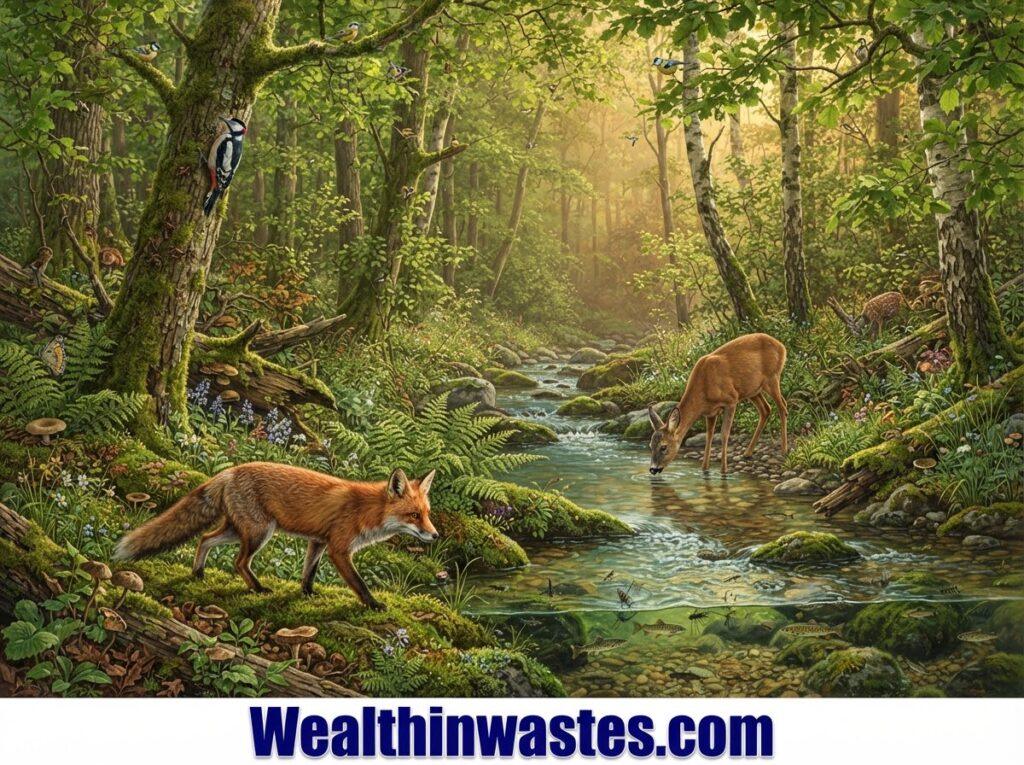
An ecosystem is a functional unit in which living organisms interact with one another and their physical surroundings. Its major components work together to support energy transfer, nutrient recycling, growth, and survival.
1. Abiotic Components: Abiotic components are non-living features such as sunlight, air, water, temperature, soil, acidity, and minerals. They influence which organisms survive and affect growth, reproduction, and distribution throughout an ecosystem.
2. Biotic Components: Biotic components include plants, animals, fungi, bacteria, and other living organisms. Their interdependence in natural communities appears through feeding, competition, shelter, pollination, decomposition, and other interactions.
3. Producers and Consumers: Producers, including green plants and algae, manufacture food using sunlight or chemical energy. Consumers obtain energy by eating plants, other animals, or organic materials within their communities.
4. Decomposers: Bacteria and fungi break down dead organisms and organic waste, returning nutrients to the environment. When harmful substances disrupt these processes, pollution can disturb ecological balance and reduce ecosystem productivity.
5. Habitats and Niches: A habitat is the place where an organism lives, while its niche describes its ecological role. Land contamination and habitat damage can reduce food, shelter, and breeding opportunities.
6. Ecological Relationships: Organisms interact through competition, predation, mutualism, parasitism, and commensalism. These relationships influence population sizes and community structure, while environmental changes can alter their frequency and consequences over time.
Types of Ecosystems in Nature
Natural ecosystems generally fall into terrestrial and aquatic categories, while people also construct or modify ecosystems. Each type provides particular habitats, resources, and environmental conditions that support different communities of organisms.
1. Terrestrial Ecosystems: Terrestrial ecosystems occur on land and include forests, grasslands, deserts, and tundra. Their vegetation, animal communities, and soil characteristics reflect rainfall, temperature, sunlight, altitude, and available nutrients.
2. Freshwater Ecosystems: Freshwater ecosystems include ponds, lakes, streams, rivers, and many wetlands. They support fish, aquatic plants, algae, insects, amphibians, and microorganisms adapted to relatively low concentrations of dissolved salts.
These habitats support varied aquatic organisms and feeding relationships. Water depth, dissolved oxygen, temperature, nutrient availability, and light penetration influence which species thrive in particular freshwater environments.
3. Pond Ecosystems: A pond provides a manageable example of ecosystem interaction. Sunlight supports algae and aquatic plants, small animals feed on these producers, larger animals consume smaller organisms, and decomposers recycle organic matter.
The structure of a freshwater habitat depends on its physical conditions and biological communities. Understanding freshwater ecology and ecosystem structure helps explain the relationships sustaining ponds, lakes, rivers, and surrounding habitats.
4. Marine and Coastal Ecosystems: Marine ecosystems include oceans, seas, coral reefs, estuaries, and coastal habitats. Salinity, currents, tides, sunlight, and water depth influence their organisms, food webs, and ecological processes.
People depend on these environments for fisheries, transport, tourism, and coastal livelihoods. The protection of marine habitats and coastal resources therefore supports biodiversity and human wellbeing.
5. Artificial Ecosystems: Artificial ecosystems develop through human construction or management. Crop fields, gardens, reservoirs, and aquariums provide examples, although their continued functioning often depends on deliberate management of water, nutrients, organisms, and other resources.
Energy Flow and Nutrient Cycles in Ecosystems
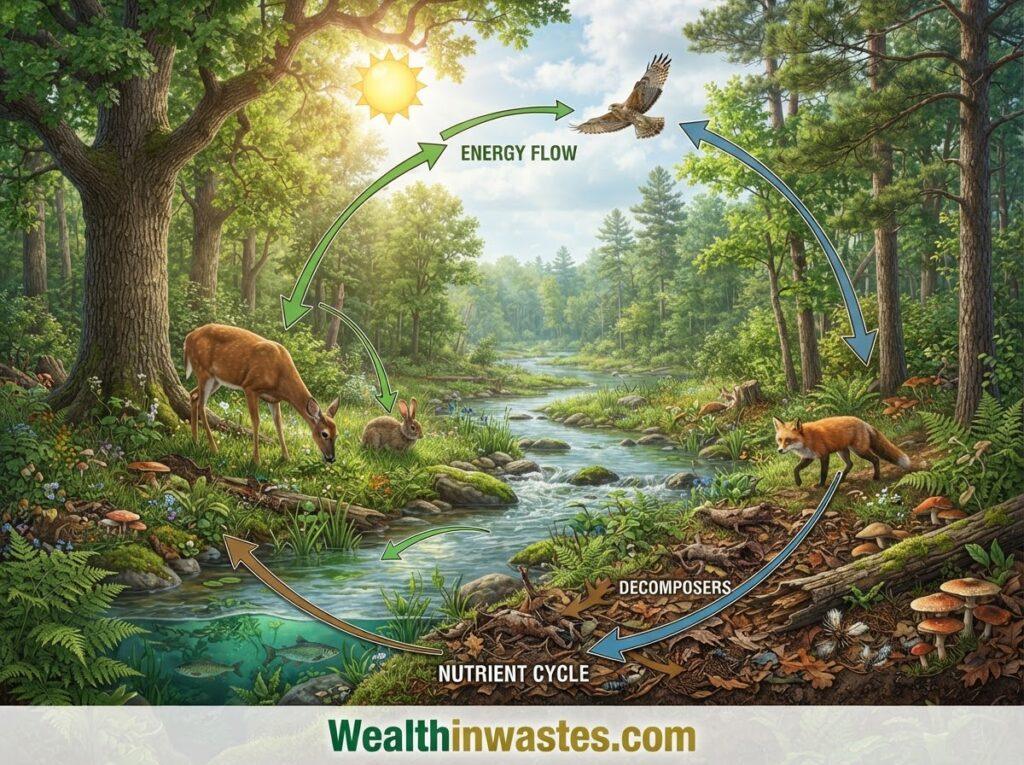
Energy flow and nutrient cycling are fundamental ecological processes. Energy enters most ecosystems through sunlight, passes between organisms through feeding, and eventually dissipates as heat, while essential chemical elements continue circulating.
Plants and algae capture solar energy through photosynthesis and convert it into chemical energy stored in organic compounds. Herbivores obtain this energy by eating producers, while carnivores obtain it by consuming other animals.
A food chain and interconnected food web illustrate how organisms obtain energy. A simple chain might show grass feeding a grasshopper, a frog eating the grasshopper, and a snake consuming the frog.
Energy becomes less available at each successive trophic level because organisms use much of it for movement, growth, respiration, and reproduction. Consequently, ecosystems generally support fewer top predators than primary consumers.
Nutrients follow different pathways because organisms repeatedly absorb and release elements such as carbon, nitrogen, and phosphorus. These materials move through organisms, soil, water, and air in interconnected biogeochemical and nutrient cycles.
Decomposition returns nutrients from dead organisms and organic waste to the environment. Proper handling of food scraps, crop residues, and manure supports responsible organic waste management and reduces unnecessary environmental pressure.
These processes demonstrate why ecosystems require both a continuing energy supply and effective nutrient recycling. Disruptions caused by excessive pollution, habitat destruction, or nutrient overload can weaken ecosystem functioning and biodiversity.
Lamarck’s Theory of Evolution
Jean-Baptiste Lamarck was an early naturalist who developed an influential explanation of how organisms change over time. His ideas helped establish evolution as an important subject in biological science.
1. Theory of Need: Lamarck proposed that environmental needs could influence organism behaviour and the development of particular structures. For example, a food shortage might encourage animals to seek resources in different ways.
2. Theory of Use and Disuse: Lamarck argued that frequently used organs would become stronger or better developed, whereas unused organs would weaken. He believed these changes could contribute to evolutionary transformation over generations.
3. Theory of Acquired Characteristics: Lamarck proposed that characteristics acquired during an organism’s lifetime could pass to its offspring. He believed repeated environmental challenges would gradually produce inherited changes within successive generations.
4. The Giraffe Example: Lamarck suggested that ancestral giraffes stretched their necks to reach higher leaves. He believed this repeated stretching lengthened their necks and that their offspring inherited the acquired change.
5. Modern Scientific Assessment: Modern genetics does not support Lamarck’s general claim that acquired physical changes automatically pass to offspring. Evolution instead involves inherited variation and several population-level mechanisms, including natural selection and genetic drift.
Darwinian Theory and Natural Selection

Charles Darwin developed a theory of evolution based on natural selection, and Alfred Russel Wallace independently reached a similar explanation. Their work helped explain how inherited differences influence survival and reproduction.
1. Variation Among Organisms: Individuals within a population differ in characteristics such as size, colour, beak shape, and disease resistance. Some differences have a genetic basis and can pass from parents to offspring.
2. Competition for Resources: Organisms need food, water, shelter, and suitable breeding conditions. Because resources are limited, individuals compete for opportunities to survive and reproduce, although the intensity of competition varies between environments and species.
3. Natural Selection: Individuals with advantageous inherited characteristics may survive and reproduce more successfully under particular environmental conditions. Across generations, the relevant inherited characteristics can become more common within the population.
4. Fitness and Reproduction: Biological fitness describes an organism’s contribution to future generations through successful reproduction. The individuals that leave more surviving offspring can pass their inherited characteristics to a greater proportion of the next generation.
5. Adaptation to Environmental Conditions: A characteristic that improves survival in one environment may offer little benefit elsewhere. Modern biodiversity and species survival research highlights how changing conditions influence populations, habitats, and extinction risks.
6. Speciation and Biodiversity: Populations can gradually become distinct through genetic changes, selection, isolation, and other evolutionary processes. Over sufficient time, these differences may contribute to the formation of new species and increased biodiversity.
Darwin’s observations of Galápagos finches helped illustrate how different beak shapes relate to different food sources. A modern biology explanation of evolution by natural selection describes the supporting evidence and genetic principles in greater detail.
Why Basic Environmental Concepts Matter
Environmental concepts help people understand the consequences of their decisions. They show how farming, industrial production, construction, and resource extraction can affect habitats, ecological relationships, human health, and long-term resource availability.
Understanding land use helps communities recognise the consequences of clearing forests and converting natural habitats. The causes and effects of deforestation and land cover change include biodiversity loss, soil erosion, and altered water movement.
Environmental knowledge also supports practical decisions about waste, energy, water, and pollution. Applying responsible environmental management practices can reduce unnecessary resource consumption and protect ecological functions in homes, farms, industries, and public spaces.
Soil and mineral resources support food production, infrastructure, and livelihoods. Understanding their ecological importance encourages careful soil and mineral resource management that limits degradation, reduces contamination, and maintains productive land for future generations.
Environmental concepts also encourage balanced development. The principles of sustainable resource use help communities meet present needs while safeguarding natural systems and maintaining opportunities for people who will depend on those resources later.
Finally, knowledge of evolution helps explain biological diversity, adaptation, and species relationships. Together, ecological understanding and evolutionary biology provide a stronger foundation for conservation, agricultural planning, environmental education, and informed public decisions.
Environmental Protection and Sustainable Choices

Knowledge becomes more valuable when people apply it to daily activities. Individuals, farmers, businesses, and governments can protect environmental quality through practical measures that reduce pollution and maintain natural resources.
1. Protect Natural Habitats: Communities can conserve forests, wetlands, grasslands, and rivers by preventing unnecessary destruction. Restoring damaged habitats helps wildlife recover and preserves essential ecological services that support human livelihoods.
2. Reduce Waste and Pollution: Households and organisations can minimise waste, reuse materials, recycle suitable items, and dispose of hazardous substances responsibly. These measures reduce contamination and help protect soil, water, air, and wildlife.
3. Conserve Soil and Water: Farmers can maintain vegetation cover, use suitable erosion-control methods, apply water efficiently, and manage fertilisers carefully. Such practices support crop production while reducing runoff, nutrient loss, and downstream pollution.
4. Support Environmental Education: Schools, community groups, and local organisations can teach people about conservation, pollution prevention, and ecological relationships. Practical environmental education encourages informed decisions and strengthens public participation in resource protection.
5. Encourage Responsible Development: Governments and businesses can assess environmental consequences before approving major projects. Better planning can limit habitat loss, protect sensitive areas, and reduce harmful effects on surrounding communities and ecosystems.
6. Build Sustainable Communities: Practical conservation works best when communities combine resource efficiency with long-term planning. Learning ways to protect the natural environment encourages collective responsibility and helps reduce avoidable environmental damage.
Freshwater protection requires particular attention because people, crops, livestock, and wildlife depend on reliable supplies. Preventing waste and contamination helps maintain freshwater resources and aquatic habitats for present and future use.
Environmental protection becomes more effective when scientific understanding guides practical action. By valuing biodiversity, conserving resources, and reducing pollution, societies can support functioning ecosystems and improve the environmental conditions on which life depends.
Read Also: United Nation REDD- Plus Initiative to Combating Deforestation
Summary on Basic Environmental Concepts and Theories
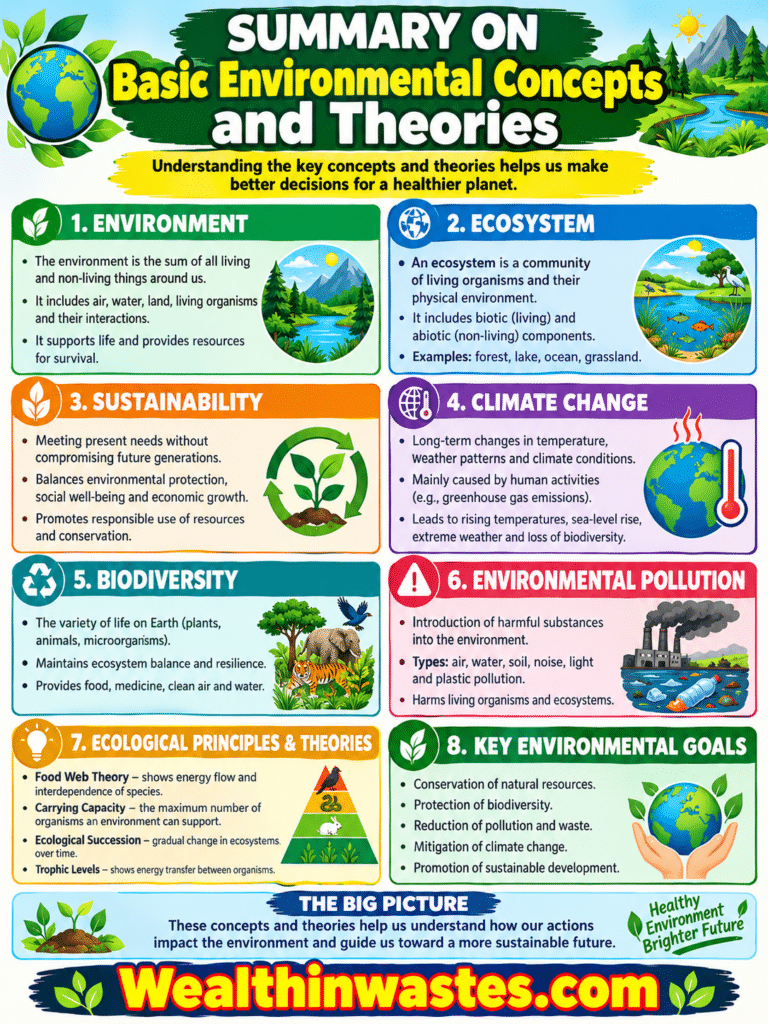
| Concept | Summary |
|---|---|
| Environment | Living and non-living conditions surrounding organisms. |
| Ecosystem | A functional unit in which organisms interact with each other and their physical surroundings. |
| Biotic Components | Living organisms, including plants, animals, fungi, and microorganisms. |
| Abiotic Components | Non-living factors such as air, sunlight, water, temperature, and soil. |
| Terrestrial Ecosystems | Land-based systems, including forests, grasslands, and deserts. |
| Aquatic Ecosystems | Water-based systems, including ponds, lakes, rivers, wetlands, and oceans. |
| Energy Flow | Movement of energy through producers, consumers, and other organisms. |
| Nutrient Cycling | Movement and reuse of essential elements through organisms and the environment. |
| Lamarck’s Theory | A historical explanation based on use, disuse, and the inheritance of acquired characteristics. |
| Darwinian Theory | Evolution through natural selection acting on heritable variation. |
| Environmental Protection | Conservation, pollution prevention, restoration, and responsible resource management. |
Frequently Asked Questions About Basic Environmental Concepts: Ecosystems and Evolution
1. What Are Basic Environmental Concepts?
They are fundamental ideas explaining environmental components, ecosystem relationships, energy flow, nutrient cycles, biodiversity, and evolutionary processes.
2. What Is an Ecosystem?
An ecosystem is a functional unit where organisms interact with one another and their physical environment.
3. What Are the Two Major Natural Ecosystem Types?
The two major categories are terrestrial ecosystems, which occur on land, and aquatic ecosystems, which occur in water.
4. What Is Lamarck’s Theory of Evolution?
Lamarck proposed that use, disuse, environmental needs, and acquired characteristics could explain evolutionary changes across generations.
5. What Is Darwinian Natural Selection?
Natural selection occurs when inherited characteristics influence survival and reproductive success, changing populations over successive generations.
6. How Does a Pond Ecosystem Function?
Plants and algae produce food, animals consume organisms, and decomposers break down organic matter and return nutrients to the environment.
7. What Is the Difference Between Energy Flow and Nutrient Cycling?
Energy flows through ecosystems and eventually dissipates as heat, whereas nutrients circulate repeatedly through organisms and environmental components.
8. Why Are Basic Environmental Concepts Important?
They help people understand ecological relationships, conserve resources, prevent pollution, protect biodiversity, and make informed environmental decisions.
Do you have any questions, suggestions, or contributions? If so, please feel free to use the comment box below to share your thoughts. We also encourage you to kindly share this information with others who might benefit from it. Since we can’t reach everyone at once, we truly appreciate your help in spreading the word. Thank you very much for your support and for sharing!
Read Also: All You Need To Know About Sustainable Practices In Agriculture