


Biomarkers in petroleum are molecular fossils that retain chemical information from the organisms and organic matter involved in petroleum formation. Their distributions help geochemists compare oils, identify related accumulations, and reconstruct geological histories.
Petroleum tagging uses these stable molecular patterns to distinguish crude oils from different sources. Unlike bulk properties alone, biomarker signatures can preserve information about source material, depositional conditions, maturity, migration, and post-formation alteration.
Among the most useful applications, biomarkers help assess thermal maturity because heating changes the relative abundance and structure of selected compounds. Analysts therefore compare specific biomarker ratios to evaluate maturity within defined geological settings.
Biomarker interpretation also supports petroleum correlation and source attribution. Oils from related source rocks often display comparable molecular patterns, while differences can reveal separate sources, mixing, migration pathways, biodegradation, or varying maturation histories.
However, biomarker evidence requires careful interpretation because maturity relationships depend on heating rate, source-rock geology, kerogen chemistry, analytical method, and alteration. Reliable petroleum tagging therefore combines biomarkers with complementary geochemical and geological evidence.
Understanding Biomarkers in Petroleum Tagging
Biomarkers are organic compounds whose molecular structures provide clues about the biological sources and geological history of petroleum. Many survive burial, heating, migration, and alteration sufficiently to support detailed crude-oil composition studies.
Petroleum tagging means identifying, distinguishing, or correlating petroleum using characteristic chemical signatures. Biomarkers strengthen this process because their distributions can remain more informative than simple measurements of density, viscosity, sulphur, or API gravity.
1. Molecular Fossils: Biomarkers preserve structural features inherited from biological precursors, allowing geochemists to connect petroleum with ancient organisms. These compounds can therefore provide evidence about source input and depositional environments during petroleum generation.
2. Source Signatures: Distinct biomarker distributions can separate oils generated from different source rocks. A consistent molecular pattern across samples may indicate genetic relationships, whereas significant differences can suggest unrelated petroleum systems or mixed contributions.
3. Geological History: Biomarker patterns can reflect burial, heating, migration, biodegradation, and water washing. Interpreting these changes helps analysts reconstruct the sequence of processes that affected petroleum after its initial generation.
4. Tagging Evidence: Biomarkers provide a molecular layer of evidence for petroleum identification, but analysts should not interpret them alone. Combining biomarker data with whole-oil properties and geological resource information improves the reliability of petroleum tagging.
Read Also: Petroleum Tagging and Biomarker Analysis
How Biomarkers Reveal Petroleum Origins
Petroleum origin depends strongly on the organic material deposited and preserved within source rocks. Because biological precursors contribute characteristic molecular structures, biomarkers can help relate crude oils to their original source environments.
The chemistry of crude oil varies among fields because source materials, depositional settings, maturity levels, and alteration histories differ. Such variation creates patterns that analysts can compare during petroleum correlation and source attribution.
Biomarker relationships become especially useful when several crude samples require comparison. Similar distributions across multiple compounds may support a common source, while systematic differences can indicate different source facies or separate petroleum families.
Migration can modify petroleum composition without completely destroying every biomarker signal. Comparing resistant compounds across oils can therefore help distinguish source-related differences from changes caused by movement through carrier beds and reservoir rocks.
Geochemical correlation also benefits from understanding petroleum generation and transformation stages. Organic matter becomes kerogen, then generates hydrocarbons as burial temperatures increase, reflecting geological history and environmental monitoring principles for interpretation.
Source correlation becomes stronger when biomarkers agree with independent evidence such as isotope data, lithology, bulk composition, and reservoir information. Concordant evidence reduces the risk of assigning unrelated oils to the same petroleum source.
Biomarker Parameters for Thermal Maturity
Thermal maturity describes the degree to which buried organic matter has experienced temperature-driven transformation. Biomarker parameters help estimate this development by tracking molecular changes produced during progressive heating in petroleum systems and pollutant classification principles.
1. Isomerization Ratios: Heating can alter the structural arrangement of biomarker molecules, changing the relative abundance of isomers. Analysts compare these proportions to estimate maturity within a calibrated range for the relevant petroleum system.
2. Sterane Parameters: Sterane distributions can change predictably during thermal evolution. Selected stereochemical ratios therefore provide maturity information when analysts apply appropriate calibration and consider the source-rock environment and analytical limitations.
3. Hopane Parameters: Hopane isomer ratios can also respond to increasing thermal maturity. Their values may help distinguish less mature from more mature petroleum, although each parameter has a finite range of reliable application.
4. Aromatization Indicators: Heating may promote aromatic structures from suitable precursor compounds. These biomarker changes can provide maturity evidence when interpreted alongside molecular, geological, and water-quality evidence within environmental assessments.
5. Resistant Biomarkers: Some biomarker compounds resist biodegradation better than many ordinary hydrocarbons. Their persistence can help preserve source and maturity information, particularly where petroleum has experienced environmental alteration conditions.
6. Maturity Cross-Checks: A single biomarker ratio rarely provides complete maturity information. Analysts should compare independent parameters because their responses can differ across early, peak, and late maturity stages and environmental indicators.
Petroleum Tagging Through Source Correlation

Petroleum tagging often begins with comparing molecular fingerprints among crude-oil samples. Biomarker distributions can reveal genetic similarities, distinguish petroleum families, and support investigations involving exploration, production, spills, or disputed sources.
Analysts compare multiple compound groups rather than relying on one molecule. Agreement across several biomarkers strengthens correlation, while contradictory patterns can indicate mixing, different sources, alteration, or analytical problems that require further investigation.
Source-rock characteristics remain important because organic matter type influences the biomarkers incorporated into petroleum. Marine, lacustrine, and terrestrial inputs can produce different molecular patterns that help constrain the likely depositional setting.
Petroleum migration can separate oils from their original source rocks and alter some compositional features. Biomarker evidence helps evaluate whether differences between samples reflect migration effects rather than completely different source materials.
Biodegradation presents another challenge because microorganisms preferentially consume susceptible hydrocarbons. Resistant biomarkers may remain detectable after substantial alteration, allowing analysts to retain useful source information when many other petroleum components have diminished.
Environmental investigations can use petroleum fingerprints to compare contaminated samples with suspected sources. Oil-pollution behaviour may alter samples, while major spill investigations show why careful source comparisons matter during investigations.
Strong source correlation requires representative samples and careful analytical controls. Representative environmental sampling practices help reduce errors caused by contamination, uneven distribution, poor sample selection, and unsuitable collection procedures properly.
Key Biomarker Compounds and Ratios
Several biomarker families commonly support petroleum tagging because they contain structural features that respond differently to source conditions, thermal stress, and alteration. Analysts select compounds according to the geological question and available petroleum fractions.
1. Steranes: Steranes derive mainly from sterols and related biological precursors. Their carbon-number distributions and stereochemical changes can provide information about organic input, source characteristics, and thermal maturity values reliably.
2. Hopanes: Hopanes commonly derive from bacterial membrane precursors and can persist through significant geological transformation. Their distributions help evaluate depositional conditions, source relationships, maturity trends, and resistance to environmental alteration.
3. Terpanes: Terpane distributions contain source and depositional information that can help differentiate petroleum families. Analysts often examine patterns among related compounds instead of interpreting a single terpane in isolation.
4. Aromatic Biomarkers: Aromatic compounds can provide valuable maturity and source information because thermal processes change their structures and relative abundances. Their interpretation can complement saturated biomarker results within comprehensive petroleum hydrocarbon studies.
5. Isomer Ratios: Ratios compare related molecules or stereoisomers, converting complex chromatographic measurements into interpretable parameters. Their usefulness depends on calibration, maturity range, source type, and the preservation of the relevant compounds.
6. Compound Distributions: Absolute concentrations alone may not identify an oil reliably. Patterns among several biomarker compounds provide stronger fingerprints across samples and conditions. Soil and mineral monitoring provides complementary context.
Factors That Limit Biomarker Interpretation

Biomarker methods are powerful, but their interpretation has important limits. A measured parameter does not always translate directly into one universal maturity value because petroleum systems develop under different geological and thermal conditions.
1. Heating Rate: Temperature changes do not affect every source rock at the same rate. Different heating histories can produce different biomarker responses, so maturity calibrations should match the basin and geological history being investigated.
2. Source-Rock Geology: Lithology, depositional environment, mineral composition, and burial history can influence biomarker generation and preservation. A parameter calibrated in one geological basin may therefore produce misleading results elsewhere.
3. Kerogen Chemistry: The original organic matter strongly affects petroleum generation and biomarker composition. Different kerogen types respond differently to thermal stress, making source characterization essential before interpreting maturity ratios.
4. Nonlinear Responses: Biomarker maturity indicators generally do not change linearly throughout petroleum generation. Some parameters approach terminal values, limiting their usefulness once petroleum reaches a particular stage of thermal evolution.
5. Alteration Processes: Biodegradation, water washing, evaporation, oxidation, and mixing can change petroleum composition. Analysts must determine whether differences reflect maturity or post-generation alteration before assigning geological meaning. Pollution-response considerations can inform interpretation.
6. Concentration Decline: Biomarker concentrations can decrease with thermal maturity or alteration. Low concentrations may reduce analytical confidence and make ratios unstable near detection limits. Pollution source information can place results in context.
Laboratory Methods for Biomarker Analysis
Accurate petroleum tagging depends on representative sampling, suitable preparation, and reliable analytical procedures. Laboratory workflows separate petroleum fractions and measure molecular patterns with instruments capable of resolving closely related compounds.
Sampling should follow a defined analytical objective because poor sample selection can undermine the entire investigation. Pollutant assessment principles also emphasize matching measurements with the environmental question and the intended use of the resulting data.
Sample preparation commonly involves separating saturated and aromatic fractions from more complex petroleum matrices. Analysts may then concentrate the relevant fractions before instrumental analysis, reducing interference and improving the visibility of target biomarkers.
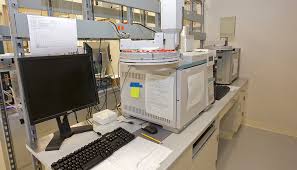
Gas chromatography provides separation of many petroleum compounds according to their volatility and interaction with the stationary phase. When coupled with mass spectrometry, it can provide molecular information useful for identifying biomarker compounds.
Mass spectral interpretation helps distinguish compounds with similar retention behaviour. Analysts examine characteristic fragment patterns together with chromatographic positions, reference standards, and established geochemical parameters to accurately confirm compound identities.
Quality control requires blanks, reference materials, replicate analyses, instrument checks, and careful data review. These procedures help identify contamination, carryover, poor separation, detector instability, and calculation errors that could distort petroleum tagging.
Results should be interpreted within the geological context rather than treated as isolated laboratory numbers. Combining analytical data with source-rock information, migration history, reservoir characteristics, and other geochemical evidence strengthens final conclusions.
Read Also: Mechanisms of Petroleum Migration and Petroleum Occurrence
Why Petroleum Tagging Matters

Petroleum tagging has practical value in exploration, production, environmental assessment, and forensic geochemistry. Molecular evidence can help explain where petroleum came from and how its composition changed during geological or environmental processes.
Tagging supports exploration by helping geoscientists correlate oils with source rocks and identify petroleum families. This information can improve understanding of petroleum systems and guide interpretation of wells, reservoirs, and migration pathways.
In production settings, biomarker comparisons can reveal relationships among oils from different wells. Such information may help identify compartmentalization, mixing, communication between reservoirs, or changes in fluid charge through a field.
Environmental investigations can use petroleum fingerprints to compare contaminated samples with suspected sources. This approach can complement ordinary hydrocarbon measurements where multiple petroleum inputs exist or weathering has altered the original contaminant pattern.
Investigators can also use biomarker evidence alongside watershed pollution management data, spatial information, and petroleum chemistry when evaluating suspected releases. Strong conclusions require multiple independent lines of evidence rather than molecular fingerprints alone.
Because petroleum tagging depends on molecular preservation, analysts must recognize uncertainty and communicate applicable maturity and alteration ranges. Environmental resource management principles support transparent interpretation for scientific, regulatory, and operational decisions, including economic impact assessments.
Overall, biomarkers provide a valuable molecular record within petroleum. When analysts combine resistant compounds, maturity ratios, source indicators, laboratory quality control, and resource-management context, petroleum tagging becomes more reliable and informative.
Summary on Practical Application of Biomarkers in Petroleum Tagging
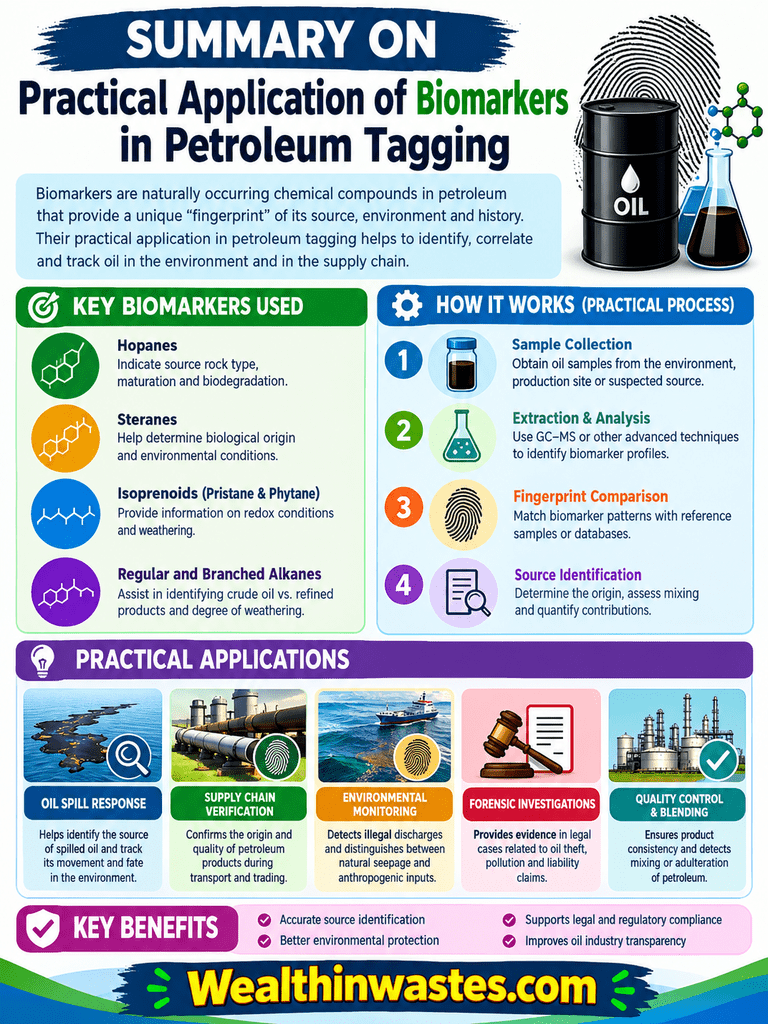
| Aspect | Summary |
|---|---|
| Biomarkers | Molecular fossils that preserve information about biological sources and petroleum history. |
| Petroleum tagging | Uses characteristic molecular signatures to identify, distinguish, and correlate petroleum samples. |
| Thermal maturity | Biomarker ratios help assess heating-related molecular changes within calibrated maturity ranges. |
| Source correlation | Similar biomarker distributions can indicate genetically related oils from comparable source systems. |
| Key compounds | Steranes, hopanes, terpanes, aromatic biomarkers, and isomer ratios provide complementary evidence. |
| Limitations | Heating rate, geology, kerogen type, nonlinear responses, alteration, and concentration affect interpretation. |
| Laboratory analysis | Sampling, fractionation, chromatography, mass spectrometry, and quality control support reliable results. |
| Best practice | Combine biomarkers with geological, isotopic, bulk chemical, sampling, and environmental evidence. |
Frequently Asked Questions About Practical Application of Biomarkers in Petroleum Tagging
1. What are biomarkers in petroleum tagging?
Biomarkers are resistant organic compounds that preserve clues about petroleum source, depositional setting, thermal maturity, migration, and alteration, supporting molecular identification.
2. How do biomarkers help identify petroleum sources?
Analysts compare biomarker distributions among oils because related source rocks often produce similar molecular patterns, while different sources can show distinct signatures.
3. Can biomarkers determine thermal maturity?
Yes. Selected biomarker ratios respond to heating and molecular rearrangement, allowing analysts to estimate maturity when appropriate parameters, calibrations, and geological context are available.
4. Why can biomarker maturity values vary?
Heating rate, source-rock geology, kerogen chemistry, and basin history affect biomarker responses, so one parameter may produce different maturity relationships between petroleum systems.
5. Does biodegradation affect petroleum tagging?
Biodegradation can remove susceptible hydrocarbons and change oil composition, but resistant biomarkers may remain measurable and continue providing useful source information after substantial alteration.
6. Which biomarker groups are commonly used?
Common groups include steranes, hopanes, terpanes, aromatic biomarkers, and stereochemical ratios, which provide complementary evidence about source, maturity, and petroleum history.
7. Why is representative sampling important for tagging?
Representative samples reduce contamination and selection errors, allowing laboratory measurements to reflect the petroleum body or environmental source that the investigation intends to characterize.
Do you have any questions, suggestions, or contributions? If so, please feel free to use the comment box below to share your thoughts. We also encourage you to kindly share this information with others who might benefit from it. Since we can’t reach everyone at once, we truly appreciate your help in spreading the word. Thank you very much for your support and for sharing!
Read Also: Water Pollution And Its Agricultural Implications