



Environmental Noise has become an important environmental health concern as transportation, construction, industries, entertainment activities, and expanding communities produce increasingly frequent and intense sounds across residential and commercial areas.
Unlike visible pollutants, Environmental Noise cannot usually be seen or touched, yet excessive exposure can interfere with sleep, communication, concentration, comfort, and overall wellbeing within affected communities.
A proper Environmental Noise Impact Analysis provides a structured approach for identifying existing sound conditions, predicting changes from proposed activities, and determining whether those changes could create unacceptable community impacts.
The process becomes especially important before projects introduce major traffic, machinery, industrial operations, generators, construction activities, or other persistent sources capable of increasing ambient noise levels substantially.
This article explains how Environmental Noise assessments work, how health effects influence standards, which populations face greater risks, and how regulators can evaluate acceptable risks and mitigation measures.
Understanding Environmental Noise Impact Analysis
Environmental Noise Impact Analysis evaluates whether a proposed activity could significantly change the existing acoustic environment and create harmful effects for residents, workers, businesses, institutions, wildlife, or other sensitive receptors.
A sound assessment begins with an accurate description of existing conditions before a project starts operating, allowing analysts to compare baseline noise with expected future levels and identify meaningful changes.
Organizations can strengthen environmental decision-making by applying principles found in environmental management planning, especially when proposed developments may create several interacting environmental pressures simultaneously.
The analysis also supports transparent discussions between developers, regulators, technical specialists, and communities because predicted noise changes can become part of broader environmental planning and approval processes.
Noise should therefore receive attention alongside other pollution concerns because communities rarely experience environmental problems separately, particularly where industrial activity, traffic, waste facilities, and dense development occur together.
A broader understanding of pollution is available through the concept of pollution and its environmental meaning, which helps explain why harmful changes require appropriate assessment and control.
Read Also: Proper Waste Control Complete Guide
Baseline Environmental Noise Assessment

1. Existing Noise Conditions: Analysts first measure current sound levels at representative locations and times, capturing normal conditions before proposed activities change traffic, machinery, operating schedules, or other background sources.
2. Measurement Locations: Sampling points should represent residences, schools, hospitals, workplaces, recreational areas, and other sensitive receptors so assessment results reflect the places where people may experience noise most directly.
3. Monitoring Procedures: Reliable assessments require suitable instruments, consistent measurement methods, appropriate observation periods, and careful documentation of weather, operating conditions, unusual events, and other factors affecting sound measurements.
4. Environmental Context: Analysts should document nearby roads, industrial equipment, construction activities, generators, commercial operations, and other sources because several sound sources can combine and influence the baseline condition.
5. Data Interpretation: Measurements become more useful when analysts examine patterns across daytime, evening, and nighttime periods instead of relying on one observation that may not represent typical community exposure.
6. Monitoring Records: Clear records allow future comparisons and help regulators determine whether reported changes arise from proposed projects, seasonal differences, altered traffic conditions, or other environmental developments.
Major Sources of Environmental Noise
Environmental Noise can originate from many human activities, with transportation representing one of the most widespread sources in densely populated areas where roads, railways, and airports operate continuously.
Industrial equipment can generate persistent sound through engines, compressors, pumps, generators, manufacturing machinery, loading operations, and material handling activities, particularly where facilities operate close to residential communities.
Construction projects can produce temporary but intense noise through excavation, drilling, demolition, concrete mixing, material movement, heavy vehicles, and powered equipment operating throughout different stages.
Commercial and recreational activities can also create noticeable noise through loudspeakers, entertainment venues, markets, workshops, religious gatherings, events, and generators used during electricity interruptions.
Research material on different sources and types of environmental pollution places noise pollution within the broader category of environmental pressures affecting communities and ecosystems.
Understanding these sources allows planners to identify practical control opportunities early, especially when project design can relocate machinery, reduce operating hours, install barriers, or separate noisy activities from sensitive locations.
Environmental Noise Effects on Human Health

1. Hearing Impairment: Prolonged exposure to sufficiently intense sound can damage hearing and contribute to permanent threshold shifts, making hearing protection and exposure control important for vulnerable workers.
2. Sleep Disturbance: Repeated nighttime noise can interrupt sleep, delay sleep onset, cause awakenings, and reduce restorative rest, potentially affecting daytime alertness, concentration, mood, and general wellbeing.
3. Speech Interference: Excessive background noise makes conversation harder because people may struggle to understand speech, communicate information, teach effectively, or hear warnings in busy environments.
4. Annoyance and Stress: Persistent unwanted noise can create irritation, frustration, tension, and reduced comfort, particularly when individuals have little control over the source or cannot escape exposure.
5. Cardiovascular Concerns: Long-term exposure to environmental stressors such as excessive noise may contribute to physiological stress responses, making careful assessment important where large populations face persistent exposure.
6. Broader Environmental Health Effects: The relationship between environmental conditions and health can be explored through environmental and health effects of pollution-related problems affecting communities.
Estimating Population at Risk
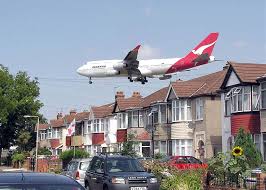
The population at risk represents people exposed to elevated Environmental Noise levels within a defined area, although exposure does not affect everyone equally because individual sensitivity and circumstances differ.
Residents living close to busy roads, factories, airports, construction sites, entertainment facilities, or other persistent sources may experience greater exposure than people living farther from these activities.
Population estimates should consider housing density, land use, operating schedules, exposure duration, and the location of sensitive facilities because these factors determine how many people may encounter elevated sound levels.
Information about sources, health effects, and environmental exposure risks provides a useful framework for understanding why exposure patterns matter when evaluating environmental hazards.
Sensitive groups may include children, older adults, people with existing health limitations, shift workers, hospital patients, students, and individuals whose daily activities require quiet environments for learning or recovery.
Accurate population estimation therefore improves risk evaluation because regulators can compare predicted exposure levels with community characteristics and prioritize mitigation where a substantial number of sensitive people could experience adverse effects.
Exposure-Response Relationships in Noise Assessment

1. Exposure Level: Regulators examine how changes in sound intensity relate to reported or observed health outcomes, recognizing that different effects may become more likely as exposure increases.
2. Exposure Duration: The length of time people experience Environmental Noise matters because repeated or prolonged exposure can create different risks from short, occasional encounters with similar sound levels.
3. Population Characteristics: Age, health status, occupation, lifestyle, and other characteristics can influence how communities experience noise, making population-specific considerations important when interpreting exposure-response relationships.
4. Environmental Conditions: Temperature, humidity, geography, terrain, building design, and surrounding land use can influence sound transmission and should therefore receive attention during environmental noise assessments.
5. Scientific Uncertainty: Regulators should recognize limitations in available evidence and avoid presenting exposure-response estimates as perfectly precise when research findings contain uncertainty or vary across populations.
6. Monitoring Evidence: Environmental measurements become more meaningful when they form part of continuous environmental monitoring programmes that track changing conditions and support evidence-based regulatory decisions over time.
Risk Acceptability and Noise Standards
Noise standards should protect public health while recognizing practical, technical, economic, and social realities surrounding the activities that generate sound within communities and industrial environments.
Where scientific evidence identifies clear harmful effects, regulators can establish protective limits and require project operators to apply measures that reduce exposure to acceptable levels.
Where uncertainty remains, decision-makers may apply precautionary approaches, especially when potential effects appear serious, exposed populations are large, or sensitive groups face prolonged environmental noise.
Effective standards should also consider community expectations, regulatory capacity, technical feasibility, local development priorities, and the availability of practical measures capable of reducing unnecessary environmental exposure.
Relevant discussions of social responses to environmental pollution demonstrate why public perception, cultural conditions, and community expectations can influence how environmental risks are understood and addressed.
Risk acceptability should therefore remain evidence-based while recognizing that communities may reasonably demand stronger protections where persistent noise interferes with sleep, communication, education, healthcare, work, or normal daily activities.
Read Also: Types of Wastewater and Motivational Factors for Recycling/Reuse
Environmental Noise Mitigation Measures

1. Source Reduction: The most effective approach often involves reducing noise where it originates through quieter equipment, improved maintenance, modified processes, alternative technologies, and better operational practices.
2. Pathway Control: Barriers, acoustic enclosures, insulation, landscaping, and appropriate separation distances can interrupt sound transmission between sources and people, reducing exposure around sensitive receptors.
3. Operational Controls: Developers can reduce disturbance by scheduling noisy activities during suitable periods, limiting unnecessary equipment use, controlling vehicle movements, and avoiding avoidable nighttime operations.
4. Land-Use Planning: Careful development decisions can separate intensive noise sources from residential communities, schools, hospitals, and other sensitive locations while supporting safer long-term environmental conditions.
5. Community Engagement: Clear communication with affected residents can identify major concerns, improve mitigation choices, and increase acceptance when communities understand project activities and proposed control measures.
6. Continuous Improvement: Environmental management should remain adaptive, using monitoring results and updated evidence to improve controls, similar to principles described in practical environmental management improvement strategies.
Regulatory Approaches to Environmental Noise
Effective Environmental Noise regulation requires clear responsibilities, measurable standards, reliable monitoring procedures, and enforcement mechanisms that encourage operators to prevent unnecessary exposure throughout project development.
Regulators should identify which agencies oversee environmental protection, public health, urban planning, occupational safety, transportation, and other activities that can influence community noise conditions.
Institutional coordination becomes particularly important when several authorities share responsibility for environmental quality, because fragmented enforcement can leave communities uncertain about complaint procedures and corrective actions.
Approaches discussed in institutional arrangements for pollution control demonstrate why agencies need suitable responsibilities, technical resources, monitoring capacity, and coordination to implement environmental standards effectively.
Noise complaints should receive systematic investigation because repeated community reports can reveal recurring problems, poorly controlled sources, changing exposure patterns, or weaknesses in existing environmental management practices.
Standards also work best when regulators combine enforcement with prevention, encouraging developers and operators to identify noise risks during planning rather than waiting until communities experience serious disturbance.
Broader pollution-control strategies can be strengthened through environmental pollution control approaches, especially where multiple environmental pressures require integrated planning rather than isolated interventions.
Summary on Analysis of the Impact of Environmental Noise
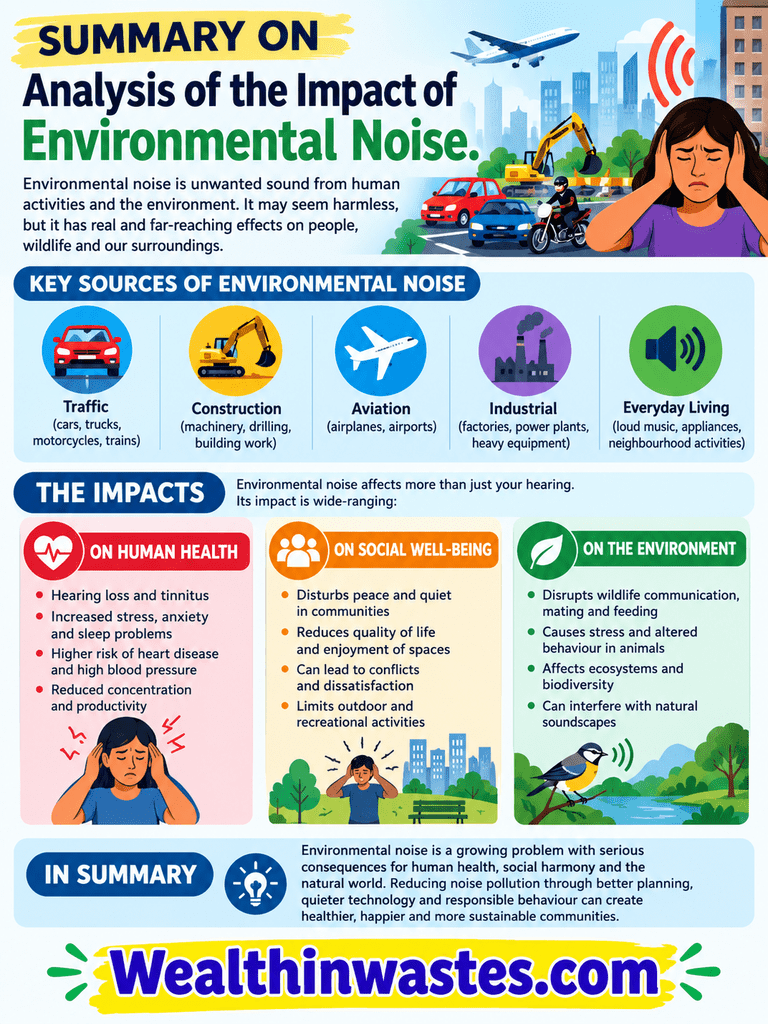
| Area | Summary |
|---|---|
| Environmental Noise Analysis | Evaluates existing sound conditions, predicts project-related changes, and identifies possible environmental and health impacts. |
| Baseline Assessment | Measures current sound conditions before new activities change the acoustic environment. |
| Health Effects | Noise can contribute to hearing impairment, sleep disturbance, speech interference, annoyance, stress, and other concerns. |
| Population at Risk | Exposure varies according to location, duration, population characteristics, land use, and proximity to noise sources. |
| Exposure-Response | Risk evaluation considers sound levels, exposure duration, population characteristics, environmental conditions, and scientific uncertainty. |
| Risk Acceptability | Standards should balance health protection, technical feasibility, economic considerations, scientific evidence, and community expectations. |
| Noise Mitigation | Source reduction, pathway controls, operational changes, planning, monitoring, and community engagement can reduce exposure. |
| Regulation | Effective control requires clear responsibilities, reliable monitoring, enforceable standards, institutional coordination, and public participation. |
Frequently Asked Questions About Environmental Noise: Impact Analysis and Health Effects
1. What is Environmental Noise?
Environmental Noise refers to unwanted or excessive sound from transportation, industries, construction, commercial activities, entertainment, machinery, and other human activities affecting surrounding communities.
2. What is an Environmental Noise Impact Analysis?
It is a structured assessment that describes existing noise conditions, predicts future changes, evaluates health risks, estimates exposed populations, and identifies appropriate mitigation measures.
3. Why is baseline noise monitoring important?
Baseline monitoring establishes existing sound conditions, allowing analysts to compare current exposure with predicted future levels and identify changes caused by proposed projects or activities.
4. Which health effects can excessive noise cause?
Potential effects include hearing problems, sleep disturbance, speech interference, annoyance, stress, reduced concentration, and other consequences associated with persistent environmental exposure.
5. Who may face greater Environmental Noise risks?
People living near major noise sources, children, older adults, hospital patients, students, shift workers, and individuals requiring quiet environments may experience greater concern from persistent exposure.
6. How can Environmental Noise be controlled?
Control measures include quieter equipment, maintenance, acoustic barriers, insulation, operational scheduling, land-use planning, appropriate separation distances, monitoring, and community engagement.
7. Why should governments regulate Environmental Noise?
Regulation helps protect communities by establishing standards, defining responsibilities, requiring monitoring, addressing complaints, and encouraging developers and operators to reduce unnecessary exposure.
8. Can Environmental Noise affect communities economically?
Yes. Persistent noise can reduce comfort, interfere with work and learning, increase complaints, and create costs associated with mitigation, monitoring, health concerns, and environmental management.
9. Why does community acceptance matter in noise assessment?
Community acceptance can influence how people perceive project risks, respond to mitigation measures, report disturbances, and evaluate whether proposed noise controls adequately protect local quality of life.
Environmental Noise management works best when assessment, monitoring, regulation, mitigation, and community participation operate together, creating a practical framework for protecting health while supporting responsible development.
Communities can further understand environmental pressures by reviewing land pollution causes, effects, and solutions, which demonstrates how environmental hazards require coordinated prevention and control strategies.
Integrated environmental planning also benefits from understanding the causes and effects of environmental contamination, because multiple hazards can occur together within developing urban and industrial areas.
Water-related environmental concerns also demonstrate the importance of systematic risk control, as explained through water pollution sources and classifications and their relationship with human and ecosystem health.
Noise planning should similarly connect with broader environmental responsibilities, including effective pollution control practices that reduce risks before contaminants or other harmful pressures reach communities.
Waste-related activities may also generate environmental pressures, making waste generation and environmental effects relevant when assessing facilities where transportation, machinery, treatment, and disposal activities occur.
Environmental Noise assessment can also complement waste minimization principles because waste prevention and source reduction approaches demonstrate how preventing environmental problems at their origin often improves overall management effectiveness.
Communities can reduce several environmental pressures by applying waste reduction and household minimization practices, especially where cleaner operations can reduce transportation demand, processing activities, and avoidable disturbances.
Appropriate treatment also matters because proper waste treatment and disposal methods can reduce unnecessary environmental impacts surrounding facilities that may otherwise produce persistent community disturbances.
Recycling can support broader environmental goals because the advantages of waste recycling include reduced disposal pressure, resource conservation, and environmental improvements that complement responsible community planning.
Well-managed waste systems can also limit unnecessary vehicle movement and facility operations, while sound waste management practices support cleaner and healthier surroundings.
Do you have any questions, suggestions, or contributions? If so, please feel free to use the comment box below to share your thoughts. We also encourage you to kindly share this information with others who might benefit from it. Since we can’t reach everyone at once, we truly appreciate your help in spreading the word. Thank you very much for your support and for sharing!
Read Also: Water and Land Pollution in Agriculture