



Environmental noise is an overlooked form of pollution that can influence how people sleep, communicate, work, study, recover, and interact within their communities throughout ordinary daily life and routine activities.
An environmental noise impact analysis examines how a proposed activity could alter existing sound conditions and whether the resulting exposure could create unacceptable effects for residents, workers, institutions, or surrounding ecosystems.
A useful analysis starts with a baseline description of the existing acoustic environment before construction or operation begins, allowing later measurements to show how much the project actually changes community exposure over time.
Some assessment frameworks use a noticeable increase, such as around five decibels, as a screening trigger, although the appropriate threshold depends on local standards, existing sound conditions, and individual project characteristics.
The predicted sound from a new source should be considered together with the baseline environment rather than assessed in isolation, because several sources can combine to create greater overall exposure.
A complete assessment also considers where people live, work, study, sleep, or receive healthcare, because the same sound level can produce different consequences depending on location, timing, duration, and sensitivity.
Understanding the Impact of Environmental Noise
Environmental noise refers to unwanted or excessive sound arising from transportation, industry, construction, commerce, entertainment, neighbourhood activities, and other human operations that reach surrounding communities.
Understanding the different forms of pollution helps place noise within the wider environmental context, because communities can experience several pollution pressures simultaneously.
Noise becomes an environmental concern when sound reaches levels, durations, or patterns that interfere with normal activities, comfort, communication, sleep, or other aspects of human wellbeing.
Environmental Noise Impact Analysis supports evidence-based decisions by comparing existing conditions with projected conditions before a project creates avoidable long-term problems for nearby residents and sensitive locations.
The process resembles broader environmental impact assessment practices, where potential effects receive attention before authorities approve development, impose operating conditions, or require mitigation measures.
A strong assessment also considers cumulative exposure because transportation, commercial, industrial, construction, and community sources can overlap and produce a sound environment that differs considerably from any single source.
Major Sources of Environmental Noise
Environmental noise comes from many activities, and identifying the dominant sources helps assess which controls can reduce exposure most effectively within a community.
1. Road Traffic: Cars, buses, motorcycles, heavy trucks, horns, and poorly maintained vehicles can create continuous or intermittent noise, particularly along busy roads and densely developed urban corridors.
2. Aircraft Operations: Aircraft takeoffs, landings, engine testing, and ground activities can expose communities near airports to repeated high-intensity sound, especially during busy operating periods and changing flight schedules.
3. Industrial Activities: Factories, generators, machinery, compressors, pumps, and material handling equipment can produce persistent noise that travels beyond facility boundaries when controls remain inadequate or equipment operates continuously.
4. Construction Activities: Excavation, drilling, demolition, concrete mixing, piling, and heavy equipment can create temporary but substantial noise, particularly when projects operate close to homes, schools, or sensitive facilities.
5. Community Activities: Religious gatherings, entertainment venues, markets, household equipment, loudspeakers, and social events can produce environmental noise that becomes significant when it occurs frequently or continues overnight.
6. Waste and Service Operations: Collection vehicles, compactors, transfer stations, maintenance equipment, and other municipal services can add recurring sound exposure, especially where facilities operate near residential areas and busy streets.
Research and community assessments also recognize that transportation and industrial activities can contribute to several environmental pressures at the same time.
Read Also: Casella Waste Services Complete Guide
Impact of Environmental Noise on Human Health

The impact of environmental noise on human health depends on sound intensity, exposure duration, frequency, timing, individual sensitivity, and whether people can obtain quiet periods between noisy events.
1. Hearing Effects: Very loud or prolonged exposure can damage hearing, while repeated exposure may contribute to elevated hearing thresholds and reduced ability to understand speech clearly over time.
2. Sleep Disturbance: Night-time noise can cause awakenings, difficulty falling asleep, fragmented rest, and poorer sleep quality, which may affect daytime alertness, concentration, mood, and general wellbeing.
3. Communication Problems: Excessive background noise can mask speech, forcing people to speak louder, repeat information, or move closer together during conversations, teaching, meetings, and family interactions.
4. Stress Responses: Persistent unwanted sound may trigger irritation, tension, annoyance, and physiological stress responses, particularly when people feel unable to control or escape the noise source.
5. Cardiovascular Concerns: Long-term environmental noise exposure has been associated with stress-related cardiovascular effects, making sustained community exposure an important consideration within broader public-health planning.
6. Reduced Performance: Noise can interfere with concentration, learning, task accuracy, workplace productivity, and recovery, especially when exposure occurs in schools, offices, healthcare facilities, or residential environments.
Related discussions of human health and environmental concerns show why pollution assessment should consider direct effects, vulnerable people, and conditions surrounding exposure.
Population Groups Most at Risk
Not every person experiences environmental noise in exactly the same way. Population characteristics, existing health conditions, age, lifestyle, housing conditions, and exposure patterns can influence vulnerability significantly.
1. Children: Children may experience greater disruption when environmental noise interferes with learning, communication, sleep, concentration, and other activities needed for healthy development and effective education.
2. Older Adults: Older people may face additional difficulties when noise interferes with sleep, communication, rest, or existing physical limitations, particularly where homes remain close to persistent transportation sources.
3. People With Existing Conditions: Individuals with certain illnesses or physiological limitations may have less resilience to stress and sleep disruption, requiring careful consideration during environmental noise assessments.
4. Night-Shift Workers: People who sleep during daytime hours can encounter unusual exposure patterns because traffic, construction, commercial activities, and community noise often increase while they need quiet surroundings.
5. Residents Near Major Sources: Communities located beside airports, highways, industrial facilities, or busy commercial areas can experience repeated exposure, making land-use planning and mitigation particularly important for long-term protection.
Broader public-health risk assessment practices similarly emphasize exposure levels, population characteristics, affected locations, and the uncertainty surrounding environmental health outcomes.
Population differences can influence how noise affects people, just as location, climate, daily activities, building design, and access to quiet spaces can alter individual exposure patterns.
The social response to environmental pollution also matters because annoyance and perceived risk can vary according to community expectations, cultural practices, trust, and previous experience.
Environmental Noise Exposure-Response Assessment
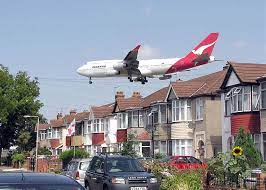
Exposure-response relationships help regulators estimate how changes in environmental noise may relate to specific health outcomes, while also showing where scientific uncertainty remains important during standard-setting decisions.
1. Measure Existing Exposure: Professionals collect representative sound measurements across relevant locations and periods, documenting daytime, evening, and night-time conditions before project activities change the environment.
2. Predict Project Noise: Acoustic models estimate sound levels from vehicles, machinery, buildings, equipment, and operations, considering distance, barriers, terrain, weather, operating schedules, and expected source characteristics.
3. Combine Sound Sources: Analysts consider cumulative exposure from existing and proposed sources rather than treating each contributor separately, because multiple noise sources can influence the same population.
4. Compare With Criteria: Predicted results can then be compared with applicable legal standards, planning requirements, health-based guidance, or project-specific criteria established by responsible environmental authorities.
5. Address Uncertainty: Regulators should recognize uncertainty caused by population differences, measurement limitations, changing weather, geographic conditions, source variability, and assumptions within prediction models.
6. Identify Sensitive Locations: Schools, hospitals, homes, workplaces, and other areas requiring quieter conditions deserve focused assessment because exposure consequences may differ substantially between land uses.
Environmental monitoring methods can support reliable baseline development, while systematic pollutant monitoring practices demonstrate the importance of consistent measurements and careful interpretation.
Environmental audits can complement project assessments by checking whether established systems remain effective, whether controls perform as intended, and whether identified environmental risks require corrective action.
For wider environmental planning, environmental audit procedures provide a useful framework for comparing existing conditions, identifying risks, and documenting recommendations for improvement.
Noise Risk Acceptability and Standards
Noise regulation involves deciding which impacts require intervention and what level of residual exposure a community can reasonably accept after practical controls have been considered.
The distinction between adverse and non-adverse effects can create difficult policy decisions because annoyance, temporary functional changes, sleep disruption, and measurable hearing effects differ in severity and certainty.
1. Define Health Outcomes: Regulators should identify the specific effects that standards intend to prevent, ranging from hearing impairment and speech interference to sleep disturbance, annoyance, and stress-related consequences.
2. Estimate Population Risk: Risk evaluation should consider exposure magnitude, duration, frequency, affected population size, vulnerable groups, and the seriousness of potential health outcomes associated with the expected noise.
3. Weigh Scientific Uncertainty: Where evidence does not establish a clear threshold, authorities should account for uncertainty rather than assuming that an absence of certainty means an absence of risk.
4. Consider Technical Feasibility: Decision-makers can compare available mitigation methods, installation requirements, operating costs, maintenance needs, land constraints, and expected reductions before selecting practical controls.
5. Consider Community Acceptance: Public perceptions, local expectations, cultural context, previous environmental experience, and confidence in regulators can influence whether proposed noise controls appear reasonable to affected communities.
6. Apply Precaution Where Necessary: Where serious effects may affect many people, a cautious approach can justify stronger controls, especially when exposure could persist for years and mitigation remains technically achievable.
Authorities should also recognize that pollution can impose wider social and financial burdens, as demonstrated by studies examining economic losses associated with environmental pollution.
Effective standards work best when regulators can monitor compliance, enforce requirements, communicate decisions clearly, and coordinate responsibilities across agencies, industries, local authorities, and affected communities.
This institutional approach resembles established pollution control responsibilities, where monitoring, enforcement, technical capacity, and clearly defined institutional roles support better environmental outcomes.
Read Also: Proper Waste Control Complete Guide
Noise Mitigation, Monitoring and Prevention

Reducing the impact of environmental noise requires action at the source, along transmission pathways, and at locations where people remain exposed for extended periods.
1. Control Noise at Source: Choosing quieter equipment, maintaining machinery, reducing unnecessary horn use, enclosing noisy operations, and improving equipment design can prevent sound from becoming a larger community burden.
2. Control Sound Transmission: Barriers, acoustic enclosures, building design, insulation, earth berms, and suitable site layouts can reduce the amount of noise travelling toward nearby receptors.
3. Manage Operating Times: Scheduling the loudest activities during less sensitive periods can reduce disruption, particularly around sleeping hours, school sessions, healthcare services, and other quiet-use periods.
4. Improve Land-Use Planning: Separating major noise sources from homes, hospitals, schools, and other sensitive locations can prevent long-term conflicts and reduce reliance on expensive corrective measures later.
5. Monitor Community Exposure: Regular measurements, complaint records, equipment checks, and compliance reviews help determine whether actual noise remains within expected limits and whether additional controls become necessary.
6. Maintain Community Engagement: Clear communication about expected impacts, monitoring results, mitigation measures, and complaint procedures can improve trust and encourage residents to participate constructively in environmental management.
Proper planning can complement specific noise controls because effective environmental management in cities encourages coordinated approaches to pollution, land use, resource management, and community wellbeing.
Construction and operational controls should also fit broader environmental priorities, including waste prevention and pollution reduction, rather than treating noise as an isolated environmental problem.
Communities can strengthen prevention by following practical environmental pollution reduction measures that reduce unnecessary environmental pressures through better planning, maintenance, and responsible daily activities.
Where waste facilities generate substantial operational noise, appropriate waste disposal methods can improve facility organization while supporting cleaner and better-controlled environmental operations.
Waste-related infrastructure can also benefit from structured waste management strategies that coordinate facility design, collection systems, operating procedures, monitoring, and community considerations.
Broader environmental protection can also consider environmental and health effects associated with poorly managed activities, ensuring that noise controls complement wider public-health and environmental safeguards.
Noise assessment should remain part of an integrated environmental management system, alongside responsible waste handling, pollution prevention, sanitation, monitoring, and land-use decisions throughout the project lifecycle.
The importance of environmental sanitation illustrates how coordinated community practices can support healthier surroundings, while noise management adds another important dimension to environmental quality.
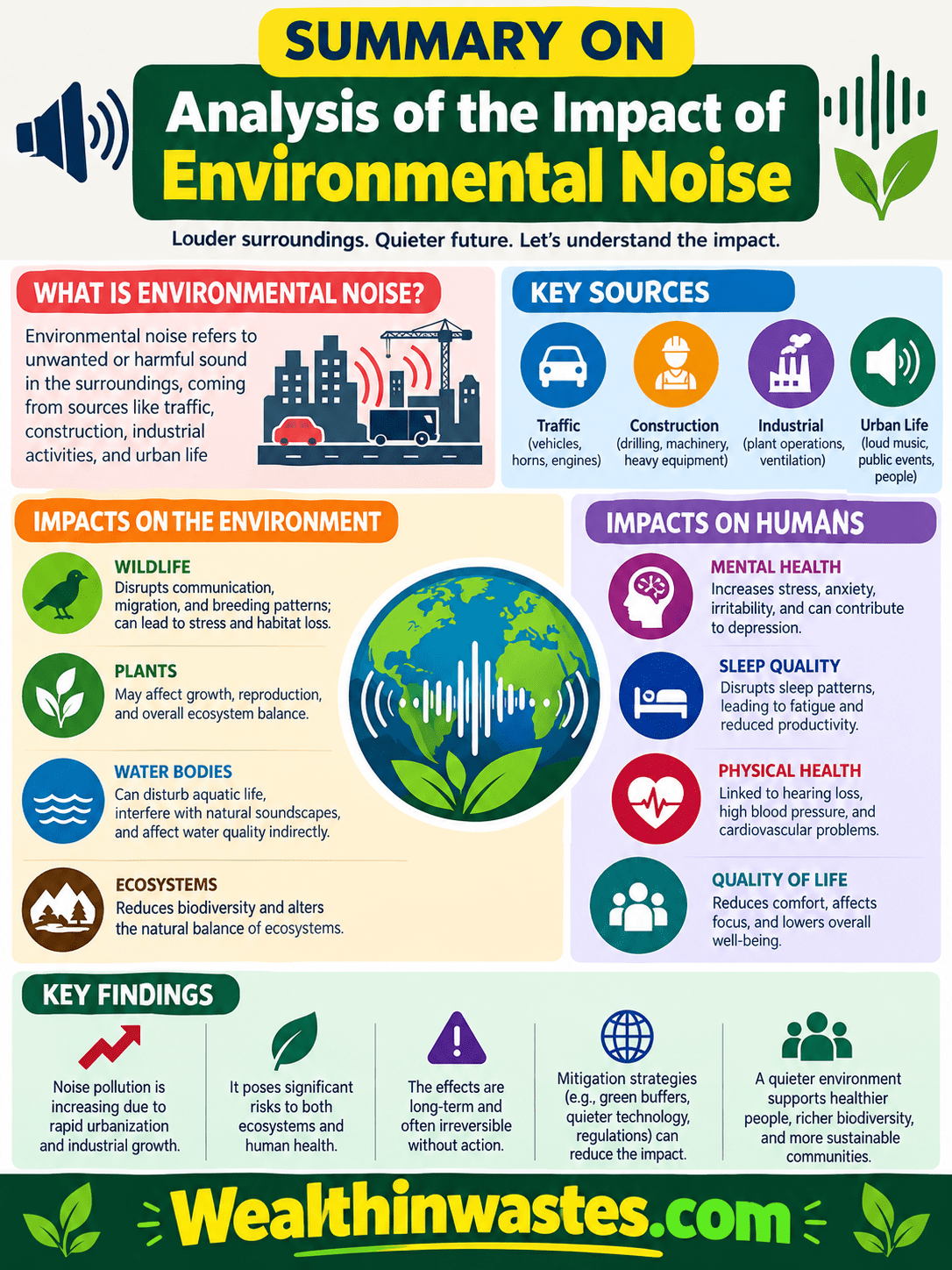
Summary on Analysis of the Impact of Environmental Noise
| Section | Main Idea | Why It Matters |
|---|---|---|
| Environmental Noise | Noise is an environmental pollutant that requires systematic assessment. | It helps identify unacceptable community exposure. |
| Noise Sources | Transport, industry, construction, aviation, and community activities create exposure. | Source identification guides effective controls. |
| Human Health | Noise can affect hearing, sleep, communication, stress, and performance. | Health effects justify preventive action. |
| Population Risk | Children, older adults, night workers, and nearby residents may face greater vulnerability. | Risk assessment should recognize sensitive groups. |
| Exposure Assessment | Baseline measurements and prediction models support informed decisions. | Accurate evidence improves standards and project planning. |
| Risk Standards | Authorities weigh severity, uncertainty, population size, feasibility, and acceptance. | Balanced standards protect health while remaining practical. |
| Mitigation | Source controls, barriers, scheduling, planning, monitoring, and engagement reduce exposure. | Integrated action prevents and controls noise impacts. |
Frequently Asked Questions About Impact of Environmental Noise: Health, Risks and Control
1. What is the impact of environmental noise?
The impact includes sleep disruption, communication difficulties, annoyance, stress, reduced concentration, hearing effects, and other consequences linked with excessive or persistent exposure.
2. What is Environmental Noise Impact Analysis?
It is a structured assessment that compares baseline sound conditions with predicted project noise and evaluates potential health, community, and environmental consequences.
3. What are common environmental noise sources?
Common sources include road traffic, aircraft, industrial equipment, construction machinery, generators, entertainment venues, loudspeakers, markets, and municipal service operations.
4. Which people are more vulnerable to noise?
Children, older adults, people with certain existing conditions, night-shift workers, and residents living close to major noise sources may require closer assessment.
5. Why is a baseline noise assessment important?
A baseline establishes existing sound conditions, allowing professionals to compare future exposure with present conditions and determine the actual change associated with a proposed activity.
6. How can environmental noise be reduced?
Noise can be reduced through quieter equipment, barriers, acoustic enclosures, better land-use planning, maintenance, operating schedules, monitoring, and meaningful community engagement.
7. Why does community acceptance matter?
Community acceptance can influence how people perceive environmental risks, participate in monitoring, report problems, and respond to proposed mitigation measures and development decisions.
8. What should regulators consider when setting noise standards?
Regulators should consider health effects, population size, vulnerable groups, exposure levels, scientific uncertainty, technical feasibility, economic factors, and community expectations.
9. Can environmental noise affect sleep?
Yes. Repeated or intrusive night-time sound can interrupt sleep, delay sleep onset, reduce sleep quality, and contribute to daytime fatigue and reduced concentration.
10. Why should noise management begin before construction?
Early planning allows developers to identify sensitive receptors, select quieter equipment, redesign layouts, schedule activities appropriately, and prevent avoidable noise conflicts before operations begin.
Do you have any questions, suggestions, or contributions? If so, please feel free to use the comment box below to share your thoughts. We also encourage you to kindly share this information with others who might benefit from it. Since we can’t reach everyone at once, we truly appreciate your help in spreading the word. Thank you very much for your support and for sharing!
Read Also: Proper Farm Waste Management Guide