



The effective environment of an organism is a foundational concept in ecology and biology, describing all the external conditions that influence an organism’s survival, growth, and reproduction. By understanding an organism’s environment, scientists can better appreciate the complex interactions that determine how species thrive, compete, and adapt over time.
One key component of the effective environment is the organic or biotic milieu. This refers to the living elements and non-living organic matter within the organism’s surroundings. It includes:
- All other organisms in the region, such as plants, animals, and microorganisms. These organisms may serve as sources of food, competition, or symbiotic partners.
- Non-living organic matter, such as decaying leaves, fallen branches, or dead organisms, which can provide nutrients or alter the habitat in ways that affect living species.
- The organism’s population, meaning other members of the same species. Interactions within a population—such as mating, cooperation, or competition—play a critical role in an organism’s ability to survive and reproduce.
The biotic milieu is not a static element; it constantly changes due to natural processes, seasonal shifts, or human activity. These changes can create opportunities or challenges for organisms, shaping their behavior and adaptation strategies.
Read Also: Chicken Brooder House – Complete Chicks Brooding Care Guide
The Effective Environment as a Whole
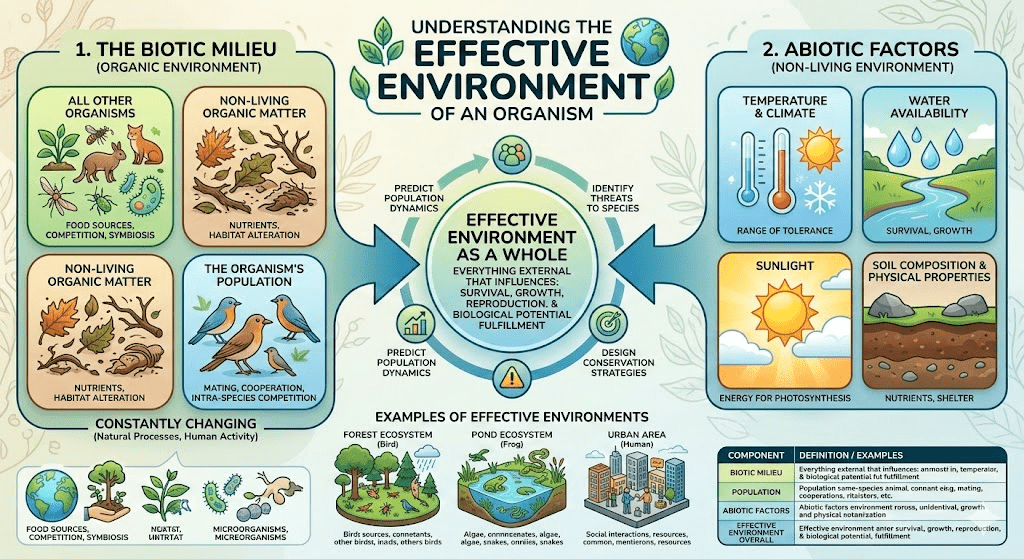
Strictly speaking, the effective environment is more than just the biotic milieu. It encompasses everything external to the organism that influences its ability to fulfill its biological potential. This includes:
- Abiotic factors, such as temperature, water availability, sunlight, soil composition, and other physical or chemical properties of the habitat.
- Biotic interactions, as described above, including competition, predation, symbiosis, and cooperation among organisms.
By combining both biotic and abiotic elements, the effective environment represents the full spectrum of conditions that determine how successfully an organism can live, grow, and reproduce. A clear understanding of this environment helps ecologists predict population dynamics, identify threats to species, and design conservation strategies.
Examples of Effective Environments
Consider the following examples:
- A forest ecosystem: The effective environment of a bird in a forest includes trees (abiotic shelter), insects and seeds (food sources), other birds (population interactions), and seasonal changes (temperature and rainfall).
- A pond ecosystem: For a frog, the effective environment includes water quality (abiotic), algae and insects (food sources), predators like snakes (biotic), and nearby vegetation (shelter).
- Human urban areas: Even humans have an effective environment, including social interactions (population), infrastructure (abiotic), and resources such as food and water.
These examples demonstrate how both living and non-living factors interact to influence an organism’s success within its habitat.
Table of Summary
| Component | Definition / Examples |
|---|---|
| Biotic Milieu | Living organisms and non-living organic matter (plants, animals, decaying matter) |
| Population of Organism | Members of the same species that the organism interacts with |
| Abiotic Factors | Non-living elements like sunlight, water, soil, and temperature |
| Effective Environment Overall | Combination of biotic and abiotic factors affecting organism fulfillment |
Frequently Asked Questions (FAQ)
- What is the biotic milieu?
The biotic milieu refers to all living organisms in an area, as well as non-living organic matter, that can affect an organism’s survival and behavior. - Does the effective environment include only living things?
No. It includes both living (biotic) and non-living (abiotic) factors that influence the organism’s growth, reproduction, and overall fulfillment. - Why is an organism’s population important?
The population consists of members of the same species. Interactions within this group, such as mating, competition, or cooperation, directly affect the organism’s ability to survive. - Can the effective environment change over time?
Yes. Environmental factors are dynamic. Natural events, seasonal changes, and human activities can alter both biotic and abiotic components of an organism’s environment. - How is this knowledge useful?
Understanding the effective environment allows ecologists to predict species behavior, manage wildlife populations, and design conservation strategies to protect ecosystems.
Read Also: An Overview of The Environment and it’s Types
Do you have any questions, suggestions, or contributions? If so, please feel free to use the comment box below to share your thoughts. We also encourage you to kindly share this information with others who might benefit from it. Since we can’t reach everyone at once, we truly appreciate your help in spreading the word. Thank you very much for your support and for sharing!