


'/%3E%3C/g%3E%3Cuse%20href='%23c'%20transform='matrix(-1%200%200%201%20720%200)'/%3E%3C/svg%3E)
'%3E%3Cpath%20id='a'%20stroke='%23000'%20stroke-width='2'%20d='m-106%20177%207%203L75-122c21-4%2042-63%2048-89-27%2023-59%2066-54%2086z'/%3E%3Cuse%20href='%23a'%20transform='scale(-1%201)'/%3E%3Cg%20id='c'%3E%3Cpath%20fill='%23b00'%20d='m-1%200%201%20180c22%200%2060-60%2071-90h379V-90H71c-11-30-48-90-71-90'/%3E%3Cpath%20fill='%23000'%20d='M71%2090C83%2060%2090%2030%2090%200s-7-60-19-90C60-60%2053-30%2053%200s7%2060%2018%2090'/%3E%3Cpath%20id='b'%20d='M4%2022s15%2030%2015%2079-15%2079-15%2079'/%3E%3Cuse%20href='%23b'%20transform='scale(1%20-1)'/%3E%3C/g%3E%3Cuse%20href='%23c'%20transform='scale(-1%201)'/%3E%3Cellipse%20rx='15'%20ry='23'/%3E%3C/g%3E%3C/svg%3E)
'/%3E%3Cuse%20href='%23a'%20transform='rotate(216%20450%20300)'/%3E%3C/g%3E%3Cuse%20href='%23b'%20transform='rotate(72%20450%20300)'/%3E%3C/svg%3E)


'/%3E%3Cpath%20fill='%23b2b2b2'%20d='M241%20382q0%2016%2017%2026%2017%2011%2042%2011t42-11q16-11%2017-26V269H241'/%3E%3Cpath%20fill='%239f7e00'%20d='M241%20379q0%2014%208%2023%209%209%2021%209%2014%200%2021-9%209-9%209-23V269h-59'/%3E%3Cpath%20d='M241%20339v-70h59v110q0%2014-9%2023l-6%205v-68h-15v72q-8%200-14-4v-68zm59%2040c0%2022%2015%2032%2029%2032%2021%200%2030-18%2030-32v-40h-59'/%3E%3Cpath%20fill='%239f7e00'%20d='M266%20277v5h2v12h-3v-5h2v-5h-9v5h2v5h-4v9h3v18h-5v10h34v-10h-5v-18h3v-9h-4v-5h2v-5h-9v5h2v5h-3v-12h2v-5zm42%20101q0%2010%206%2017%206%206%2015%207%2010-1%2016-7%206-7%206-17v-29h-43'/%3E%3Ccircle%20fill='%230044ad'%20cx='329.5'%20cy='372'%20r='6'/%3E%3Cellipse%20fill='%230044ad'%20cx='300'%20cy='340'%20rx='16'%20ry='21'/%3E%3C/svg%3E)

'%3E%3Ccircle%20r='92'/%3E%3Ccircle%20fill='%23fff'%20r='80'/%3E%3Ccircle%20r='16'/%3E%3Cg%20id='c'%3E%3Cg%20id='b'%3E%3Cpath%20id='a'%20d='m0-80%203%2048L0-8-3-32M21-77%2011-30%202-8%205-32M40-69%2019-26%204-7%2013-29'/%3E%3Cuse%20href='%23a'%20transform='scale(-1)'/%3E%3C/g%3E%3Cuse%20href='%23b'%20transform='rotate(45)'/%3E%3C/g%3E%3Cuse%20href='%23c'%20transform='rotate(90)'/%3E%3C/g%3E%3C/svg%3E)


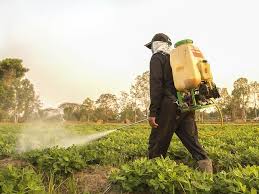
The increasing pesticide use in less developed countries reflects major changes in agriculture, food production, trade, technology, and pest management. These changes can increase dependence on chemical control when other safeguards remain limited.
Pesticides can protect crops from insects, weeds, fungi, rodents, and other harmful organisms, helping farmers reduce losses and improve production. However, frequent or inappropriate applications can create environmental and health concerns.
Less developed countries may face conditions that encourage heavier pesticide dependence, including pressure to produce export crops, limited extension services, weak enforcement, and easier access to some chemical products and formulations.
The problem does not come from pesticide use alone. Risks become greater when farmers select unsuitable products, apply excessive quantities, ignore protective measures, or continue spraying after pests develop resistance to earlier chemicals.
Understanding the reasons for increasing pesticide use can help governments, farmers, development agencies, and communities design practical pest-management systems. These systems can maintain crop protection while reducing unnecessary chemical exposure and environmental contamination.
Modern Technology and Pesticide Use
Modern agricultural technology has increased farmers’ access to improved seeds, irrigation systems, machinery, fertilizers, pesticides, and other production inputs. These tools can raise output, but they may also increase dependence on coordinated chemical protection.
Development programmes often promote intensive farming systems to improve food supplies, household incomes, and export earnings. When these systems prioritize high yields, farmers may adopt chemical pest control as a routine part of production.
Technology can also change the scale of farming. Larger cultivated areas, uniform varieties, and synchronized planting may allow pests to spread rapidly, making farmers more likely to seek fast and predictable chemical control.
Financial support from governments, development institutions, and agricultural programmes can accelerate the adoption of modern production packages. Without equally strong training, monitoring, and stewardship, pesticide use may grow faster than safety capacity.
Larger and more intensive farms often require coordinated pest management because many crops mature together. When biological, cultural, or mechanical controls act slowly, farmers may turn toward chemical options for immediate crop protection.
Modern production packages often combine improved seeds with fertilizers and crop-protection products. This integration can make pesticide application seem like a normal component of intensive farming rather than a measure reserved for confirmed pest problems.
Farmers seeking reliable yields may favour products that promise rapid results, especially where crop losses threaten income, loan repayment, household food security, or access to profitable markets. Commercial expectations can reinforce this preference.
Read Also: Proper Methods of Disposal of Dilute Pesticide Waste
Agricultural Goals and Pesticide Demand
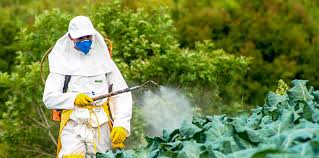
Agricultural goals strongly influence pesticide demand in less developed countries. Governments and producers often seek greater yields, foreign exchange, food security, reliable employment, and dependable supplies from commercial farming systems.
Export-oriented programmes can encourage the cultivation of cash crops that require strict appearance standards and reliable harvest quantities. Pest damage may threaten contracts, prices, and export opportunities, encouraging repeated chemical treatments.
When production targets become closely tied to market expectations, farmers may view pesticides as essential insurance against uncertain pest pressure. This can increase applications even when pest populations do not justify routine treatment.
Cash-crop expansion may also replace diverse farming systems with larger areas devoted to fewer crops or varieties. Reduced diversity can simplify pest movement and increase the need for intensive monitoring and control.
1. Export Production: Farmers growing commodities for external markets may face strong quality requirements, making visible insect, fungal, or weed damage economically costly and encouraging greater chemical treatment frequency throughout production.
2. Yield Targets: Programmes designed to raise productivity can encourage producers to protect every possible unit of output, sometimes leading to preventive applications rather than treatments based on verified pest thresholds.
3. Market Expectations: Buyers may demand consistent size, appearance, timing, and quantity, creating pressure to prevent cosmetic damage and maintain uniform harvests throughout the production season for reliable market access.
4. Income Protection: Where a single harvest provides a major share of annual income, farmers may perceive pesticide application as a practical way to reduce financial losses from sudden pest outbreaks.
Hybrid Seeds and Monoculture Dependence
Improved hybrid seeds can increase yields, shorten production cycles, and support commercial agriculture. Yet some high-performing varieties may lack resistance to pests common in their new growing environments and farming systems.
When farmers cultivate genetically similar crops across large areas, pests can encounter abundant and continuous food supplies. This uniformity can make outbreaks more difficult to contain when natural enemies cannot respond quickly.
Monoculture also reduces the diversity of plants and habitats within agricultural landscapes. Fewer alternative hosts and refuge areas can alter ecological relationships, sometimes allowing particular pests to build populations rapidly.
These conditions can make pesticide use appear necessary for protecting uniform crops. The resulting dependence may become stronger when farmers have limited access to resistant varieties, crop rotation advice, or biological control services.
Vulnerable varieties may perform well under favourable conditions but still require stronger pest protection when local pest species lack effective natural barriers, resistance, or suitable biological control within the production environment.
Large areas planted with similar crops provide predictable resources for pests, allowing populations to spread across farms. This uniformity can increase the perceived need for chemical suppression during serious or rapidly expanding outbreaks.
Diverse crop systems can interrupt pest development and support beneficial organisms, whereas simplified systems may reduce these natural checks. Reduced diversity can therefore increase chemical dependence across repeated production cycles.
Repeated planting of the same crop gives specialist pests continued access to suitable food and habitat. Crop rotation, resistant varieties, and ecological management can interrupt this pattern and reduce pressure for pesticide applications.
Pesticide Treadmill and Resistance
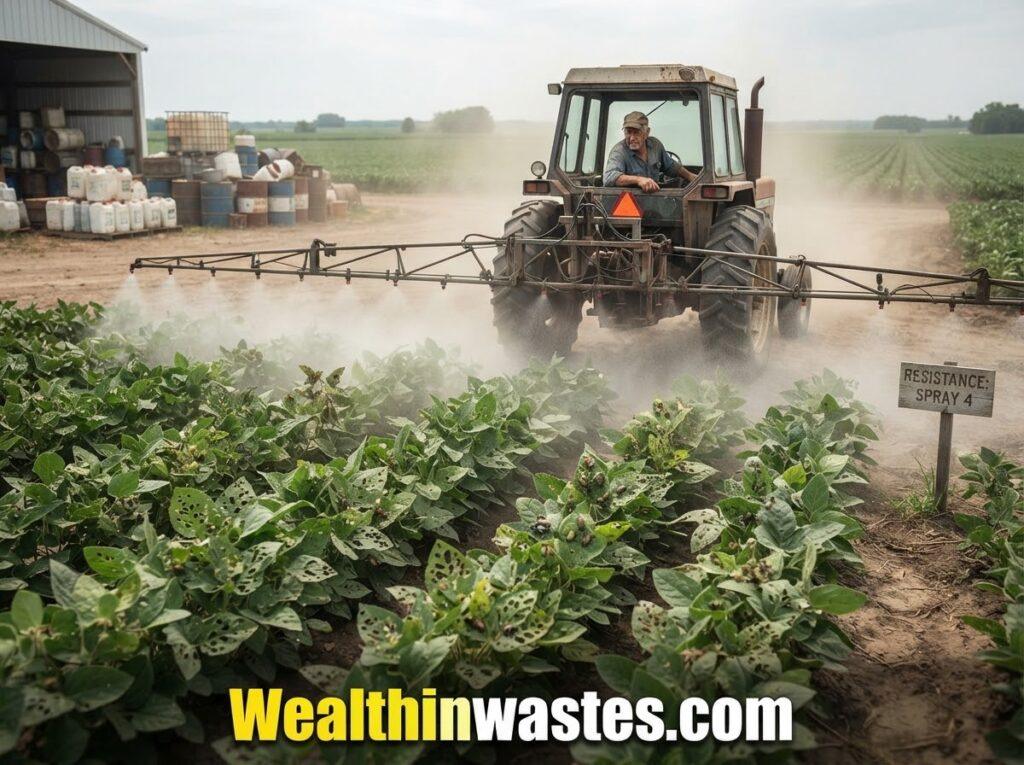
The pesticide treadmill describes a cycle in which pesticide use selects for resistant pest populations, reducing effectiveness. Farmers may then increase applications, change chemicals, or adopt products with different modes of action.
Resistance develops because pest populations contain genetic variation, and repeated exposure can favour individuals that survive treatment. Those survivors reproduce, gradually increasing the proportion of resistant pests in later generations.
Broad-spectrum pesticides can also affect predators, parasitoids, and competing organisms that naturally suppress pests. Removing these beneficial organisms can disturb ecological balances and contribute to pest resurgence after treatment in some fields.
As control becomes harder, farmers may respond with additional applications or stronger chemical mixtures. This cycle can increase production costs while raising the amount of pesticide released into soil, water, air, and food systems.
1. Selection Pressure: Repeated exposure allows resistant individuals to survive and reproduce, gradually reducing pesticide effectiveness and making previously useful treatments less dependable across repeated production cycles and pest generations.
2. Pest Resurgence: Chemical treatments may reduce natural enemies alongside target pests, allowing surviving pest populations to recover rapidly after the initial treatment effect declines in treated fields and surrounding habitats.
3. New Products: When resistance weakens an existing pesticide, farmers may switch products, increasing dependence on additional active ingredients and potentially creating new selection pressure over subsequent seasons and applications.
4. Wider Exposure: More frequent or broader applications can increase opportunities for pesticide residues and spray drift to reach workers, neighbouring farms, water bodies, livestock, wildlife, and consumers in surrounding communities.
Weak Pesticide Regulation and Standards
Weak regulation can contribute to increasing pesticide use and abuse when governments lack sufficient resources to register products, inspect markets, train users, monitor residues, and enforce safe-use requirements effectively and consistently.
Regulatory systems need clear rules for product approval, labelling, importation, storage, sale, application, transport, and disposal. Where these systems remain incomplete, inappropriate or poorly understood products may circulate widely without adequate oversight.
Import controls matter because pesticide availability can differ substantially between markets. Stronger regulatory capacity helps authorities identify products that do not meet local safety requirements and prevents unsuitable chemicals from entering agricultural supply chains.
Enforcement also depends on practical resources. Inspectors, laboratories, extension officers, border agencies, and environmental authorities need funding, equipment, trained personnel, and coordinated procedures to make regulations meaningful and consistently enforceable.
Poor registration systems can make it harder to identify unsuitable products, verify active ingredients, or ensure that labels provide accurate information for local users, inspectors, retailers, and agricultural extension personnel.
Rules cannot protect communities effectively when agencies lack enough inspectors, laboratories, transportation, or legal capacity to monitor pesticide markets and farming practices consistently across all regions and agricultural zones in practice.
Unregulated sellers may provide products without reliable instructions, creating opportunities for incorrect dosage, counterfeit formulations, improper storage, and unsafe handling by inexperienced users or smallholder farmers working without adequate guidance.
Conflicting agricultural, trade, health, and environmental priorities can weaken coordinated pesticide management when authorities do not share responsibilities or enforce consistent standards effectively across sectors nationally and locally.
Physical and Cultural Pesticide Disparities
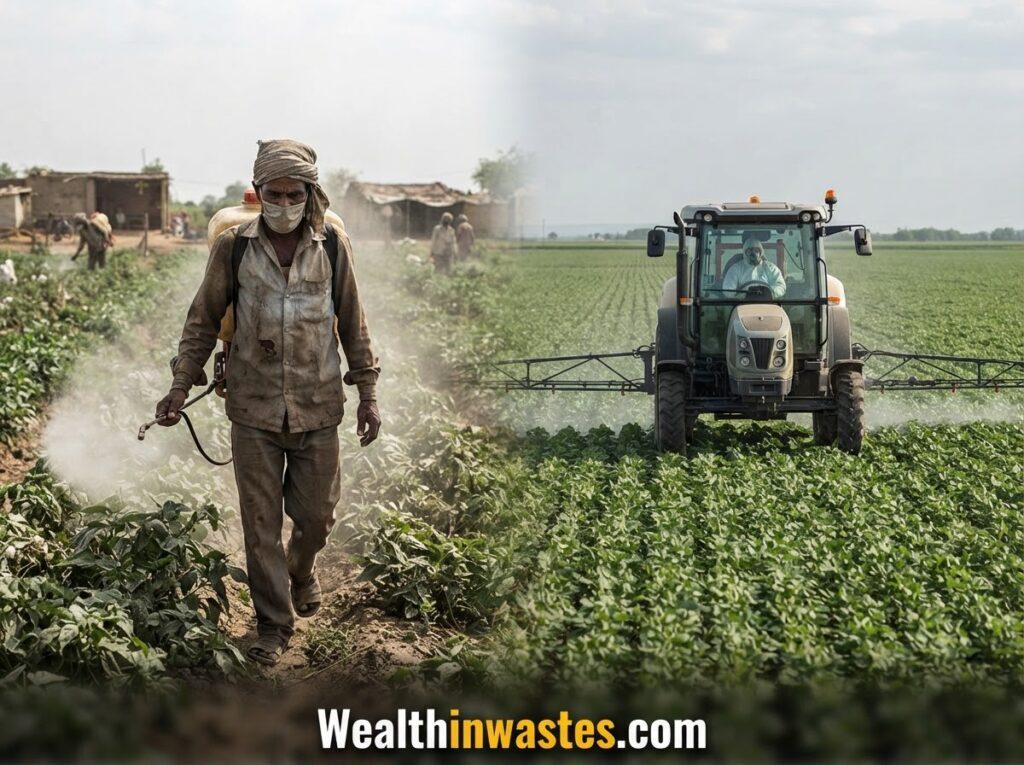
Pesticide safety depends on the environment, farming system, equipment, climate, user knowledge, and application practices. A product suitable under one set of conditions may behave differently in another setting or season.
Temperature, rainfall, humidity, wind, soil properties, and water movement can influence pesticide drift, runoff, leaching, degradation, and persistence. These factors should shape decisions about product selection and application timing in practice.
Cultural practices also matter. Language barriers, literacy differences, traditional farming habits, limited extension support, and inadequate protective equipment can affect how farmers interpret labels and apply pesticides during routine field work safely.
When users lack locally relevant guidance, they may copy practices from other regions without understanding the differences in crops, pests, weather, soils, equipment, and legal requirements. Such mismatches can increase exposure and reduce effectiveness.
1. Climate Conditions: Heat, rainfall, humidity, and wind can alter pesticide behaviour, affecting spray movement, evaporation, runoff, degradation, and the likelihood of off-target contamination during field application under field conditions.
2. Soil Differences: Soil texture, organic matter, moisture, and permeability influence how pesticide residues bind, move, degrade, or reach groundwater without effective water resource management following agricultural applications under different field conditions, seasons, and local climates.
3. Cultural Practices: Local customs, communication patterns, literacy levels, and traditional application habits can influence whether users follow product labels and recognized safety procedures accurately during routine pesticide handling and spraying.
4. Equipment Limitations: Poorly maintained sprayers, inaccurate measuring devices, leaks, and missing protective equipment can increase exposure while reducing the amount of pesticide reaching its intended target effectively during each treatment.
Limited Training and Safety Systems
Training gaps can turn necessary pesticide applications into avoidable exposure events. Farmers need practical knowledge about product selection, label interpretation, dosage, timing, equipment maintenance, personal protection, storage, disposal procedures, and emergency response.
Extension services can bridge this knowledge gap by translating technical recommendations into locally useful guidance. Where extension coverage is limited, farmers may depend on informal advice from neighbours, retailers, or product sellers.
Safety systems also include access to protective equipment, clean water, first-aid arrangements, secure storage, and reliable disposal options. Without these supporting facilities, even informed pesticide users may struggle to maintain safe practices.
Record keeping and supervision can further reduce misuse. Application records help users track products, rates, dates, target pests, weather conditions, and harvest intervals, making repeated mistakes easier to identify and correct.
1. Practical Training: Demonstrations can teach farmers how to calibrate equipment, interpret labels, mix products correctly, protect skin and lungs, and recognize conditions that increase spray drift during field operations.
2. Extension Support: Local advisers can help farmers diagnose pest problems before treatment, choose suitable control options, and combine chemical methods with cultural and biological practices effectively throughout production before spraying.
3. Protective Resources: Gloves, suitable clothing, eye protection, boots, and other appropriate equipment can reduce direct exposure when farmers must handle or apply pesticides during agricultural activities and field operations.
4. Safe Storage: Secure, dry, clearly identified storage areas can prevent accidental poisoning, leaks, contamination of food or feed, and access by children or unauthorized users in farming communities on the farm.
Read Also: Methods of Disposal of Waste Pesticide Containers
Market Pressure and Export Demand

Market pressure can reinforce increasing pesticide use when farmers compete to deliver uniform harvests at specific times and meet buyers’ standards. Cosmetic damage may reduce the value of otherwise edible produce.
Export agriculture can create especially strong incentives for predictable quality because buyers may specify residue limits, appearance requirements, and delivery schedules. Farmers may respond by protecting crops more aggressively against visible damage.
Commercial input suppliers can also influence purchasing decisions through product promotion, demonstrations, credit arrangements, and technical advice. These activities may increase awareness of chemical options without always providing equal emphasis on nonchemical controls.
Greater market integration therefore creates a need for balanced pest-management guidance. Farmers benefit from understanding both the commercial consequences of pest damage and the environmental, safety, and resistance consequences of unnecessary applications.
Buyers may reject crops with visible pest damage, creating incentives for frequent treatments when farmers believe appearance strongly determines price and market access in competitive trading conditions during important trading periods.
Fixed harvest and transport dates can encourage protective spraying when producers fear that pest damage could delay harvest or reduce the volume meeting buyer requirements on time during tight delivery windows.
Commercial marketing can increase pesticide visibility and availability, especially where farmers receive product advice without comprehensive independent extension support or balanced information about alternative controls and prevention from product promotion activities.
Farmers with borrowed production capital may prioritize actions they believe will protect yields, including pesticide applications, because crop failure can threaten repayment, household income, and future production opportunities and future production plans.
Summary on Reasons for Increasing Pesticide Use and Abuse in Less Developed Countries (LDCs)
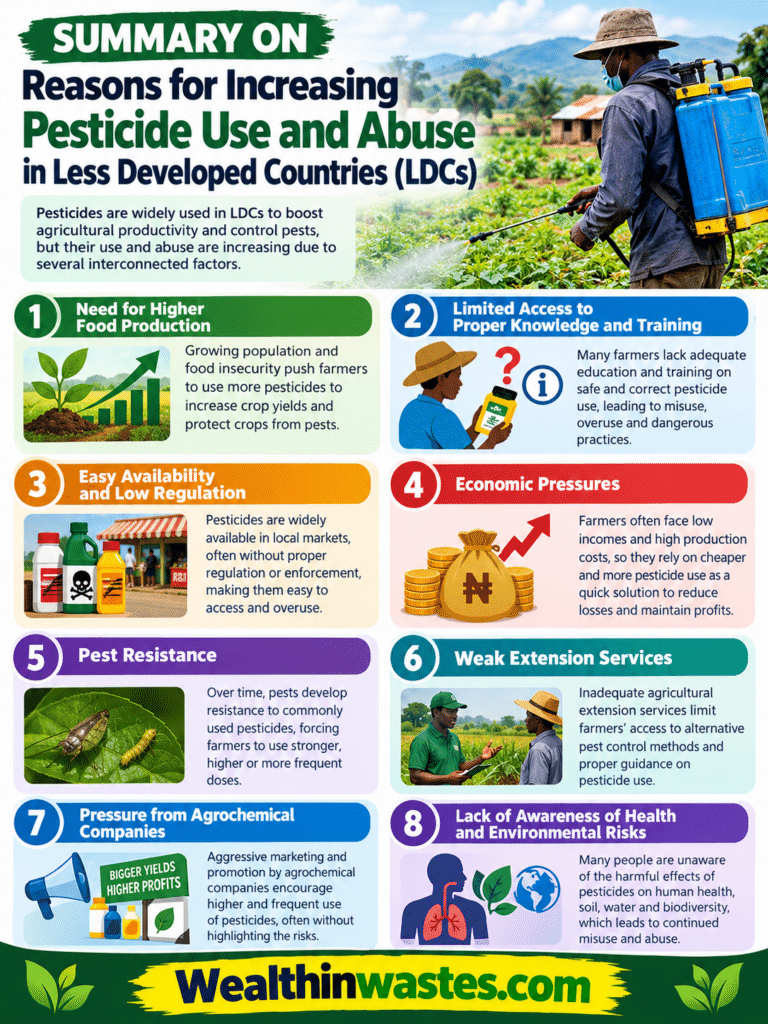
| Section | Main Idea | Why It Matters |
|---|---|---|
| Modern Technology and Pesticide Use | Intensive farming technologies can expand chemical dependence. | Technology needs matching stewardship and training. |
| Agricultural Goals and Pesticide Demand | Yield, food security, and export targets can increase applications. | Market objectives can create pressure for frequent treatment. |
| Hybrid Seeds and Monoculture Dependence | Uniform and vulnerable crops can support pest outbreaks. | Crop diversity and resistant varieties can reduce dependence. |
| Pesticide Treadmill and Resistance | Repeated use can encourage resistance and pest resurgence. | Resistance increases costs and encourages further chemical use. |
| Weak Pesticide Regulation and Standards | Weak oversight can allow misuse and unsuitable products. | Strong registration and enforcement improve safety. |
| Physical and Cultural Pesticide Disparities | Local climate, soil, culture, and equipment affect safe use. | Local guidance helps match practices to conditions. |
| Limited Training and Safety Systems | Knowledge and protective resources affect application safety. | Training reduces avoidable exposure and misuse. |
| Market Pressure and Export Demand | Quality, delivery, and financial pressures can increase spraying. | Balanced market guidance supports safer pest management. |
Frequently Asked Questions About Increasing Pesticide Use in Less Developed Countries
1. What is increasing pesticide use?
It refers to the growing frequency, volume, or range of pesticide applications used to protect crops and other agricultural products from pests.
2. Why does technology increase pesticide demand?
Modern farming systems can expand production, standardize crops, and intensify cultivation, creating stronger demand for reliable pest-control inputs.
3. How do agricultural goals affect pesticide use?
Export targets, yield goals, food security needs, and income protection can encourage farmers to use pesticides more frequently to prevent costly crop losses.
4. What is the pesticide treadmill?
It is a cycle where repeated pesticide use encourages resistance and pest resurgence, leading farmers to change products, increase treatments, or adopt broader controls.
5. Why can weak regulation increase pesticide abuse?
Weak registration, inspection, monitoring, and enforcement can allow unsuitable products, poor practices, and misleading advice to spread through agricultural markets.
6. How do climate and soil affect pesticide risks?
Weather and soil conditions influence drift, runoff, leaching, degradation, and persistence, so application methods must match local environmental conditions.
7. Can farmer training reduce pesticide misuse?
Yes. Practical training improves product selection, dosage, timing, equipment handling, personal protection, storage, and disposal decisions.
8. How can pesticide dependence be reduced?
Integrated pest management, crop diversification, resistant varieties, monitoring, biological controls, cultural practices, and careful chemical use can reduce unnecessary applications.
Do you have any questions, suggestions, or contributions? If so, please feel free to use the comment box below to share your thoughts. We also encourage you to kindly share this information with others who might benefit from it. Since we can’t reach everyone at once, we truly appreciate your help in spreading the word. Thank you very much for your support and for sharing!
Read Also: What is Integrated Pest Management?