


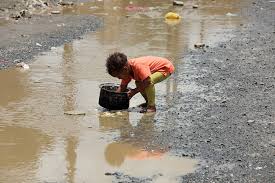
Water scarcity occurs when available supplies cannot adequately meet human, economic, agricultural, or ecological needs. Water stress becomes visible when demand pressures existing resources beyond sustainable levels, creating a water emergency.
Physical scarcity arises where natural supplies remain too limited to satisfy demand, especially in dry regions. Economic scarcity can occur when finance, institutions, infrastructure, or governance prevent reliable access for vulnerable communities.
Several interacting forces drive the problem, including population growth, urbanization, migration, changing diets, industrial expansion, climate change, pollution, weak infrastructure, and competition among agriculture, energy, households, and ecosystems worldwide today.
These pressures do not affect every location equally because climate, rainfall, groundwater reserves, economic capacity, infrastructure quality, and management institutions differ widely. A region may therefore experience physical or economic scarcity.
The following ten causes explain how rising demand, unreliable supplies, poor management, technological limitations, and constraints on alternative water sources can intensify water stress and scarcity across communities and productive sectors.
Population Growth and Agricultural Demand
Food production adds another major demand because expanding populations require more crops and livestock. Irrigated agriculture can intensify withdrawals where rainfall cannot reliably support higher yields throughout each growing season and production cycle.
Urbanization and migration can concentrate people within cities and expanding settlements, creating sharp local demand increases. Rapid development may outpace networks that should deliver water, collect wastewater, prevent leakage, and protect sources.
Groundwater often becomes an important buffer when surface supplies fluctuate. However, prolonged pumping can lower water tables, increase energy requirements, reduce spring flows, and create shortages when withdrawals exceed natural recharge.
Population pressure also changes land use as communities expand housing, roads, markets, farms, and industries. These changes can reduce infiltration, increase runoff, and place additional pressure on nearby freshwater resources.
1. Population Growth and Agricultural Production: Rising populations require more water for households and food production, while expanding irrigation increases withdrawals wherever rainfall cannot meet agricultural demand consistently across growing seasons.
2. Urbanization and Migration: Growing cities and population movements concentrate water demand, often stressing supplies when infrastructure, storage, sanitation, and distribution systems cannot expand quickly enough to serve new residents safely.
Read Also: Methods of Disposal of Waste Pesticide Containers
Dietary Changes and Water Stress
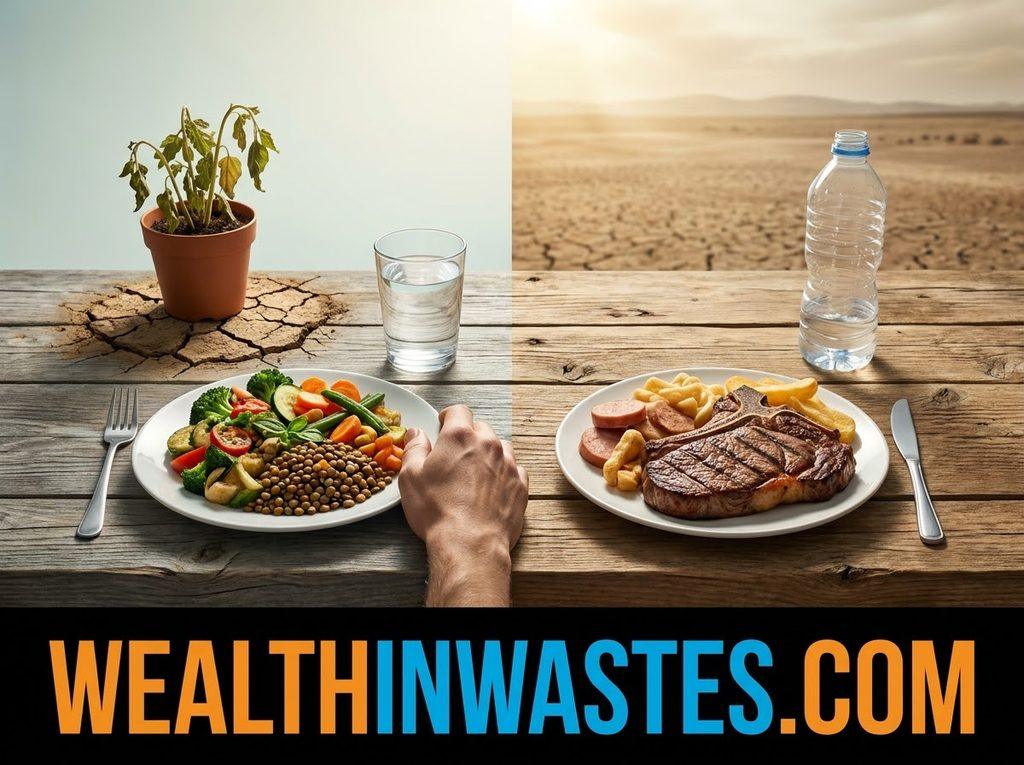
Diet changes can raise the amount of water embedded in food production because different foods require different quantities across cultivation, feed production, processing, distribution, and increasingly complex global supply chains.
As household incomes increase, diets often diversify toward more animal products, processed foods, vegetable oils, and other products with substantial water footprints. These shifts can increase indirect pressure on freshwater resources.
Livestock production requires water for animal drinking and for growing feed crops. The combined demand becomes significant where feed production depends heavily on irrigation and can affect global water quality through runoff.
Water-intensive diets can also enlarge agricultural land requirements, fertilizer use, energy consumption, and processing needs. These connected pressures may increase competition among food producers, households, industries, and environmental water requirements.
Understanding food-related water demand helps communities improve efficiency throughout food systems rather than focusing only on household consumption. Better crop choices, efficient irrigation, reduced food losses, and responsible production support sound water quality principles.
3. Changes in Diet: Rising demand for meat, dairy, oils, and other water-intensive foods can increase agricultural withdrawals, especially where growing feed crops and processing activities depend strongly on freshwater supplies.
Industrialization and Water Scarcity
Industrialization expands the use of water for manufacturing, cooling, processing, cleaning, energy generation, and material production. As industrial activity grows, competition for reliable freshwater can increase across households, farms, cities, and ecosystems.
Factories may alter water availability indirectly when they release inadequately treated effluents. Contamination can make rivers, lakes, wetlands, or groundwater unsuitable for particular uses, reducing the usable supply and increasing the impact of industrial effluents.
Industrial pollutants may include salts, nutrients, oils, organic compounds, suspended solids, metals, solvents, or other chemicals. Their effects depend on concentration, persistence, exposure pathways, and characteristics of the receiving environment.
Communities may then need costly treatment before using affected sources. This links water quality with scarcity because polluted water cannot always satisfy demands like clean freshwater, as shown by documented water pollution effects.
Industrial growth therefore requires integrated planning that accounts for withdrawals, wastewater treatment, discharge controls, recycling opportunities, and protection of nearby water bodies. Such planning can reduce both quantity and quality pressures.
4. Industrialization: Expanding industries increase water demand while poorly controlled discharges can degrade usable supplies. Effective treatment, pollution prevention, and recycling can reduce pressure on freshwater resources and surrounding ecosystems.
Water Infrastructure and Management Gaps
Water systems depend on reliable infrastructure to abstract, store, treat, transmit, and distribute supplies. Aging pipes, damaged pumps, inadequate storage, and poorly maintained irrigation networks can reduce water reaching users, making water resource protection essential.
Leakage is especially serious because treated or pumped water may disappear before reaching households, farms, businesses, or industries. Utilities then need additional abstraction and energy to compensate for losses within weak systems.
Poor management can magnify physical shortages because authorities may lack accurate data on groundwater levels, river flows, demand patterns, and seasonal availability. Without dependable water accounting, allocation becomes less efficient and weakens water catchment protection.
Unclear water rights and weak coordination can also encourage overuse, conflict, or investment delays. Different sectors may compete for the same sources without shared rules that protect users and environmental needs.
Financial constraints can worsen these problems because infrastructure renewal, monitoring, maintenance, and staff training require sustained investment. Economic water scarcity often appears when water exists physically but institutions cannot deliver it reliably.
5. Inadequate Water Supply Infrastructure and Poor Management: Leaking networks, weak irrigation systems, limited storage, poor monitoring, and unclear allocation arrangements can reduce reliable access even where water exists naturally.
Climate Change and Water Scarcity
Climate change affects water availability by altering rainfall, evaporation, snow and ice storage, soil moisture, and runoff timing. These changes make established water-supply assumptions less reliable by disrupting connected hydrologic processes.
Warmer conditions can increase evaporative losses from soils, reservoirs, crops, wetlands, and other surfaces. Higher crop water requirements may then increase irrigation demand during periods when supplies are already constrained.
Changing rainfall patterns can create longer dry periods in some locations and heavier rainfall events in others. Intense rainfall may generate rapid runoff instead of gradual infiltration, limiting recharge and increasing flood damage.
Climate change can also worsen drought frequency or severity in some regions while increasing flood risks elsewhere. Communities that depend on seasonal water patterns may therefore face greater uncertainty when planning storage.
Water quality can deteriorate during droughts because lower flows concentrate pollutants, while floods can wash sediments, nutrients, pathogens, and wastes into water bodies. Scarcity therefore concerns both quantity and usable quality.
Climate pressures also interact with population growth, land-use change, and infrastructure weaknesses. Their combined effects can increase vulnerability, making flexible planning, conservation, storage, monitoring, and ecosystem protection important for groundwater resilience.
6. Climate Change: Changing temperature and precipitation patterns can intensify droughts, floods, evaporation, and seasonal uncertainty, reducing dependable supplies while increasing water demand across vulnerable regions, communities, and agricultural systems.
Rising Water Demand and Technology Gaps
Rising water demand requires coordinated action across households, farms, industries, energy systems, municipalities, and ecosystems. Without cross-sector planning, withdrawals may grow faster than available renewable supplies in shared river basins.
Competition becomes sharper when several users depend on the same river basin or aquifer. Decisions that increase withdrawals for one sector can reduce availability for another, especially during droughts or seasonal low flows.
Water management needs reliable data, transparent allocation, realistic demand estimates, and regular review. Planning should also account for ecological requirements because rivers, wetlands, and groundwater support essential functions, while performance indicators improve evaluation.
Technology can reduce demand through improved irrigation, leak detection, smart monitoring, efficient fixtures, wastewater treatment, and better industrial processes. Yet technology cannot solve shortages when finance, skills, or governance remain weak, as treatment options show.
Modern tools also support modelling and risk analysis. These approaches help managers compare scenarios, estimate supply reliability, identify vulnerabilities, and test conservation or allocation strategies before implementing major investments using better treatment system design.
7. Increasing Water Demand and Competition: Growing needs across agriculture, households, energy, and industries can exceed available supplies when sectors share limited sources without coordinated allocation, conservation, and demand management.
8. Need for New and Better Technologies: Limited access to efficient equipment, monitoring tools, treatment systems, and decision-support technologies can increase water losses, pollution, uncertainty, and operating costs in stressed regions.
New Water Sources, Reuse, and Rainwater
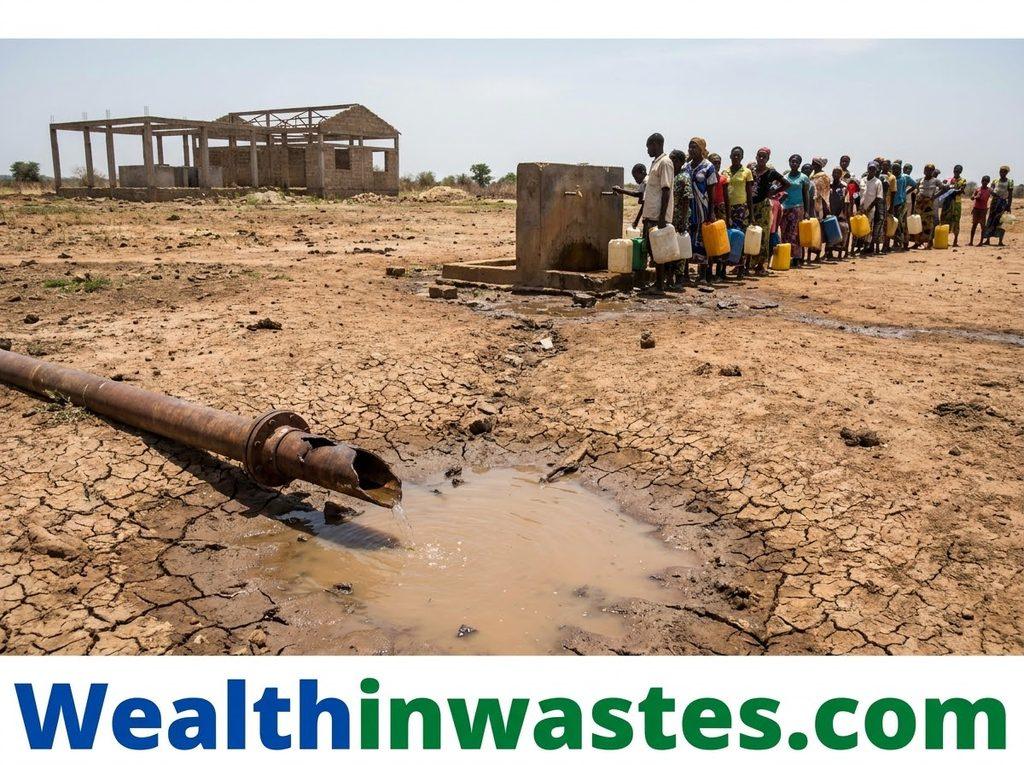
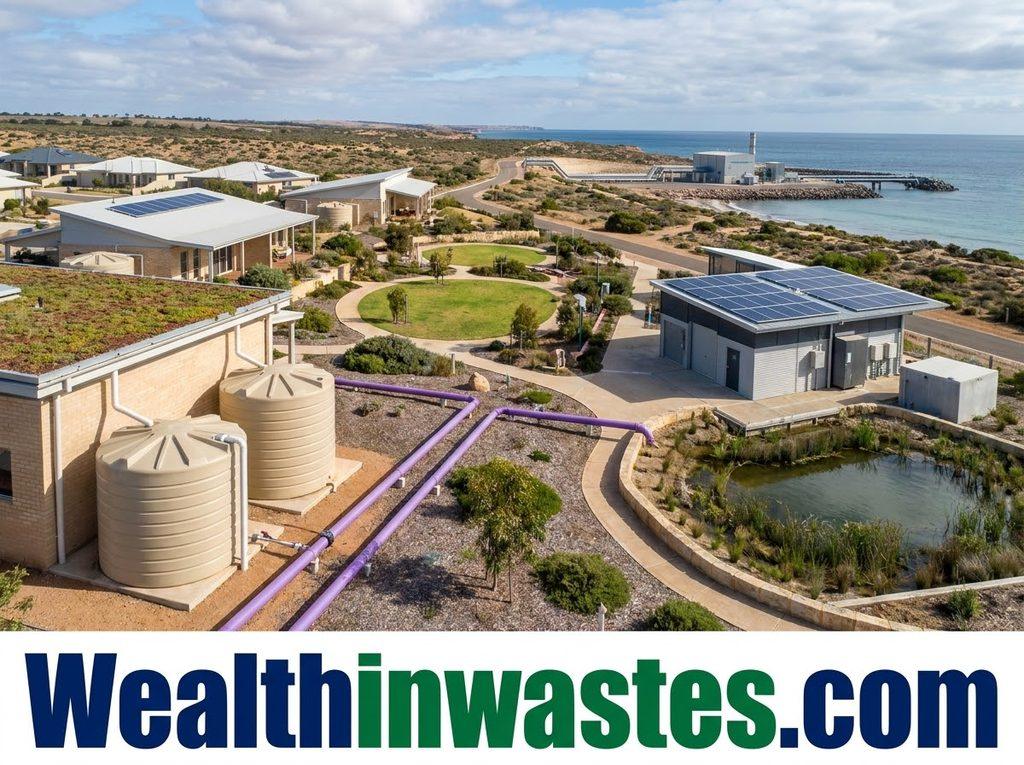
Communities can reduce water scarcity by diversifying sources rather than depending on one river, reservoir, or aquifer. Alternatives include rainwater, treated wastewater, groundwater, surface storage, and small-scale systems supported by public water treatment.
New sources must match local geology, climate, quality requirements, energy availability, and environmental limits. Poorly selected projects can shift problems elsewhere by increasing extraction, energy demand, salinity, or ecological disturbance.
Water recycling and reuse can reduce demand for freshwater by supplying suitable treated water for irrigation, industrial processes, cleaning, landscaping, or other non-potable applications where standards permit, especially when wastewater treatment standards are followed.
Rainwater harvesting provides another practical option, especially where rainfall is seasonal. Capturing and storing runoff can improve local resilience, reduce dependence on centralized supplies, and support farms or households during short dry periods.
Reuse and harvesting require safe design, suitable storage, maintenance, and water-quality monitoring. Public acceptance matters because users need confidence that reused water is appropriately treated for its intended purpose, reflecting water reuse and recycling practices.
9. Developing New Sources, Recycling, Reuse, and Rainwater Harvesting: Limited source diversification can worsen scarcity, while carefully managed alternative supplies can supplement freshwater, reduce withdrawals, and strengthen resilience during shortages.
Read Also: Pesticide Conversion Mechanisms in the Environment Non-Enzymatic Conversion
Desalination and Freshwater Supply
Desalination can produce freshwater from seawater or brackish water, making it valuable in coastal areas with limited conventional supplies. Its usefulness depends on technology, energy, cost, and environmental conditions, including reverse osmosis desalination.
Reverse osmosis uses pressure to move water through selective membranes, leaving much dissolved salt behind. It can provide high-quality water but requires pretreatment, pressure, maintenance, and reliable electricity, as explained in water and wastewater purification.
Desalination produces concentrated brine that requires careful management. Discharge practices can affect marine environments when facilities release concentrated streams without suitable controls, monitoring, dilution, or environmentally appropriate disposal under drinking water production planning.
Cost remains another constraint because desalinated water generally requires more energy and infrastructure than many conventional freshwater sources. Affordability therefore influences whether households, industries, municipalities, or farms can adopt it.
Membrane fouling and scaling can reduce performance and increase maintenance expenses. Better materials, pretreatment, energy recovery, and controls can improve efficiency, but economic and environmental constraints remain, including those described under reverse osmosis problems.
10. Water Desalination: Desalination can expand freshwater supplies, yet energy use, production costs, membrane fouling, and brine management can limit adoption, especially where water prices remain low for many users.
Summary on 10 Causes of Water Stress and Scarcity
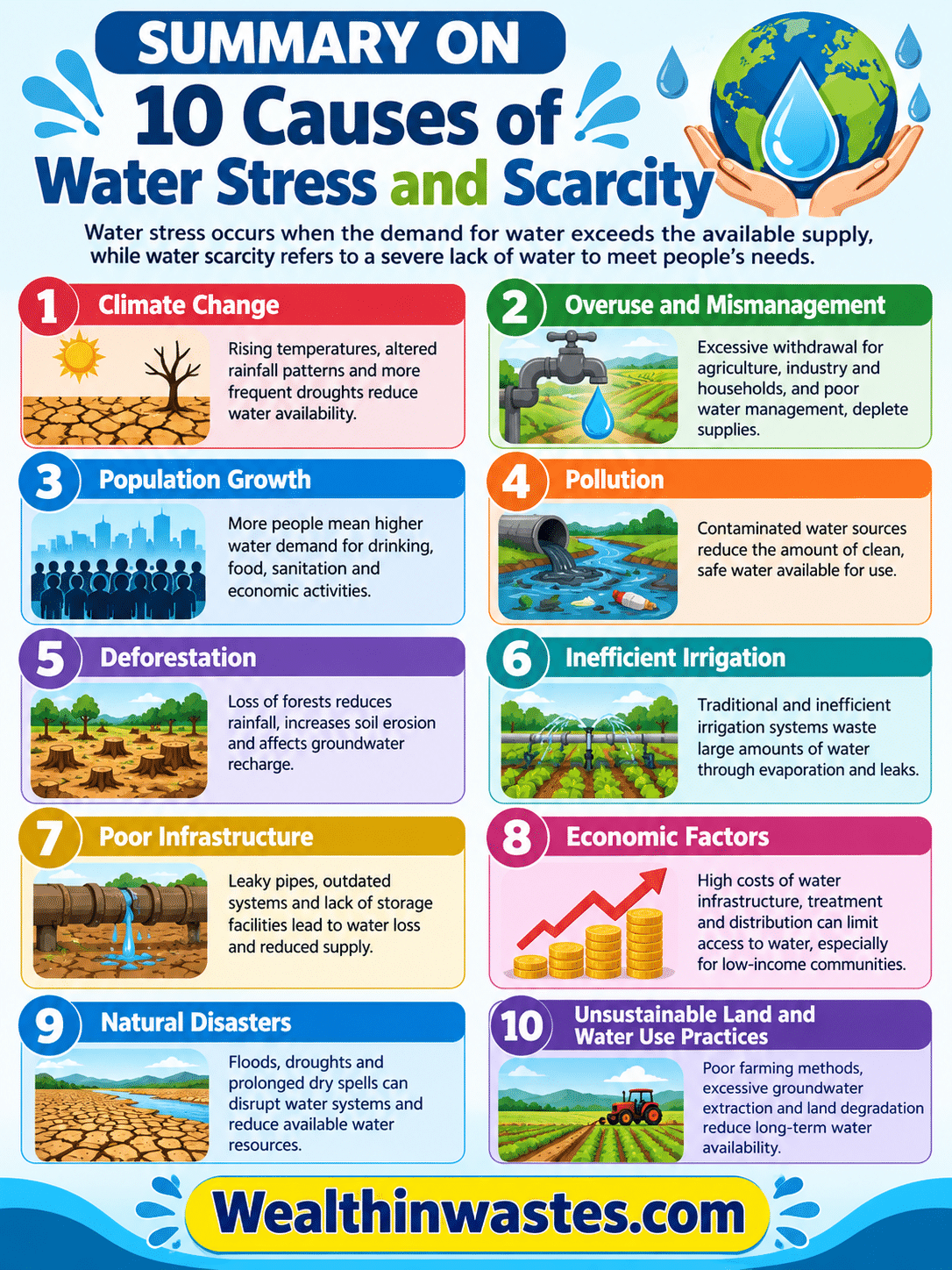
| Section | Main Idea | Why It Matters |
|---|---|---|
| 1. Population Growth and Agricultural Production | Growing populations and food production increase freshwater demand. | Higher demand can exceed available supplies. |
| 2. Urbanization and Migration | Population concentration increases pressure on local water systems. | Infrastructure may fail to keep pace with demand. |
| 3. Changes in Diet | Water-intensive foods can increase indirect water demand. | Food choices influence agricultural water withdrawals. |
| 4. Industrialization | Factories require water for processing, cooling, cleaning, and production. | Industrial demand and pollution can reduce usable supplies. |
| 5. Poor Infrastructure and Management | Leaks, weak systems, poor data, and weak coordination reduce reliability. | Existing supplies may remain inaccessible or inefficiently allocated. |
| 6. Climate Change | Changing rainfall, evaporation, drought, and floods affect water availability. | Seasonal reliability and water security can decline. |
| 7. Increasing Water Demand and Competition | Multiple sectors compete for shared water resources. | Uncoordinated withdrawals can increase shortages and conflicts. |
| 8. Technology Gaps | Limited access to efficient systems and decision tools increases losses. | Efficiency and informed water management may remain weak. |
| 9. New Sources, Reuse, and Rainwater Harvesting | Alternative sources can supplement conventional freshwater supplies. | Diversification can improve resilience during shortages. |
| 10. Water Desalination | Desalination can create freshwater from saline sources. | Energy, cost, maintenance, and brine management limit wider adoption. |
Frequently Asked Questions About 10 Causes of Water Stress and Scarcity You Should Know
1. What is water stress?
Water stress occurs when demand places substantial pressure on available water resources. It can reflect limited supply, high withdrawals, poor quality, weak infrastructure, or competing demands across users.
2. What causes physical water scarcity?
Physical scarcity develops when naturally available water cannot meet demand. Dry climates, drought, over-abstraction, seasonal variability, declining groundwater, and limited surface supplies can contribute.
3. How does population growth increase water scarcity?
Population growth raises demand for drinking, sanitation, food, housing, energy, and services. When supply systems cannot expand adequately, existing rivers, reservoirs, and groundwater face greater pressure.
4. Can water pollution cause water scarcity?
Yes. Pollution can make rivers, lakes, groundwater, or reservoirs unsuitable for intended uses. The resulting loss of usable water increases treatment needs and reduces dependable supply.
5. How can water reuse reduce scarcity?
Properly treated wastewater can replace freshwater for suitable non-potable uses such as irrigation, landscaping, cleaning, or industrial processes. This reduces pressure on conventional freshwater sources.
6. Is desalination a complete solution to water scarcity?
Desalination can supplement freshwater supplies, especially in coastal areas, but energy demand, capital costs, membrane maintenance, brine management, and affordability can limit widespread adoption.
Do you have any questions, suggestions, or contributions? If so, please feel free to use the comment box below to share your thoughts. We also encourage you to kindly share this information with others who might benefit from it. Since we can’t reach everyone at once, we truly appreciate your help in spreading the word. Thank you very much for your support and for sharing!
Read Also: Usefulness of Water Resources in Agriculture